The Field Trip Bonus

Wayne Robichaux accompanied me for part of my field trip last weekend.  We decided to head north up Hwy. 51 for a look at things between Hammond and Tangipahoa, Louisiana.  While we didn’t notice any older trestles or bridges to photograph, we did come across this old abandoned fuel oil dealership located a bit south of Amite.  This caught my eye as I plan to have a couple of these facilities on my new layout, one each at Monterey and Willis.

I took quite a few photos around the premises and thought I’d share a few of them here.

Here’s the overall view looking south east at the facility.  That’s a bi-level platform on the front of the building.  The CN mainline is about 25 feet behind my right shoulder.Fuel Oil Dealer - Looking Southeast

And looking east we see the loading shed for the trucks.  That’s the main pump house at right.  Note the small tank end in the distance.  This tank was separated from the three main tanks.Fuel Oil Dealer - Loading Shed

The loading shed detail:  the piping from each of the tanks rises next to the platform.  Each has a flow meter on it, then a hose and nozzle for filling the delivery trucks.  Note the supports for the missing signage at the roof ridge.Fuel Oil Dealer Shed Close-up

And finally, an overall view looking north east:  Visible here is the concrete dam built around the tank farm to contain any spillage.Fuel Oil Dealer Looking Northeast

This will aid tremendously in arranging at least one of my facilities.  Since the pumps and piping were still in place, I was able to discern the literal “flow” of the business.  My theory is that if you want to model a business or industry convincingly, you must understand the process or the flow of the business so that you can logically place the structure(s) and supporting elements.

As an added bonus to the day, we had six trains pass by while we were trackside (all duly recorded on silicon).  Taking a break from layout construction to do a little railfanning and research was what I needed.

-Jack

A Field Trip

Most of my readers are aware of the Canadian National (former Illinois Central) line that runs east from Baton Rouge to the connection with the north-south mainline in Hammond.  This line has been under an upgrade project for some time now, with lots of tie replacement, plenty of new ballast, and most significantly, the replacement of all the small wooden bridges and trestles to concrete and steel structures.  I had made a note to myself some time ago that I needed to photograph some of the old wooden trestles before they were demolished.  On a recent trip over to Hammond, I had driven down Hwy. 190 which parallels the line for much of it’s length.  I was shocked that only about a half dozen wooden structures remained, and those were grouped in a rather small area just west of Livingston.

So, this past weekend I grabbed the camera and set out to document these last few hold-outs while they still exist.  My aim was to not only document the structure, but to take some close up shots that I could use for detailing and creosoting (painting) these same structures on my own layout.  Here are a couple samples from the 60 or so images that I grabbed.

This is typical of the trestles left, a few are a bit shorter:CN Trestle

And a close-up view of a couple bents:CN Trestle Detail

This is a small “bridge” (actually, more like a big wooden box culvert):CN Bridge

Note the variations of color and texture on the wing walls:CN Bridge Detail

The day was clear and bright and I over exposed a bit because I wanted to get some of the color and detail beneath the trestles.  It is very apparent why most models painted flat black don’t look much like creosoted structures after you study these images.  Not only are the many colors apparent, black, grays, tans, etc., but the textures and streaking are very pronounced.  This should be interesting to try to simulate.

More later…

-Jack

Layout Construction Photos

I’ve completed a major reorganization of the Layout Construction Photos section on the main website.  As the layout has grown (and the number of photos has increased), I found it getting increasingly cumbersome to add material.  I originally started by adding photos in a linear fashion as I worked around the layout.  But as I started jumping back and forth to various layout sections, that approach wasn’t suitable.  I really wanted to keep photos of a given area together, but it was difficult to do that, and navigation through the photos was poor.  Now the photos are grouped, generally by the various areas of the layout that they pertain to.  Hopefully this will make things simpler for all of us.

I’ve had to rename a ton of files to accomplish all this.  One negative side effect though was that all of the links referring to the renamed pages had to change as well.  Hopefully, I’ve gotten them straight.  But if you find something out of order, please drop a line and point out the error.

I hope you enjoy the new format . . . let me know what you think.

Last Saturday I made the pilgrimage over to Hammond to attend the annual banquet of the Southeast Louisiana Chapter, NRHS.  As usual, I enjoyed visiting with the folks there, and after an excellent meal we had a nice presentation by Rick Pitcher on passenger service back in the “good old days”.  Afterward I spent a few hours over at the depot and managed to catch a few trains going by.  Another great day!

And I’ve installed a few more Tortoise switch machines on the layout.

-Jack

The Tall Timber and Santa Fe

Last Saturday I managed to drag myself out of bed early enough to make breakfast over at the Warehouse Restaurant in Baton Rouge.  An informal group of railroad enthusiasts and modelers usually gather there on Saturday mornings to socialize and enjoy a good breakfast together.  Jim Lofland was there and after the meal, he invited a few of us to drop by his home for an impromptu operating session on his Tall Timber and Santa Fe Railway.  Wayne Robichaux and I accepted, along with Gary McMills, and shortly after we were getting a tour of all the latest things to happen on the railroad.  Gary had other obligations and couldn’t stay for the session, so just Jim, Wayne and I started the trains rolling.

Jim’s layout has been in existence pushing 40 years now.  Even though the construction is very “old school”, it still looks good and operates very well.  Jim keeps everything in fine tune and trains run smoothly.  The layout recently received a make-over with hundreds of new trees installed.  Jim loves to build structures and as a result, industries on the layout frequently change as newer buildings replace the old.  I hadn’t been to Jim’s in several years, so there was an awful lot of new stuff to check out and study.  The short session went well and I’m happy that Jim invited us over for a visit.

I’ve hunkered down beneath my layout these past few weeks and have been busy installing Tortoise switch machines.  The weekend before, Ron Findley and I had gone over to Hattiesburg, Mississippi for the NRHS Mississippi Great Southern Chapter’s annual banquet, and as usual it was excellent.  The advertised guest speaker had cancelled at the last minute due to illness, however David Price and Dan Watson put together a splendid presentation about their exploits back in the 60s ferreting out and visiting quite a few shortlines (many of them steam powered) in Mississippi, Louisiana and Alabama.  They ended the show with me clamoring for more.  After the banquet while heading toward home, we managed to catch a couple freight trains passing the depots at Hattiesburg and Slidell.  A really nice day!

This Saturday Ron and I will head over to Hammond for the NRHS Southeast Louisiana Chapter’s banquet, and we’ll probably hang around the depot over there for a bit afterward.  The traffic has increased on the CN line and it’s not uncommon to see BNSF and UP power on the trains.

And I’ll be installing more Tortoises the day after.

-Jack

A Bit o’ Work, a Bit o’ Fun

A few weeks ago I posted an update of layout construction progress and I mentioned several activities scheduled for this month.  So, starting with the first of those scheduled activities, I attended the (3rd annual) Train Day at the Library in Baton Rouge.  This years show surpassed last years (which had surpassed the first year).  Forrest Becht and the folks who are involved in planning and hosting the show are really listening to the feedback provided by the visitors and have made the appropriate changes to reflect that.  As a result, (in my opinion) the show has enjoyed considerable improvement in the few short years of its existence.  Now this isn’t a large show, but rather a small gathering at a local library.  There is a large and very nice photo exhibition of railroad subjects, tables and cases of models are displayed, and several local and regional organizations have a presence with plenty of hand-out literature.  There are on-going slide shows throughout the day, and several small operating train layouts (three rail and some N scale).  It’s fun and it’s free.  Can’t beat that.

Next week Ron Findley and I are heading over to Hattiesburg, Mississippi for the annual banquet of the Mississippi Great Southern Chapter of the NRHS.  Their banquet is always well attended, with lots of displays, sales tables, a good speaker and plenty of great food.  I’m looking forward to that.

Layout activity: I’ve completed the refurbishing and wiring up of 25 Tortoise switch motors and have even installed the first one.  I need to install 18 more to get all the switches presently installed operational.  I also completed the hard-wired aspects of my cab bus (throttle bus).  I ended up relocating the DCC command station to the middle booster location since this was electrically central to the layout.  This has reduced my longest cab bus run by nearly half.  As I add fascia to the layout, along with throttle plug-in points, I will only have to daisy-chain from point to point using pre-made data cables…nice and clean.

I should be getting back to benchwork and trackage this spring.  I haven’t done any of that since last October and I’m anxious to get back to it.  I haven’t added any new photos to the main website since early January since all I’ve been doing has either been done on the workbench or beneath the layout.  However the photos on the site do show the latest in the benchwork progression.

If you’re interested in coming by for a visit, just drop a line and we’ll set it up.

-Jack

Just Chipping Away

I’ve been chipping away at lots of little mundane tasks these past several weeks.  The fascia project was held up a few weeks due to inclement weather, however it’s complete now (well, it’s complete to the planned stopping point).  It looks good even unpainted.  I’ve been taping panel mock-ups on it and I’ve finalized where they will be located.  I even installed my first throttle plug-in port though I’ve yet to wire it up.

I turned attention to refurbishing my Tortoise switch machines this past weekend.  I’ve quite a few that were used on a layout back in the 80s and early 90s, and an even larger stash of never-used machines that I’ve been squirreling away for years.  Due to their age, I thought it would be prudent to open one up for inspection.  As expected, there was little trace of lubricant inside.  I inspected the machine for wear (virtually none), then applied fresh lubricant (Labelle #102 as recommended by Circuitron) very sparingly to each bearing surface and a bit to each set of gear teeth.  A very thin smear across the contacts on the circuit board and it was done.  Note that once the label is punctured to remove the center case screw, the warranty is void.  However as these date from the 80s, that wasn’t an issue for me.  I did however, open up one of the newest machines (purchased in 2010) just as a comparison.  I was a bit disappointed to see that the oil had migrated away from the bearings and gear teeth and had settled along the outer case lines.  I would assume this wouldn’t happen for machines in regular use, but I feel compelled now to open all 70 of these things for inspection and possible re-lubrication.  Yep, I’ll loose the few years of warranty left on the new ones, but I figure a dry set of bearings will undoubtedly result in a shortened working life of the machines.  I figure the best way to tackle this will be to do a bunch of them on an assembly line basis, say 20 or so at a time.

Another task for the Tortoise machines is to pre-install the wiring to the contacts.  I use eight pole barrier strips at each machine as it makes installation easy and trouble-shooting simpler.  I’ll solder leads to each contact and terminate each with a spade lug.  Then after the machine is installed, I can just screw the lugs to the barrier strip.

I’m finally near ready to start modifying all of my Shinohara code 70 switches to make them DCC friendly.  I’m going to etch all the copper off the PC board switch rods (the throw bars) and then I’ll be ready to start production on them.  This project has been a major hold-up for continuation of the trackwork beyond Maynard.

One of my favorite times of year is near…NRHS meets and banquets.  I’ve made my plans to attend the Mississippi Great Southern Chapter’s affair in mid February, and the Southeast Louisiana Chapter’s get-together a week or so later.  Oh, even earlier than that is the 3rd annual Train Day at the Library in Baton Rouge on January 31st.  This is evolving into a pretty nice “show” each year.  I’m looking forward to all of these events.

That’s about it for now.  I’ll post updates on the Shinohara/Tortoise projects when they’re done, and hopefully I’ll have news about further trackwork progress.

-Jack

Comments Made Easier

For every comment posted on this blog, I usually get about three emails from folks who simply reply to the post notification they receive.  There’s nothing wrong with that except that no one gets to read their comment besides myself.

I have suspected that the log-in ritual may be a contributing factor.  Perhaps folks don’t want to bother logging in just to post a comment (and that includes me).  The log-in thing was an attempt to control spammers, and it’s worked wonderfully in that regard.

I’ve decided to open things up a bit by eliminating the need to log in to comment (however, you’ll have to enter your name and email).  We’ll try this for awhile and see how it goes.  Hopefully it’ll make life easier for you folks.

Now keep those cards and letters coming!

-Jack

Another Electrical Adventure

As I’ve mentioned before, electrical things usually come fairly easy to me.  However sometimes those little electrons do their best to stymie me, as I illustrated in another post.  This past week I ran into another of those little gremlins.

We’ve had a lot of rain these past few weeks, so I thought it would be a good opportunity to catch up with the under table electrical work.  I had put in a good bit of trackage over in Monterey, which included the turning wye.  It all had to be connected electrically, so I crawled under the layout and started connecting about a jillion track feeders.

When I initially started my track installation and wiring, I kept a small battery/buzzer device connected to the track which would sound the alarm if I happened to connect something in a way it didn’t like.  However, once I installed my PSX circuit breakers (CB boards), I would get a constant alarm as the device would back-feed through the CB board circuitry.  So, being lazy, I unclipped the device from the track rather than disconnect the main feeds from the circuit breaker.  I was quite careful though, and all my wiring is color coded, so I didn’t anticipate any problems.

Well, I suppose I should have anticipated them because when the wiring was completed and the power was flipped on, the fault light on the CB board lit up with complaint.  Arrghhh!

The last trackage installed had been the wye.  So back under the layout I went, disconnecting track feeders one at a time, starting from the far end.  After all the wye feeders were disconnected, the fault light remained on.  So I started disconnecting the rest of the feeders to the mainline, and yard trackage.  I disconnected every feeder and the light kept glowing.  Now what?  The problem had to be in the track itself.  So I disconnected the CB board and started poking around with my little buzzer device.  I eventually determined that the problem was somewhere in the wye trackage.

One tail track of that wye crosses the mainline utilizing a Walthers/Shinohara 90 degree crossing.  The crossing itself had been a big concern initially because during manufacture it had apparently been removed from the injection mold prematurely and was significantly warped.  I contacted Walthers for a replacement but they had none in stock, and had no ETA for new inventory.  Checking around quite a few mail order shops, I was unable to locate one.  It tested out OK electrically, and I could press it down flat to the table against it’s will, so I decided to go ahead and try using it.  I stuck it down with adhesive caulk and soldered the connecting tracks to it, and this seemed to tame it.

With that background, I strongly suspected that the crossing might be the culprit.  So I held my breath and sliced through one of the rails between the crossing and the wye switch.  I figured that would at least tell me whether the problem was in the wye trackage, or in the crossing.  The buzzer informed me that the problem was in the wye.  Rats!  So I figured I needed to start isolating the switches.  With great difficulty, I managed to slide the rail joiners of the first switch until they contacted a tie.  But they wouldn’t slide quite far enough for me to lift out the switch.  So I carefully cut down through the rail joint and rail joiner on each rail.  Still no joy.  In the meantime Wayne had come over and after looking things over, was just as puzzled as I.

I just stood there leaning on the layout, wondering just what in the world was happening here.  Then I had the epiphany.  One of the three switches and it’s tail track comprise the turning section of the wye, i.e. the reversing section.  It is necessary to gap all four rails of that switch to isolate it from the other wye trackage.  I had dutifully sliced through these rails and filled the gaps with bits of styrene, filed and shaped to the rail contour.  My realization was that I had probably sliced through the rails on the wrong side of the internal jumpers built into the switch.  Again I held my breath and made a single cut through the crosstie that I suspected would surround said jumper, then hooked up the buzzing device.  Nothing…as in success!  Such a rookie mistake.  I had failed to note the internal jumpers (visible from the underside of the switch) before gluing it down.  It also happened to be the last track assembly that I had installed.

I carefully reconnected all the feeders throughout (with the sound maker hooked up), then set about repairing all the damage I’d done to the track during my trouble shooting.  Fortunately I was able to slide those shortened rail joiners back onto the mating rails, then soldered everything to keep it in place.  The initial cut at the crossing was aligned with the aid of a couple tiny brads driven into the roadbed (they’ll have to be painted over or otherwise concealed later), then all soldered.  A piece of styrene was inserted into the severed crosstie to keep the gap from closing.  And finally, I had to run a wire jumper to the short, now isolated rail at the offending switch and connect it to the barrier strip below.  I reconnected the track power, and hit the master switch.  Success!, the fault light was out and the Alco on the siding burbled to life.

I won’t be doing anymore track or electrical work without my buzzer connected.

-Jack

Dressing Up

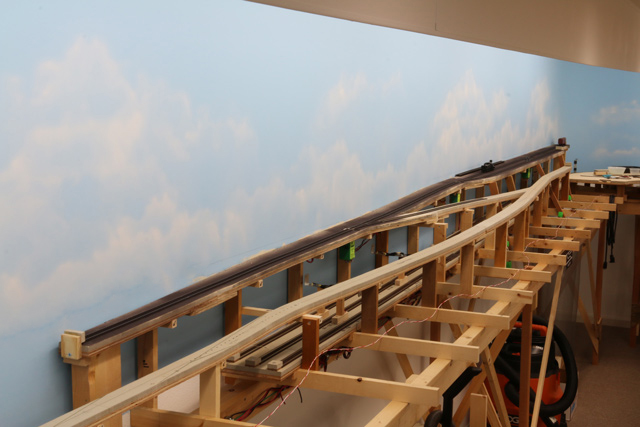
I had mentioned a few weeks ago that I’d post some photos of the new fascia being installed on the layout.  However, progress had come to an abrupt halt as available time to work on the fascia coincided with rain.  I do all my cutting outside these days to avoid sawdust collecting in the train room.  Yesterday however, the sun was out and Wayne came over for a short work session.  We knocked out another section of the fascia, giving a total of about 22 installed feet now.  We’ll put in one last eight foot length next weekend (weather permitting), and that will do it for a while.  The balance of benchwork has track switches and plenty of under table work remaining.  Fascia there would just be in the way.

Fascia Nearing Maynard
What a difference even this unpainted Masonite makes!  I won’t be painting it for a while though, as I’d like to get some of the hole cutting (for panels and throttle plug-ins) done first.

Fascia at Maynard
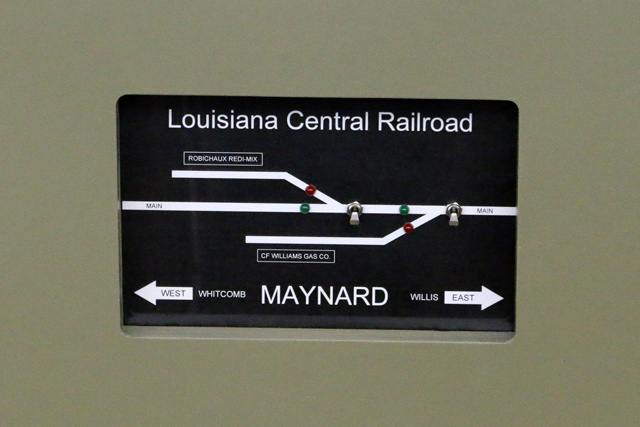
Panning left a bit from the previous view, the fascia extends up through Maynard.  Those “panels” you see are just mock-ups for me to study.  They’re merely photocopies taped to the fascia.  I haven’t decided yet whether to recess the panels, or just surface mount them.  Since I’m close to needing some now, I suppose I’d best make the decision soon.  I’m also mulling over what color I’ll be using for the fascia.  I’m leaning toward a dark greenish-grey, but nothing is off the table yet (except flat black).

-Jack

Happy New Year!

Well, in just a few hours we’ll be into the new year.  I thought I’d take a couple minutes to wish all of you a very happy new year, and I hope it’s a prosperous one for each of you as well.

I’d like to thank you for taking time to read my various ramblings through this year, and I’m appreciative to those who left comments.  I’d like to make this blog interesting to all who read, so if you have ideas, suggestions or complaints, please feel free to let me know.  Your comments are important to me, so let me hear from you this new year.

cheers

Best regards to all,
-Jack

A New Drill Press (and other ramblings)

What with all the functions and family things going on at this time of year, I’ve scarcely had time to do anything of great magnitude out in the train room for several weeks now.  I have however, managed to pick away at lots of little things.  I thought I’d post this quick update of what’s going on.

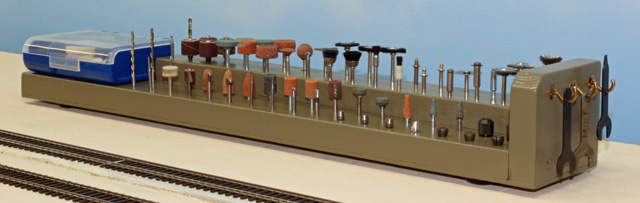
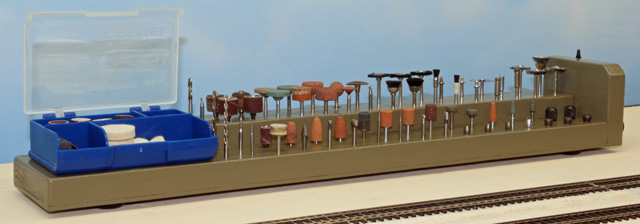
I’ve mentioned a couple times that I needed to start modifying all of my Shinohara code 70 switches to be “DCC friendly”.  I have about 40 or so of these things to work on, and trackwork has come to a grinding halt until I get some of them done.  A drill press should make the task considerably easier.  I’ve had a large floor model press for years, however it simply has too much run-out in the chuck (or perhaps the arbor) for it to be of use with tiny wire size drills.  So I ended up purchasing a small table-top model that I think will be better suited to the task.  Upon arrival and assembly, the first realization was that I didn’t have anything suitable to sit it on out there in the train room.  So I cobbled together a small table from scraps, slapped a coat of paint on it, and now have a stout, compact place to operate the press on.  I chucked a pin vise adapter into the machine and inserted a number 70 drill bit.  I’ve only run it for a minute or so and haven’t drilled any holes yet, but I can tell the bit is running much truer than it would have in my large floor press.  Hopefully I’ll be able to start work on the switches soon.

Wayne Robichaux came over to lend a hand and we’ve installed the first 15 feet of fascia to the layout edge.  It sure makes a difference in the appearance, with even Wayne remarking how it made the layout look like a real layout (whatever that means….).  Nah, just kidding, I know what he’s getting at….even unpainted, it adds a nice finished look to the edge.  We will install perhaps another 20 feet or so along the mainline between Willis and Maynard.  I’ll hold off installing it in other areas until all track is down and wired, and the switch motors are installed.

I keep crawling under the layout to connect more track feeders to the power bus.  I’m connecting feeders to each switch and to almost every length of flex track.  That’s producing a LOT of feeders.  The only track sections without feeders are those soldered to an adjacent section that has a feeder.  I hope this pain now will be rewarded years down the road with good, dependable electrical performance.

I’ve another half dozen minor tasks that I’ve completed, but this post is becoming long-winded, so I’ll spare y’all the details.  Now that I have some fascia applied, I can begin installing some of the fascia mounted items such as throttle plug-ins and switch panels.  I’ll also have car card boxes, work shelves and a few other odds and ends on the fascia, but those will come much later when we are nearing operation.

I’ll post a photo or two in the next week or so when we finish the fascia project.

I’d like to wish all of you a very Merry Christmas and a great New Year!

-Jack

KCS Holiday Express

Last Friday I went over to Baton Rouge with my daughter and her family to visit the Kansas City Southern Railroad’s Holiday Express train.

KCS Holiday TrainThis is really a fun train to see for both kids and adults.  My three grand kids enjoyed the spectacle despite the extremely long wait in line to go inside the train.  But it was worth the wait.  There are two cabooses and a boxcar (the reindeer stable) that are heavily decorated inside with just about anything you can think of with a Christmas theme: colorful lights and ornaments, Santa Clauses, winter scenes, holiday villages, two O scale and one HO scale train layouts (lots of fun to watch), Christmas trees, and just way too many other things to list here.

Outside the train sits Santa Claus.  And while waiting in line to see Santa, one can enjoy the large scale model train running around the flat car that displays the huge lit-up Santa sleigh and the reindeer.

My oldest grand daughter is nearly twelve now and is in that grey area of belief vs. disbelief in Santa.  Well, ‘ole St. Nick would not hear of it.  He sensed her hesitation and whispered something in her ear.  Later we asked what he told her.

“When you quit believing, you start getting socks and underwear for Christmas.”

biggrin

-Jack