LCRR Avatar

About Jack Shall

I've been a model railroader and railfan for well over 60 years now. My interests lie in the steam era and the early diesel era. My modeling has been in HO, but I do have a closet interest in Fn3 :-) It's been a number of years since I've done any layout construction, and the new Louisiana Central pike under construction is by far my most ambitious effort. Follow along with me on this new adventure of the Louisiana Central.

Whupped Into Submission

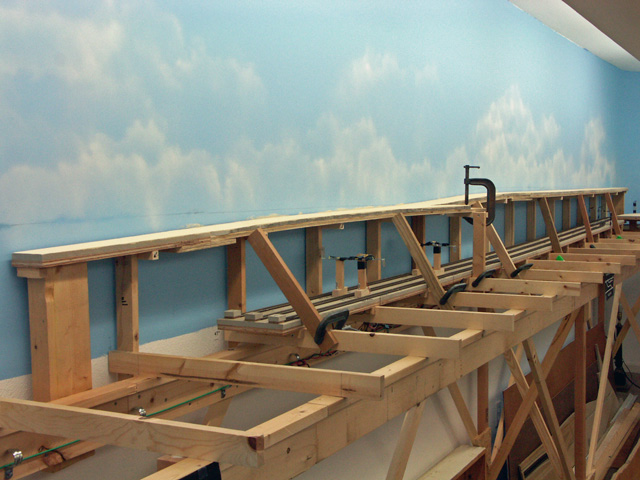
Hallelujah, I finally got the entire high line sub-roadbed of the Spencer logging trackage installed.  Today I sanded out the drywall mud that I used to fill seams and screw holes, then put a coat of light dirt colored paint on top of it all.  Here’s a photo of the installation:

Spencer high line in the woods.The angled braces are temporary and will be removed after I get the rest of the sub-roadbed installed, along with scenery supporting structure.  The double switchback will connect to this level where the branch is coming off next to the clamp.  The switchback will extend about 10 feet, then will switch again to head back toward the camera, going downgrade the whole time.

This initial section along the wall looks quite simple, but it was the most difficult benchwork I’ve installed to date.  The problem was one of access, both for attaching the risers to the joists (less than three inches of working room, and at some risers, even less), and attaching the sub-roadbed to the riser cleats (not enough room to fit a drill motor needed to drill the pilot holes).  I had written about these difficulties earlier here and here.  My friend and assistant, Wayne, helped me get several risers in place, but I had to do the remainder single handed.  Not having those extra hands required me to re-think how to approach the problem.  Generally, I clamped things where they had to be, then removed the assembly from the main benchwork so that I could permanently attach those parts together with screws.  I did this in four sections until I finally got it all screwed together.

After the track switches are laid, I’ll have to remove the sub-roadbed once again (simply unscrewing it from the riser cleats) in order to install the Tortoise turnout motors and do the electrical wiring.  Again, the problem is lack of clearance to fit the drill motor needed to drill the pilot holes for the Tortoise mounting screws, and the (perceived) difficulty in getting everything aligned properly.  While this will be tedious, it will hopefully result in a much better installation of components.

Once the high line trackage is completed, I’ll put in the double switchback and the mainline run heading west back to the mill.  That should be considerably easier as that trackage won’t have anything below it.

I’ve also started laying track over in Monterey.  I figured the most critical place was the crossing located where the north leg of the wye crosses the mainline.  And that is where I started, laying the crossing, the north leg of the wye and the mainline coming in from the east, all as one unit.  Next I’ll install the north switch of the wye, and the curved switch that is at the entrance to the yard.  To see the trackplan, click this Louisiana Central Railroad link to open in another window.

I’m pleased that I’m able to make weekly progress, and with the fall approaching, I should soon garner even more time to put in on the pike.

-Jack

With a Clear Head

A couple weeks ago, I wrote about a couple snags I’d run into while test fitting some risers for the logging trackage heading up into the woods.  The problems stemmed from a lack of clearance.  I ultimately decided to walk away from the problems for the time being, then to later re-address them with a clear head.

This past weekend I had completed installing the industrial trackage over in Maynard.  I was in the process of doing the wiring below the benchwork when my able-bodied assistant Wayne called and offered some assistance for anything that needed assistance.  Not one to turn down assistance, I accepted the offer, and an hour or so later we were staring at the benchwork over at the logging site.  We floated a couple ideas around as to how to do things, then finally just got in there and started doing.  As it turned out, the problems weren’t insurmountable after all.

There’s a three inch space between the back L-girder and the wall, which my cordless drill won’t fit into.  However, I still have my very first power tool which was given to me by my dad back in the early sixties…a Ram 1/4″ drill motor.  This all metal, piece of machinery art still works just fine, and it just happened to be narrow enough to fit within that three inch space.  Great!   Wayne was able to support each riser at it’s location by pressing it firmly against the wall (sometimes using shims to adjust the alignment) while I got below to attach the riser to the joist.  Wayne was as steady as a clamp while I drilled the holes, then (with difficulty) managed to put in the screws using an old-fashioned screwdriver.  We did about nine risers, and by then my knuckles were raw from rubbing the wall and L-girder while twisting the screwdriver in those tight confines.  I have about six more risers to install, and by next weekend my knuckles should be ready for a little more abuse.  It’s all downhill after that.

The important thing here is that we found the solution, and it wasn’t complicated at all.  The solution comes after having a clear and relaxed mind…always does.  I knew this would happen…always does.

-Jack

A Bit Closer to Revenue Generation

Back in April I installed the mainline track up to the east end of Maynard.  This is the first town down the line (west) from Willis, where the visible portion of the layout begins.  Shortly after that I completed the roadbed through the town and was ready to lay track.  There are two spurs planned for Maynard, one will serve a ready-mix concrete plant, and the other a retail propane dealer.  I had intended to install the mainline and industrial trackage within a week or so in order to start generating revenue for the railroad.

Well, I got side tracked with other things and the trackwork took a back seat.  Since I had decided last week to back off for a while on my sub-roadbed construction for the Spencer logging operation, I thought this weekend would be perfect to get a little trackwork done.  So off I went to Maynard.  The two mainline switches are installed now, and one of the spurs is complete.  I’ll put a little track down for the other spur during my next work session.  The mainline can’t advance much beyond these switches as the track curves here to the side of the room where the Spencer trackage is headed up into the woods (the area I’m taking a break from).  I don’t plan to construct the mainline through this area until all the Spencer sub-roadbed is installed (my new rule: work from the rear toward the aisle).

But that’s okay as I have a ton of trackwork that needs installing over in Monterey now that the sub-roadbed there is completed and the track plan has been drawn out.

I don’t particularly enjoy doing trackwork as it is so finicky, but it was quite satisfying to see it installed at the end.  After I install those last few feet of spur track, I’ll make all the feeder connections below, and then run the Alco and a few cars over it.

It occurred to me though, if I’m going to complete the mainline sub-roadbed by spring per my 2nd Anniversary prediction, I’d best not take too long of a breather with that Spencer sub-roadbed!

-Jack

Side-stepping Burn Out

I was reading a blog post yesterday Stalledwritten by Trevor Marshall in which he was lamenting the lack of progress on his layout over the past month or so.  His posts of late have been largely philosophical in nature, and that was mostly because of his lack of new work to write about.  He even went so far as to include links to other posts where others had written about being in a similar circumstance.

Now it’s very common for layout activity to slow during the summer months.  Trevor explained that several other commitments were draining his time, plus the previous winter had been quite brutal, and the spring long and chilly, therefore he was really enjoying spending much of his (summer) spare time relaxing on the patio reading books and enjoying adult beverages.  Others responded, mentioning similar activities.

Yard work takes up much of my time during Southern hot, humid summers and occasionally I’ll partake of a railroad related activity that will take me out of town for the day.  But I’m generally working on the layout during the majority of my free time.  Even when there’s not much apparent work going on with the layout, it isn’t out of my mind.  I’m constantly reviewing, refining and planning both the immediate work and the long term tasks that will be required.  While I’ve made some pretty good progress this summer on the Louisiana Central, I’ve been feeling a bit burnt-out lately.  Much of the work has been boring, tedious and/or repetitive, and sometimes quite aggravating.

I’ve started work on the sub-roadbed for the Spencer Lumber Company’s line up to their reload point in the woods.  There’s a 20 foot stretch of roadbed that will span almost two thirds the length of the longest wall in the room.  I’ve cut out the plywood and Homasote, pre-installed the splice plates for the sections, and fabricated most of the risers that will be required.  I started test fitting the risers Sunday and ran into a nasty surprise.  The risers will attach to the very end of the joists butted up to the wall.  The existing risers supporting the lower staging yard are attached to these same joists.  Unfortunately, the attachment point for many of them is also at the end of the joists.  While I can simply put the high line risers on the other side of the joists, the problem is not having room to clamp the risers to the joists.  I generally clamp the risers temporarily so I can adjust them for both elevation and level, then permanently attach them with a couple screws.  And that leads to a second complication: I don’t think I’ll have enough room to get a drill motor in position to drill the pilot holes for the screws.

If I had been more forward thinking, I would have installed the high line benchwork first, then unscrewed the sub-roadbed from the risers, placing it aside while I then installed the staging yard below.  As it is now, it isn’t reasonable to uninstall the staging yard to move it out of the way as it is complete with track, wiring and all those optical detectors.

That was when I decided that I needed a little down time to clear my head from the aggravations that sometime occur during layout construction.  When I read Trevor’s column, I realized that one mustn’t let the hobby devolve into something that becomes a chore rather than a pleasure.  While I fully intend to continue construction of the railroad, I realize that I probably should add some other activities into the mix in order to keep my sanity and enjoyment of the hobby intact.  In a few days, I’ll begin pondering the sub-roadbed situation and I’ll figure out a solution.  But the solution will come after having a clear and relaxed mind….always does.

So forgive this somewhat lengthy ramble; I’m just clearing my head.

-Jack

Do You Smell That?

There was a brief discussion recently over on the Model Railroad Hobbyist forum about scents and their use on model railroads (read the discussion here).  The topic roamed around a bit, with discussion ranging from what people had experienced, some product that had been available, and some ideas about what could be done today.

One person mentioned the defunct line of scents that was marketed under the name of Olfactory Airs, which I remembered.  There were a dozen or so different scents offered in the form of bottles of oil.  I remember a couple of the scents: creosote, diesel oil, pine trees, and coal smoke.  You were supposed to put a few drops onto something like a cotton ball or similar, then stick it some place on the layout for it to release its aroma to the surroundings.  Unfortunately, it never lived up to its promise in my opinion.  The odors didn’t linger very long and it was hard to relate the odors to what they were supposed to be.  Apparently others thought so too, as the company eventually disappeared.

But I think the idea was really cool.  Imagine running a train down the mainline on a hot summer day and detecting a faint odor of creosote as you’re moving down the line.  Or the smells of steam, hot oil and coal smoke down by the roundhouse?  Maybe the aroma of a pine forest by the logging operation, or even the smell of flowers when passing a meadow.  It can go on and on.  And no, I’m NOT interested in introducing the aromas of a stock yard or a fish processing plant.

As hobbyists, we’re really caught up in the sounds of locomotives now, and I even plan to experiment with stationary sounds in a few strategic locations some day in the future (gotta get some trains running first!).  But I suspect that smells are something that not many of us have experienced on a model railroad.  One of the posters on the forum (using the handle of Professor Klyzlr) even offered a few ideas as to how the concept might be implemented.  Maybe I’ll have to bookmark that column for later reference.

-Jack

Optical Detection Explained

Well, there I go again.  Earlier I posted a column celebrating the completion of all the hardware and wiring for my optical detection system (well, it’s not really complete….I still have to build the panels that will display the occupancy indicator LEDs).

Problem is, I just assumed all readers would know what I was talking about.  Not!  I’ve been informed that I should quit assuming.

So, I’ll try to explain in 3000 words or less, just what an optical detection system is.  Now keep in mind that my explanation here is strictly in the context in which I am employing said detection system.  And I will avoid getting into the directions that the electrons are traveling and the gory details of the circuitry that makes this all happen.

I have six staging tracks, all of which are hidden from normal viewing.  In order to ascertain where a train is while running on this track, I decided to employ a detection system.  There are several ways to detect a train, and I chose to employ optical detection.  The system utilizes photo-transistors (PTs) which can sense whether or not they are seeing light.  When they do, they will turn on, that is, they act as a switch and will close a circuit.  I have installed my PTs centered in the track between a pair of ties, with their tops just above the roadbed.  The PTs are wired to a circuit board located under the layout.

As a light source, I’m using infrared LEDs (IR-LEDs).  To avoid seeing light beneath the layout, and to make the circuit less susceptible to ambient lighting, I chose to use components that are sensitive to light in the infrared range.  This isn’t visible to the naked eye, and in fact, that’s what most TV remote controls use.  The PTs and the IR-LEDs selected are matched to their light spectrum and work in harmony together.  The IR-LEDs are mounted on the “towers” I spoke of in the last post, and are pointed down at the PTs.  They are simply wired to a 12 volt DC bus (a pair of wires).

The circuit board I mentioned above is the “brain” of the system.  The inputs to the board are the PTs.  The outputs are to plain old red LEDs which are used as indicators, installed on a simple panel with a track diagram.  Each indicator LED is placed on the track diagram at the location where a PT sensor is located on the actual track.

With the power on and the IR-LEDs shining brightly, the PTs see the light and the circuit board determines there is nothing out there as no PT is “closed”.  Therefore, no power is supplied to the indicator LEDs on the panel.  But when a train comes along, it blocks the light of an IR-LED shining on a PT below, and that PT turns on, which in turn lets the circuit board know that something is at that location.  It in turn lights up the appropriate panel indicator LED and you now have a visual indication of where the train is.

Simple, huh?

Actually, it really is.  I purchased the circuit boards already built up from a fellow hobbyist up in Canada.  All I had to do was install the PTs and IR-LEDs, and wire them up.

Your test will arrive in the mail later in the week.

-Jack

Optical Detectors Installed

I can hardly believe it myself.  I’ve completed the installation of all 24 of the photo-transistors (herein known as PTs) and their accompanying infrared LEDs (IR-LEDs) as used in my optical detection system.  Whew, what a job!  Nothing about the project was particularly difficult…at least not on paper.  The premise was simple, the wiring was simple, the hardware was simple.  But the effort to do each task wasn’t trivial, and the collective effort expended was nothing short of colossal.

Installing the PTs was by far the fastest and easiest thing to do.  Simply drill a 3/16″ hole and stick the PT into it.  Didn’t even have to secure them…they are held by friction.  I then ran a 26 pair phone cable around the layout and tapped into it with the PT leads, each PT on it’s own circuit.  The cable ends at a backboard beneath the layout where the circuit cards are located.  I made the tie-ins and the detection circuit was complete.

The IR-LEDs required much more effort.  The IR-LEDs are used as the illumination for the PTs.  I chose to install these up over the track, with the LEDs pointed down over the PTs.  I ended up fabricating a “tower” for each IR-LED.  In fact, I actually fabricated three types of towers as required by different installation requirements.  Using flat metal framing straps procured from Home Depot, the fabrication involved was drilling a couple holes, making some bends in the metal, then installing the towers onto the benchwork.  Later I made up some assemblies, each consisting of an IR-LED, a current limiting resistor, and some wire leads.  I installed these on the towers, ran the leads down below the sub-roadbed, and attached them to the 12 volt DC bus.

Today I applied the power, checked that each IR-LED was in fact illuminated (had to use my digital camera for that since you can’t see light emitted from them with the naked eye), then rolled a boxcar through all the “traps”.  All worked perfectly with no adjustments required!

Here’s a photo of a couple of the towers.  The one in the foreground is a double tower, in that it supports two IR-LEDs (one over each track).  If you go over to the main website, I have photos of all three types.

IR-LED Support TowerThere is one final task to do before the system is operational, and that is to build three small panels which will contain track diagrams with red LEDs located at appropriate locations.  This will be the visual indication to the engineer as to where his train is on the hidden staging track, and most importantly, when to stop.  I  need to install the fascia before building and installing the panels, so that task will be a ways down the road.

But having the hardware installed over the staging tracks clears the way for me to start the sub-roadbed and trackwork for the upper level above.

Progress is surely sweet!

-Jack

The 2nd Anniversary

Last week I had intended to celebrate the second anniversary of the Louisiana Central’s construction, but work and other things simply got in the way.  This past weekend I spent some quiet time in the layout room and pondered what had happened over the past year.  A year ago I wrote a piece after pondering the same thing.  At the end I had stated a goal of completing the L.C. mainline by the end of the second year.  I suppose I was feeling overly optimistic that day, or perhaps my inexperience with building a large layout clouded my sensibilities.  Not only was that goal not met, it wasn’t even close!

To be truthful, I lost a couple months where I just couldn’t do any meaningful work on the layout due to some health issues.  That was followed by several more months of light duty in which some progress was made, but nothing to get excited about.  But even putting that aside, there simply was no way to get that far along in a single year with me only working on the layout during weekends.  After reading several model railroad forums, and seeing what other friends were doing, it finally helped open my eyes to what realistically can be done in a year’s time.

I’m doing much better now, and for the past three or four months, I’ve made good progress on the layout.  I also recently reduced my hours at work (semi-retirement) so have an extra day each week to put some time in on construction.  I’ve been mixing tasks during this time trying to get everything current, and also trying to avoid getting bored or overwhelmed with a single job.

The layout has five major benchwork areas: three sections along walls, and two peninsulas.  The basic L-girder benchwork for all was completed last year.  What is happening now is everything above the L-girders: joists, risers, sub-roadbed and track.  Benchwork has been completed along two of the walls and on one of the peninsulas.  This past weekend marked the construction start of the fourth section.  My friend Wayne came over and we started cutting out and placing the joists on the section of benchwork along the longest wall of the building (34′-6″).  While I hesitate to make predictions now based on my result from last year, I’m confident that these last two areas will have benchwork completed by late winter or perhaps the early spring.  Trackwork has lagged behind more than I’d like, so I want to put more emphasis on getting the track installed as well.

Here’s a pic showing the recently completed work on Saturday and Sunday.
Benwork in the AlcoveAs always, comments are welcome….drop a line!

-Jack

The Monterey Preview

OK, as promised, here are a couple shots of the recently completed benchwork at Monterey.  This first view is from the entry (at right) into Monterey. The long stretch at mid-photo is the location for the Monterey yard.  The Georgia-Pacific kraft paper and box plant will be further down where the soldering station and tools are.  The benchwork sticking out on the lower left is the Willis yard peninsula.

Monterey, looking westThe photo below is taken from the other end of Monterey yard.  The G-P plant will be to my far left (out of view).  Those strange objects sticking up along the wall are the metal brackets supporting the infra-red LEDs used for the photo detection system on the staging tracks.  They’re located over the partially recessed (and to be hidden) Texas and Pacific track.  That’s the top of a boxcar just visible at the left.

Monterey, looking eastThese, and several other photos appear on the main website.  Click here to visit.

-Jack

Progress Non-indicators

I’ve been hesitant to write anything about what I’ve been up to for a couple weeks now for fear that it would be –well– boring.  I’ve been spending an awful lot of time doing things that don’t really show up or add visible progress to the layout.  For example, I’ve been hard at work installing the optical detection system for the hidden staging tracks at Willis and under the Spencer logging operation up in the woods.  That alone has been quite a chore, including fabricating support brackets for the illumination LEDs, bus runs of wire, wiring dozens of photo-transistors and LEDs, and more.  When complete, not a single soul is likely to bend over and look into the dark recesses at the back of the layout to see that system (they likely won’t even know that it exists).

Then there are the power buses and dozens of track feeders to same.  Again, a very necessary endeavor, but entirely unnoticed by crew or visitors.

I spent quite a bit of time creating gently sloped ramps for the mainline at Monterey to get the various yard and industrial tracks from the elevated roadbed down to the tabletop.  It’s all done now and waiting for track.  Even though that work is visible, it is very likely to go unnoticed.  And how about those track bumpers that I manufactured and installed on the ends of all six staging tracks?

And so it goes.  I can list another half dozen projects that I’ve undertaken and completed these last several weeks, and not one will garner any attention by those who casually peruse the layout.  And none will likely be photographed and immortalized on the website.

Those of you that have constructed, or are constructing a larger sized layout know exactly what I mean by all of this.  Everything I’ve done is necessary for the operation of the layout.  But I confess to being a little depressed about putting in so much time doing things that do little to reward you with a feeling of accomplishment (well, there is the self-satisfaction of having done the chore and scratching it from the list).

However . . . things are looking up for the near future.  Once the detector work is completed (and it’s not terribly far off), the sub-roadbed construction can again proceed.  And I now have several areas where a bit of track may be laid, and that’s always something that gets attention.  Gratification time is getting near!

In truth, there has been some visible work.  I’ve completed all of the benchwork and sub-roadbed for Monterey and the area immediately to the east, including it’s roadbed (with tapers), and all is covered in a nice coat of paint.  I suppose I should take some photos and post them to the main website.  Maybe I can get to that by the weekend.  Now that would be gratifying!

-Jack

Fascia Anyone?

I need to be thinking about putting up parts of the fascia around the layout.  The fascia will be much more than just a nice piece of trim on the layout’s edge.  It will be supporting the various control panels, throttle plug-ins, beverage holders and various appurtenances as I may think of in the future.

But I can’t reasonably start any type of train operation until I get at least a few panels installed and a hand full of the throttle plug-ins.  Thus, I need some fascia.

The fascia will average 8″ in height, the top undulating to match the terrain and elevation at any given location…pretty standard fare.  I plan to use Masonite hardboard for the fascia, and have been thinking of laminating two 1/8″ thick panels together.  My reasons for this two-ply configuration are twofold: I think working 1/8″ material around a tight radius will be much easier than using 1/4″, and the two plies should give me the rigidity of a single 1/4″ panel.

My general plan is to screw the first panel to support blocking on the benchwork.  Then I’ll come back and glue the second panel to the first using yellow carpenter’s glue.  Clamping the panels together until the glue sets is a bit problematic.  I’ll be able to clamp along the bottom of the fascia, but will probably have to use some screws along the top to clamp that.  The downside to that would be having to remove the screws and fill all those holes afterwards if I wish to keep the fascia “clean”.

I’d love to hear from you folks out there if you have other ideas or suggestions as to how I might accomplish this task.  It would be good having alternatives to think about.  Any thoughts would be welcome, everything from materials to methods.

-Jack

Assaulting Homasote Joints

Regular readers will recall the disaster I incurred in my attempt to use a belt sander for tapering roadbed and truing joints between Homasote sheets (Banning the Belt).  In laying the sub-roadbed for Monterey, which is essentially a Homasote tabletop, I was faced with three wide joints with a significant mismatch in height.  As I’ve mentioned several times, Homasote isn’t known for its consistency in thickness.  These height mismatches between panels were as great as a 16th of an inch…much too great to simply lay track, or even roadbed and track over.

Hand sanding large expanses of Homasote isn’t practical.  It just doesn’t sand like wood.  This past weekend I knew I had to get these joints matched up before track laying could commence.  So I tried another approach to the problem.  I had a Surform tool in my toolbox so I tried it out.  Surprise, it actually started shaving off the Homasote.  Now, it wasn’t pretty.  It actually grabs little chunks of Homasote and rips them out.  The tool clogged quickly, but a small stiff bristle brush worked well to clean it up.  I didn’t want to simply do a quick taper right at the joint, but rather I wanted a gradual taper of at least 3-4 inches in width.

Once I got it fairly close with the Surform tool, I decided to try my finish sander for the final sanding.  I attached some 50 grit paper (pretty coarse for a finish sander) and started working the surface.  This worked out much of the roughness created by the Surform tool.  I worked it for quite some time and ended up with a pretty decent taper and surface.

The final step was to smear a coat of drywall mud over the joint, building up from the formerly thinner side of Homasote up to the joint.  I’ll sand this down tonight and apply another coat.  After doing this two or three times, I should have a pretty decent joint between the panels and will be satisfied.

It was several hours of work, but in the end I think it’ll be worth it.  Did I mention the layer of fluffy dust over that area of the room to clean up?

On another note, I had intended to keep my electrical wiring current with the track laying.  But I’d let the wiring slip over these past couple months.  Surveying under the layout, I realized that there were about two dozen sets of track feeders that hadn’t been connected to the power bus yet.  I took the first step in installing the terminal blocks at each location (which serve as the interface/disconnect between the feeds and the bus), and I crimped spade lugs on all of the feeders.  Over the next weekend or two I’ll make taps into the power bus and run the heavy gauge taps to the terminal blocks.  My method, though tedious, works quite well and should result in dependable wiring that will also be easy to troubleshoot when necessary.

All in all, a pretty busy weekend especially since I was away from home most of Saturday.

-Jack