LCRR Avatar

About Jack Shall

I've been a model railroader and railfan for well over 60 years now. My interests lie in the steam era and the early diesel era. My modeling has been in HO, but I do have a closet interest in Fn3 :-) It's been a number of years since I've done any layout construction, and the new Louisiana Central pike under construction is by far my most ambitious effort. Follow along with me on this new adventure of the Louisiana Central.

Trains are Running Again

I’ve been working and playing with my new NCE “Hybrid” DCC system for a couple days now, and things seem to be running smoothly.  The installation was mostly straightforward, with a few glitches in figuring out the polarity of certain wires and connections between NCE and my existing Lenz equipment.  The power input, and the track and cab buses were literally a simple plug-in and all worked fine.  The biggest challenge was hooking the control bus from the Lenz boosters to the NCE command station.  Lenz uses the Euro style wire connectors for everything, whereas the NCE uses that style for just the power input and track outputs.  The NCE box utilizes a telephone type plug for the control bus, so I had to figure a way to go from a twisted single pair cable to that telephone connector.  I had an old telephone out in the garage that I had retired probably 20 years ago, so I took the receiver jack out of its base (with wires attached) and I secured it to the backboard at my controls area.  I already had a barrier strip there where the control bus terminated, so I soldered a couple spade lugs to the appropriate pair of the jack’s wires, and simply attached them to that barrier strip.  Then I was able to use the telephone handset cord to plug the NCE box into that jack, and -voila!- I had signal on the bus.  Today I finished off the installation by hooking my computer up to the NCE box, and then cranking up DecoderPro.  After doing the configuration for NCE, I was up and running.  Other than a little tidy-up work, I’m done with the new installation.

In my last post I neglected to mention the other big reason I became disillusioned with my Lenz system.  My favorite thing about the Lenz was that LH90 throttle with the big knob.  The thing I liked the least about the system was that LH90 throttle with the big knob.  Huh?  How’s that you say?  Well, the LH90 throttle doesn’t have a full keypad.  It can only access five functions directly (that is, with a single key press).  Getting to higher functions (up to function 8) requires pressing a shift button before pressing the desired function.  Getting to functions up to 28 requires as many as a dozen button presses!  With my earlier decoders, this wasn’t any particular problem.  But with the advent of sound decoders, that shortcoming was quite disappointing.  I generally need between eight and ten “instant” function buttons to set things up the way I prefer . . . easy to do with a full keypad.  Even the small NCE throttles I have satisfy that requirement.

And last, I failed to mention the fast and convenient service Art Houston (my NCE dealer) provided when I called to order the system.  Thanks, Art!

Can’t wait to get back out in the train room tomorrow to run some trains!

-Jack

The New Hybrid DCC System

Back in the early 2000’s, I made the decision to go with the Lenz brand for my DCC power and control system.  That decision was based in part on the knowledge that Lenz was developing a new radio throttle that would utilize a knob (which I prefer) for the speed control (it looked identical to the present LH90 throttle).  That throttle did not come to fruition, as Lenz abandoned the project quoting the difficulty and expense in making an international throttle that could meet all the various requirements of broadcasting both in Europe and North America.  Major disappointment!  But anyway, I had already purchased their Set01 that uses the LH100 tethered throttle, and I decided to stick with their system.

Over the years I had added components to the system: several of the LH90 throttles with the big knob for speed control, a couple more boosters, a computer interface so I could use DecoderPro with the system, and a few other odds and ends.  But I still wished for a good radio throttle.  Lenz did come out with a plug-in that allowed you to use a wireless telephone as a throttle, and I understand it works well. But somehow, that just struck me as a kludge and I couldn’t warm up to it.  Then a few years ago Lenz introduced a method for using a “smart” cell phone for a throttle.  While there are some nice things about that, it still isn’t the type of control I want.  If I were to go wireless, and if I wanted a “true” throttle, I’d have to use the CVP system.  Their throttles interface to the Lenz system via a CVP base station, and are said to work quite well.  But there is a downside to that solution: big $$$.

Well, I recently had an epiphany.  The NCE system uses the same bus protocol as Lenz, and the two systems have many similarities in the way they operate.  I started investigating and found that I could use my Lenz boosters with an NCE system.  And NCE makes a radio throttle that I like . . . with a knob!  And further, I wouldn’t need to purchase all the throttles needed for the layout as so many folks around here use NCE, and already have throttles (something that didn’t benefit me with Lenz or CVP).

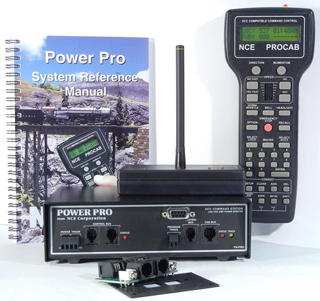
So, I made the decision to make the change.  I recently sold my Lenz command station/booster, the computer interface, and all my Lenz throttles.  I kept and will continue using my separate Lenz boosters, and will keep the throttle plug-ins around the layout.  I ordered an NCE Power Pro system with a radio throttle . . .

NCE-Power-Pro_R

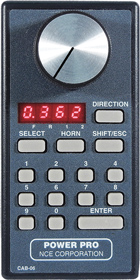
. . . along with a couple of the Cab06 throttles that use that beautiful knob.

NCE-Cab06pr

The box arrived late this afternoon, and I have been reveling in it’s contents.  I’ll be heading out to the train room in the morning to start my installation, which should be rather straight-forward given the similarity of the systems.

Radio control at last!

I’ll do a follow up report soon once I get things operational.  I’m keeping my fingers crossed that all turns out as expected.

-Jack

Lenz DCC Equipment For Sale – SOLD

I’ve decided to sell some of my Lenz equipment.  I’m offering a command station/booster, a computer interface, and several throttles.  All items are like new, clean, no scratches or dents, and are complete, and have the latest version 3.6 software.  My layout is not operational yet; equipment has only been used for testing during construction.  Manuals are included.  If you’d like to take a look at what I’m offering, head over to my For Sale page on the main website.

In my last post I had indicated my need to take a bit of a breather from layout construction.  I think that was a good decision as my spirits are taking a lift with this time off.  To be sure, my enthusiasm for the hobby hasn’t waned a bit, as most every day I find myself focused on something hobby related.  One of the things I’ve been mulling for some time is a slightly different approach to the method I’ll be using to control the layout.  I’m going to take something of a hybrid approach to this, hence my decision to sell off some of my Lenz equipment that won’t be needed in my new scheme of things.

I spent a little time last night visiting the MidSouth Model Railroad Club over in Baton Rouge, and I enjoyed seeing their relatively complete layout in action.  Getting around an operational layout helps to get the juices flowing again.  I spec I’ll be back out in the train room pretty soon for some construction.

-Jack

Side Stepping Burn-out, Part Deaux

I have to confess, I really haven’t felt much like working on the layout for a couple of weeks now.  Sure, I’ve been heading out to the layout room most each day, but I really haven’t been very productive . . . mostly looking for “low hanging fruit” to work on.  I reconditioned a bunch of old Tortoise switch motors.  And I transferred a sound decoder and speaker from a “basket case” Bachmann modern 4-4-0 to another similar model I have that is running and intact.  Another small project completed.  And I spent a day checking out my newly repaired digital camera.  But none of this was advancing the state of the layout itself.

The last two weekends have featured back-to-back NRHS* Chapter banquets, one in Hattiesburg, Mississippi, and the other in Hammond, Louisiana.  I attended both and thoroughly enjoyed every aspect of each day.  The journeys were good, the meals were good, the presentations at both were excellent, and most importantly, I really enjoyed the company of fellow modelers, railfans and historians.  Today was the Hammond event, and afterward Ron Findley and I headed over to the train depot to hopefully catch a few trains.  Traffic was a bit slow, so we decided to just stroll down Cate Street (along the track) and I started photographing the wonderful old buildings along that street.  I guess Ron and I really got caught up into it, as we ended up strolling to the end of the business district, then started down Thomas Street where we repeated our photographic endeavors.  And then there was Oak Street, and finally, Church Street.  I believe I ended up with several hundred images, and I totally enjoyed our little foray.  We eventually found our way back to the depot, where I noticed that there was quite a bit a material staged along the tracks and maintenance-of-way area.  There was a crane parked on a spur, and one of those neat (Difco?) side dump ballast cars.  Lots of rail, ties, ballast, spikes, tie plates and more.  I suspect that this was material left over from the recent trestle repairs down at the Bonnet Carre Spillway. For those of you who are unaware, the CN experienced a major fire there a couple weeks ago that took out an entire span of trestle between two concrete fire breaks.

But back to my original confession above, I have been going “hot and heavy” on the layout construction for over a year now.  You long time readers may remember I went through an intense period of burn-out during my second year of construction and got very little accomplished, relatively speaking, as a result.  I even wrote a post about it, Side-Stepping Burn Out.  When I returned to serious construction a few months later, I knew I would have to change my work habits to help avoid this problem in the future.  In large part, I’ve done better because I will work on something -say, trackwork- for several weeks, then I’ll switch off to something else; benchwork, electrical work, workshop projects, just about anything to break up the repetition and boredom that sometimes occurs when building a relatively large layout (mostly single handedly).  But the burn-out symptoms have been rearing their ugly head again for some time now.  And I’ve simply backed off from what I’ve been doing.  I’m feeling a bit better about things now, especially after these two great Saturdays, and I suspect in another week or so that I’ll be raring to get after it again.  To be sure, I continually feel some guilt for letting this time pass without “real” production, but I’ve told myself that this is after all, a hobby.  And if I’m not happy doing it, then it ain’t a hobby!

So not to worry, the Louisiana Central will continue to see heavy construction, albeit with just a short delay.

Hmmm, now I’ve got to figure out how I’m going to fit those neat city buildings in over at Willis.

-Jack

*National Railway Historical Society

LCRR Mainline Reaches Oneida

I thought I’d post a brief update of the progress at Oneida.  Since my last post, I’ve completed all the roadbed within the area, and I’ve completed the mainline through town.  The roadbed took a bit longer than I thought it would as it had several variations in height.  The mainline roadbed is 3/16″ thick.  The roadbed tapers down to 1/8″ through the passing siding.  Then it tapers down to zero at the sub-roadbed (the Homasote base) for the industrial spurs.  But I also had a couple conditions where I had to slope down to just 1/16″.  This happened at a switch and also at the crossing.  I didn’t want them located on a slope, so I leveled the roadbed out at 1/16″, then later continued down to the Homasote base once past those areas.  It took some time, but it came out well and I think both the operation and visuals will be worth the effort.

Here are a couple photos:

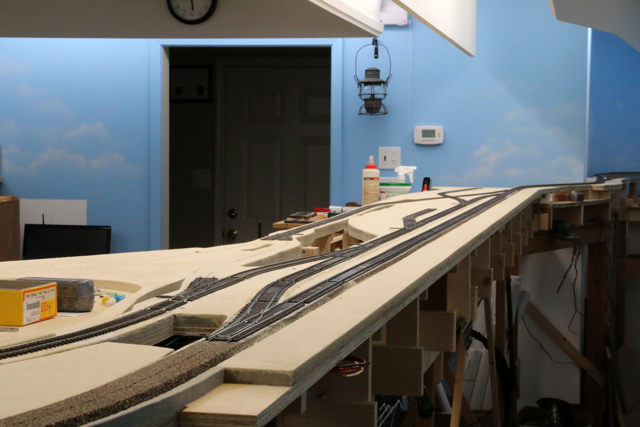
Trackwork at Oneida - 02
This is entering the east end of Oneida.  The first switch directs to the private Spencer Logging Company’s trackage leading to the Spencer log pond.  The next switch is the start of the passing siding.  The third switch will be the spur for the sand and gravel pit.  The mainline track and switches are completed, as is the crossing.  The other trackage is in the process of being fitted, and then installed.

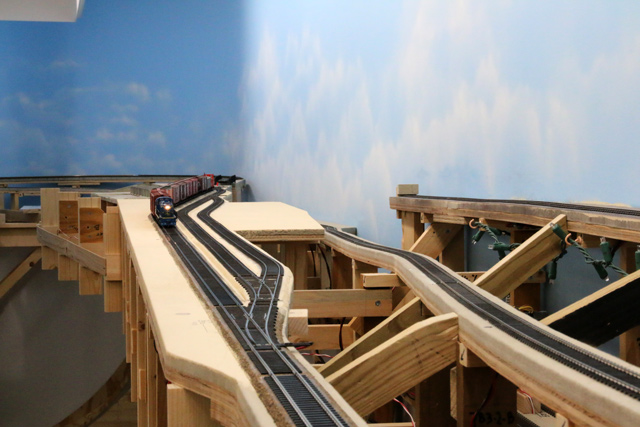
Trackwork at Oneida - 04
Here we are at the west end of town, looking back toward the east.  Down at the alcove, you can see the Louisiana Central mainline (the upper track) curving from Whitcomb (at the right just out of the picture) to Oneida at left.  The lower track is the Spencer Lumber Company’s mainline coming from the woods (at right), and into Oneida.  Note that the Spencer has trackage rights down there where the (future) bridge is crossing the (future) river.  In the foreground, the first switch is to the passing siding.  The next switch (on the passing siding) will be the spur to the loading area of the Spencer mill.  The depressed area (where all the clutter is resting) is the mill pond.

I have a few more photos of Oneida that I’ll be posting on the main website in the next day or so.  If interested, you can find the track plan here.

The last code 83 switches have been installed here in Oneida.  All remaining switches here, and in the yards at Monterey and Willis, will be code 70.  These are (as I’ve mentioned before) not “DCC friendly”, therefore will require modifications.  Unfortunately this will slow my progress down somewhat.  However, I’m thrilled that the mainline only has to finish curving around this peninsula, run back down to the far end, and then cross the room entrance into Monterey where it will be complete!

-Jack

Train Day at the Library – 2016

The 4th annual Train Day at the Library in Baton Rouge is now in the bag.  Last Saturday was a gorgeous day and folks took advantage of that to attend the event.  The usual fare was presented including operating layouts, slide shows, photo exhibitions, and numerous displays of models.  Several railroad historical societies were represented as well.  This year we had a new addition to the displays: Bill Chidester brought two Fairmont motor cars over and they were displayed at the entrance to the library.  One is in operating condition and the other is his recent acquisition of a derelict which Bill plans to restore.  The speeders drew plenty of attention from both adults and kids.

Bill, Jack & Wayne at TD@L-2016It’s the end of the day and the motor cars have just been loaded up on Bill Chidester’s trailer for the trip back home.  That’s Bill on the left, Wayne Robichaux on the right, and yours truly at center.  Photo by Bob Schilling.

I really have enjoyed this small gathering each year.  I look forward to seeing friends there, especially those that I don’t get to see very often.  And Saturday was no exception in that regard.  Many thanks to Forrest Becht and all the others that made the show possible.

Wayne and I, along with Bill and his wife, made our way over to a local steak house afterward.  A New York strip, along with a loaded baked potato and salad, all washed down with a cold and tasty brewski, was the perfect way to cap off the day.

-Jack

More Photo Proof as Promised

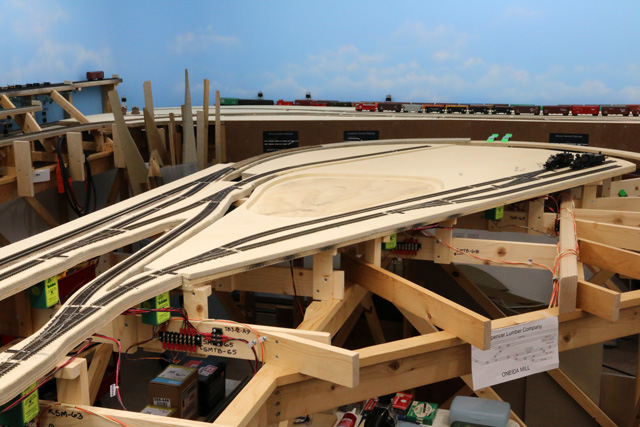
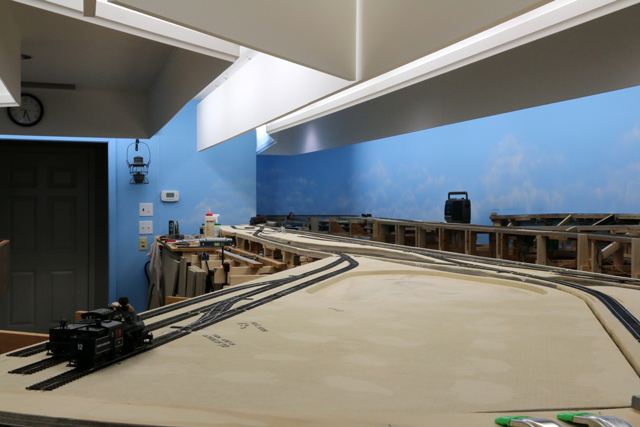
A few days ago I posted some photos taken of new construction in Whitcomb, located near the Spencer Lumber Company’s logging operation.  I ended by promising to post a few pics of the Oneida area located on the peninsula at the opposite side of the aisle.  Well, here they are:

Entering Oneida from the East
Here’s an overall view of the second peninsula taken from the alcove.  This is the last major benchwork section on the layout.  The area you’re viewing is the town of Oneida.  The narrow roadbed in the foreground is where a Pratt truss bridge will be located, with the riverbed below.

Site of Bridge Over Little River
Looking back at the (future) Pratt truss bridge which will be spanning the Little River.  There will be a sand and gravel pit operation to the left near the river flowing across the layout. Just to the left of this view the Spencer mainline will split from the joint trackage that crosses the river.

Spencer Mill Site
Panning even further to the left, the area that will contain the crude oil shipping point is at center.  The Spencer Lumber Company mill complex is seen down at the end.  The roadbed meandering at the far right is the Spencer mainline heading toward the mill.

I will be shifting to trackwork soon as I’m getting ahead of myself with all this benchwork.  I will need to put one more short piece of sub-roadbed down at the west end of Oneida (from the stub at top left of the above picture).  This is so I can have some working room ahead of the mainline switch leading into the passing siding that starts as the mainline enters town.  Leaving Oneida, the track will make the hairpin turn at the end of the orb, then head back down on the other side of the peninsula toward the room entry.  From there, it will turn left, then pass across the doorway (over a lift-up bridge) to connect with the town of Monterey (the end of the line).  And that, my friends, will complete the mainline!

As I mentioned earlier, if you’d like to see more photos, you’re invited to visit the photo section of the website: Whitcomb and Oneida.  And you can find the track plan here.

-Jack

A Visit to the Grande Pacific

This post is a bit tardy relative to the event, however I had started preparing the earlier post Photographic Proof of Progress! last Tuesday and wanted to complete and publish it before starting anything else.  Okay, on to this story:

Last Wednesday I had the opportunity to visit Art Houston’s Grande Pacific Railroad.  Wayne Robichaux called Monday evening and informed me that Art was hosting an open house and an informal operating session, and would I be interested?.  Well I had never been to the Grande Pacific, and I decided it was high time that I got myself over to Art’s place, so I accepted.  Wayne picked me up at 7:35 on a rainy Wednesday morning, and then after picking up Jim Lofland, we headed south to Houma, Louisiana, the home of the Grande Pacific.

The two hour drive was uneventful and we arrived just as the layout was cranking up.  Art was busy greeting everyone as they arrived, so I set about checking out his layout.  A bit later after things were running smoothly, Art gave me a schematic diagram of the railroad so that I could get a feel for the route.  As it happened, an empty coal train was departing for it’s run to the mine near the other end of the line, so I decided I’d hitch a ride and see where the train led me.  The Grande Pacific is a multi-level layout with three levels in most places and a fourth level down at the staging yards.  Because of this, the length of run is deceptively long, and I spent a good deal of time with that train.  Once it arrived at the mine, it had to pull the loads, then spot the empties in their place.  Once the new train was made up, the journey back to the origination point began.

It was while that train was on it’s return voyage that a group of fellows from the North Shore area (of Lake Pontchartrain) arrived.  These were all folks that formerly operated on the late Lou Schultz’s C&O layout, and naturally I knew all of them quite well.  By mid afternoon it became practically a mini-reunion with no less than 12 former C&O operators in attendance at Art’s open house.  What a splendid turn of events!

Art himself was quite the gracious host.  Those that wanted to operate did so, and those that wanted to “railfan” and kibitz with each other did that also.  Art was fine with all of it.  He came over to me several times during the day for extended conversation about various things on the layout, and even some discussion about certain model railroad industries.  All was interesting.  And did I mention the refreshments?  I don’t think anyone left Art’s house hungry.

The Grande Pacific is an interesting layout, and is built for heavy operations.  There is something there for just about anybody’s operating interest.  Art has quite a bit of information about his layout on his Facebook page.

Thanks Art for an entertaining day!

-Jack

Photographic Proof of Progress!

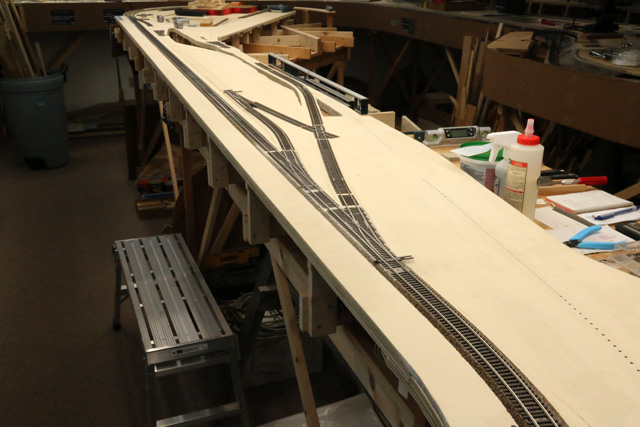
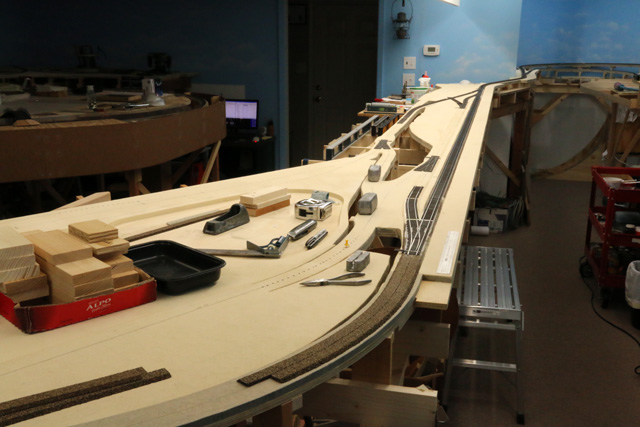
Earlier in the week I finished installing the sub-roadbed (plywood topped with Homasote) in the town of Oneida.  This town is located on the 2nd peninsula, which happens to be the 5th and final major area of benchwork.  Today I sanded and filled joints between panels and did general cleanup in the area.  Tomorrow I’ll likely get a coat of paint down to seal things.  I’ve been promising for weeks (months?) to get some pictures posted of the work that’s been done in both Whitcomb and in Oneida.  Well I’ve finally done it!  Here are a few to start things off:

Looking down the aisle
Here’s an overall view looking down most of the length of the room.  That’s the Spencer Lumber Company’s Camp 6 on the right, along with the double switchback required to get up the hill.  To the left of that is the Louisiana Central mainline.  Way down at the far end is Whitcomb.  Over on the peninsula at left we see Oneida.

Whitcomb up close
Here’s a closer view of Whitcomb.  I’ve started the trackwork in this area and the mainline (left) is complete and wired.  The passing siding (center track) and the industrial spur (right) aren’t installed yet . . . the pieces are being cut and fitted, and they should be going down soon.  The next track to the right (on it’s own supports) is the Spencer mainline from the woods.  It’s heading back to the mill at Oneida.  And the high line against the wall is the tail of the 2nd switchback on the track up to Camp 6.

The alcove
Down in the alcove, both the Louisiana Central and the Spencer mainlines make a 180 degree curve, then head back to Oneida on the peninsula.  The gap in the roadbed at right is where the plate girder bridge will go.  The Spencer mainline passes below the bridge here.  The two mainlines join at left for a bit of joint trackage over the river bridge to be located just east of Oneida.

I’ll get a pic or two taken at Oneida in a few days after I finish up the painting and cleanup.

If you’d like to see more photos, you’re invited to visit the photo section of the website: Whitcomb and Oneida.  And you can find the track plan here.

Happy New Year to all!

-Jack

A Benchwork Binge

It’s been over three weeks since my last post.  This time of year gets kind of hectic with all that’s going on.  But even so, some significant progress has been made on the layout.

I’ve been on a benchwork binge for several weeks now.  I mentioned back in November that I’d started cutting out the sub-roadbed for the two turn back loops contained within the alcove in the train room.  That has been completed and installed along with the cork roadbed.  Track can now be laid.

But I didn’t stop there.  Coming out of that alcove, one enters the second peninsula of the layout.  This is the 5th and final major section of layout construction.  I had previously installed the joists in this area in preparation for the sub-roadbed.  As of today, all of the Louisiana Central sub-roadbed has been installed through the town of Oneida (located on said peninsula).  I’ve cut the sub-roadbed out for the Spencer trackage that will be in the mill site, and will probably get it installed within the next few days.

The only sub-roadbed work left now is the big loop at the end of the peninsula orb, then the mainline run back down the back side.  The track will then traverse the bridge across the room entry and enter Monterey (the end of the line).  The mainline has long been completed in Monterey, so I simply need to connect there.  Wow! the end (of sub-roadbed construction anyway) is actually in sight!

I’ve been saying for months now that I’d post a few photos of the recent construction.  As soon as I complete the work at Oneida near the mill, I will snap a few shots and get ’em posted.

I’ll likely shift to track laying soon as I’m getting way ahead of myself with benchwork.  I can put down about 35 feet of mainline right now, plus a passing siding and quite a few feet of industry trackage.  The Spencer mainline can also now get into Oneida, so I need to put that down (about another 35′ of that).

Again, I’m pleased with the progress.  I’ll be starting the new year on a positive note!

I’d like to wish each of you a very Merry Christmas!

-Jack

The Social Aspects of Model Railroading

In my last post I mentioned that I was becoming more fond of the social aspects of the hobby.  Well, tonight I thought I’d expand on that a bit.

I’m a regular reader of Trevor Marshall’s blog (Port Rowan in 1:64) and he often writes about the social aspects he enjoys as part of his hobby.  It isn’t uncommon for him to host an operating session, then retire to a local eatery afterwards for a nice meal and a pint or two.  He recently wrote of hosting a couple visitors at his home during which they actually devoured two meals in the one day (lunch, then later, supper).

For a good number of years I was a regular operator at the late Lou Schultz’s C&O layout.  One of the things I really enjoyed there was the social camaraderie that took place in the crew lounge both during the session, and afterwards.  I’ve just this year started eating breakfast out on Saturday mornings with a group of model railroaders (I recently referred to this as the ROMEO* breakfast).

Thinking back on it, the very first group of model railroaders that I fraternized with was the original Crescent City Model Railroad Club in New Orleans.  This came about when I was in my mid teens.  After the operating session, we usually drove to a pizza place on Veterans Highway in “new” Metairie.  Back in the mid 60s, pizza wasn’t a common thing in the deep south.  Indeed, the first slice of pizza I ever consumed was during that late hour “snack”.

The point of all this is that as I’ve aged, the social aspects and the camaraderie of being with others of the same ilk has become more and more desirable to me.  I hope to one day have a small group of folks over for regular operating sessions, and to maybe head out somewhere afterwards to share a meal.  Just tonight I was visited by two local modelers, Rod Fredericks and Gary McMills. Gary had been here once before, perhaps a year or so ago.  But much has been done on the layout construction since his last visit, so he had plenty to look at.  This was Rod’s first visit, so he received the nickel tour.  After the walk-through we just plunked down in some chairs and had a good old fashioned bull session.  What an enjoyable evening!  I had even thought of us perhaps heading around the corner to enjoy a cold brew, but tomorrow is Thanksgiving day and everyone needed to get on home for an early start in the morning.

I have to thank Trevor for reminding me of how much fun these social interactions are.  It’s really easy to hunker down in the layout room day after day and to simply forget that there’s so much more out there to enjoy about the hobby.  Reading of Trevor’s enjoyment has prompted me to stick my head up out of the benchwork occasionally to spend time with friends.

-Jack

*Retired Old Modelers Eating Out

Planes, Trains and Automobiles

Well, the automobiles were only used for transportation to see the planes and trains in this case…

The past month has seen somewhat sporadic progress on the layout.  I confess to several distractions during this period.

Three weeks ago Ron Findley and I motored down to New Orleans for the Airpower Expo at the Lakefront Airport.  This year’s show was again quite interesting, with a nice roster of war birds in attendance.  There were three bombers there (all flying): a B-29, a B-17 and a B-25.  A P-51D Mustang was busy all day with flights, along with an SB2C Helldiver and a P-40 Warhawk.  Also on display were an SBD Dauntless dive bomber, a P-51C Mustang in “red tail” livery, a P-39 Airacobra, a C-47, and several training aircraft of various vintages.  The National WWII Museum (co-sponsor of the event) had quite a few pieces of ground equipment ranging from trucks and jeeps, to small field pieces, to a light tank.  A great day with good weather and plenty of flying.

Then last weekend I headed over to Ponchatoula with Ed Dayries to take in the annual train show over there.  The show is primarily aimed at the 3-rail crowd, but there was also a nice S scale layout in operation, as well as a live steam display.  Vendors were offering their goods in just about all of the common scales/gauges.  We capped it off with a short run up to Hammond where we happened to catch Amtrak #58, the northbound train running from New Orleans to Chicago.

Progress on the layout has come in short spurts during this time.  I’ve finished the mainline track through Whitcomb and the switch motors are installed.  I’ve started on the passing siding and industrial spur trackage.  I’ve finished all the joists on the peninsula that I wrote of last month, and I’ve cut out the basic sub-roadbed shapes for Oneida…trimming and adjustments will be made later once it’s time to plot out the track centerlines.

Today saw an uptick in the production, with some excellent progress being made.  Wayne Robichaux and I made a lumber run this morning after enjoying the weekly ROMEO* breakfast.  After unloading the material, we proceeded to lay out and cut the plywood and Homasote sub-roadbed pieces that will be needed for the turn back loops located in the alcove west of Whitcomb.  We completed both the Louisiana Central and the Spencer Lumber Company’s sub-roadbed loops.  I’ll probably start making risers for all of this tomorrow.

I received the 72′ bridge that I needed for the overpass at Whitcomb but it still sits on the workbench awaiting assembly.  I’m going to have to start focusing on specific tasks for the remainder of the year.  There are many events (those distractions) between now and late January that I’ll likely participate in.  But that’s okay, because for me, that’s part of what I enjoy about this hobby.  As I age I’m finding the social aspects are becoming more and more important.  I can hardly wait for each event, whether it be a train show, an open house, or an NRHS banquet…I’m ready for it!  And of course, with the holidays coming up, I’ll also be enjoying good time with family.  It’s a great time of year!

But fear not, the Louisiana Central will continue to progress.  Ultimately, I can hardly wait for the day when trains are operational.

 -Jack

*Retired Old Modelers Eating Out