High Line Completed

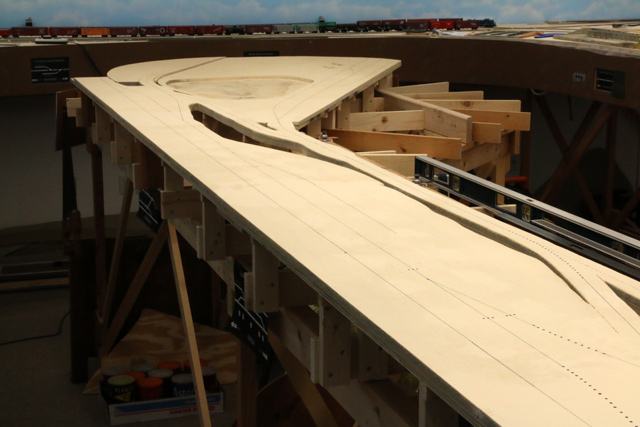
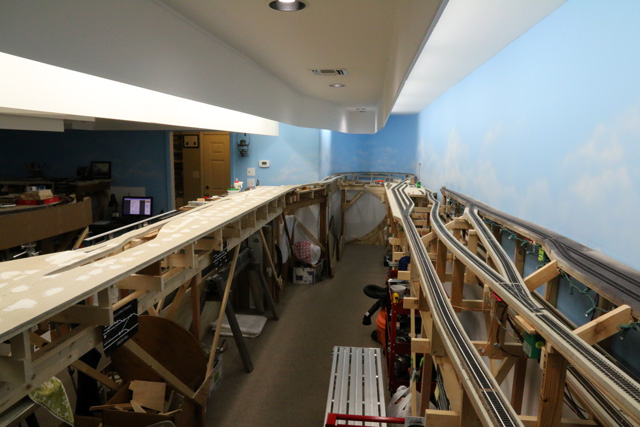
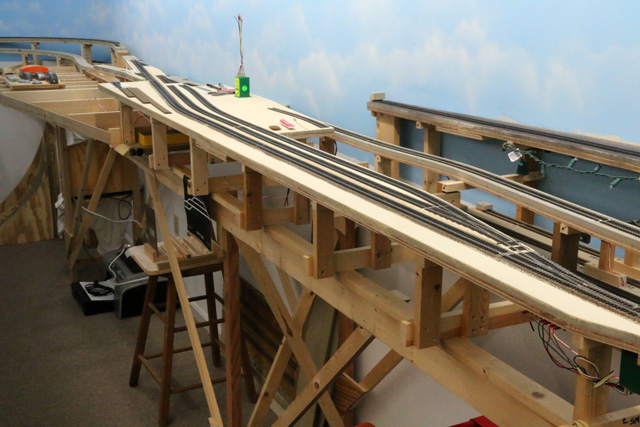
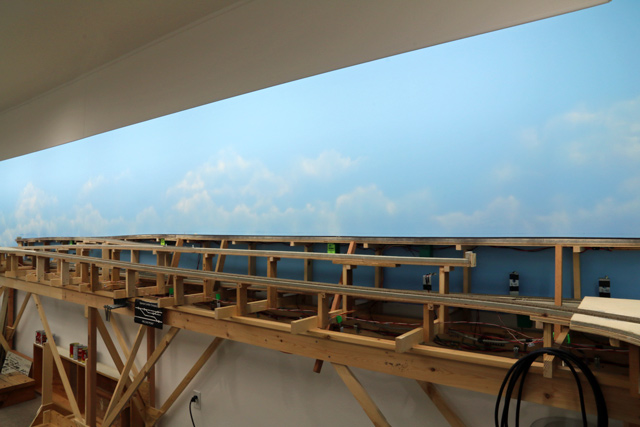
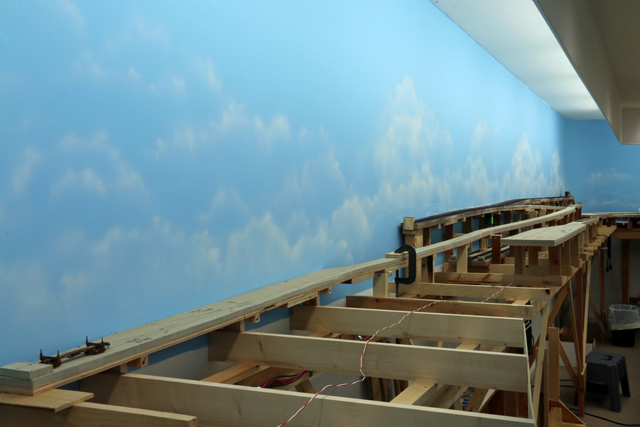
The Spencer “high line” to the re-load point at Camp 6 is now complete.  All track is laid, wired, and operational.  As I mentioned in the previous post, I’ve sprayed a coat of Rust-Oleum Camouflage Brown paint over the track.  Later when I start doing scenery work, I’ll go back and paint ties in several other shades of brown and grey, and I’ll weather the rail with a rusty brown color.  I still have to connect the Tortoise switch motors to the panel toggles, but that will have to wait until the panel is constructed.

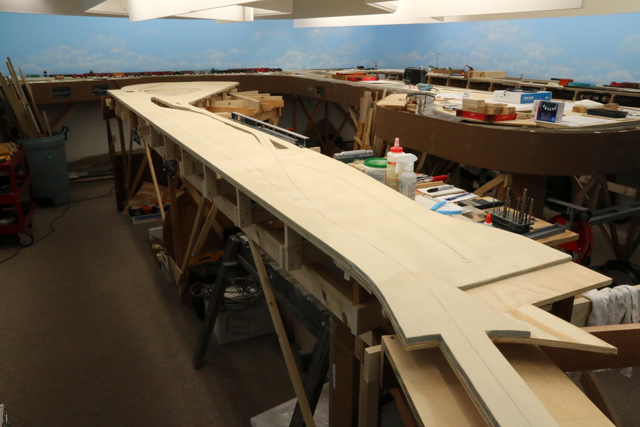
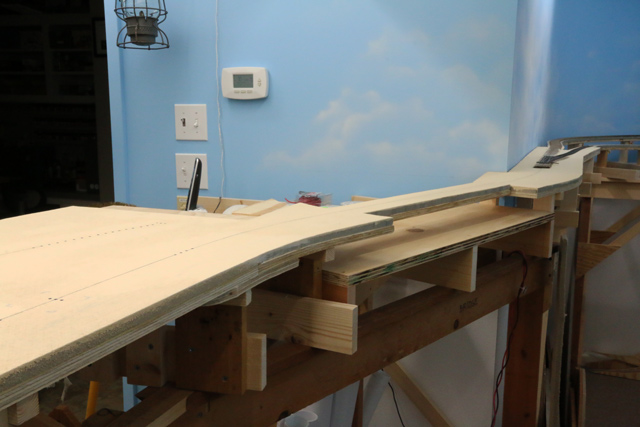
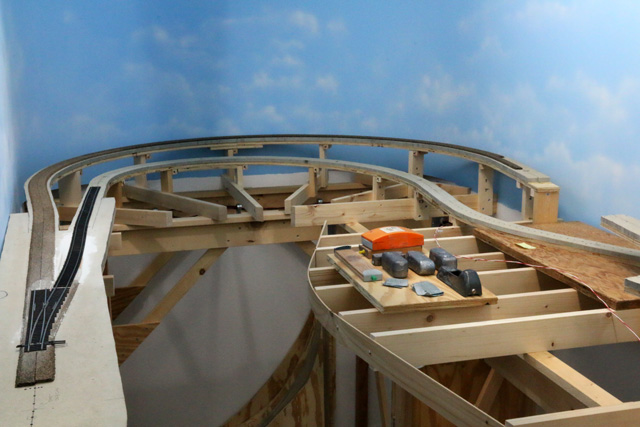
Next up is the double switchback which will bring the rails down from the hill to the valley below.  This past weekend I got the sub-roadbed for the double switchback cut out and the riser assemblies constructed.  Then I temporarily clamped the risers to the joists and set the sub-roadbed on top.  I’m playing with the grades and I’ll screw everything down once all is tweaked to my satisfaction.  By next weekend, track should start going down on that section.  Then the long mainline will proceed through Whitcomb and on to Oneida where the sawmill is located.

The Louisiana Central mainline can also start to progress westward out of Maynard once I’ve completed the switchback trackage.

It sure feels good to see benchwork and trackwork progressing again!  Stay tuned for more.

The only disappointment this past weekend was with my Bachmann 3-truck Shay.  I decided to put it though its paces with a string of cars.  I was surprised to see it struggling to pull the seven car train up the grade!  Upon close examination, I noticed that one of the six driving axles was not turning at the same rate as the others.  On the third ascent up the grade (with one fewer cars), I heard some popping noises come from the locomotive.  Then it quit moving.  Again I examined it up close and noticed a second axle was not rotating properly.  Bottom line . . . my Shay apparently is victim to the dreaded Bachmann split gear syndrome.  This isn’t good news at all as I’ve read that Bachmann no longer has replacement parts for the Shays.

But there was a bright moment.  I put the Rivarossi Heisler (acquired last year) on the track, and she hauled the full seven car train up the grade without slipping.  Good show!  At least I still have a way to haul the logs out of the woods, albeit not with the intended power.

-Jack

Spencer Camp 6

The Spencer Lumber Company will play a significant role on the layout.  Spencer will have a sawmill at Oneida (on the peninsula closest to the top of the track plan), and will have a railroad mainline running from the mill up to Camp 6 (a re-load point) in the woods east of Whitcomb.  Camp 6 is physically located along the wall at the top of the track plan.  The Louisiana Central mainline between Maynard and Whitcomb will also run along this section of benchwork, near the aisle.  My construction protocol is to work from the wall out toward the aisle (a lesson learned the hard way).  Therefore, I needed to build and install the Camp 6 roadbed and trackage before advancing the LC mainline from Maynard (where it presently ends) to Whitcomb.

The sub-roadbed for Camp 6 has been in place since last September.  However trackwork was never started only because I’d not tackled the task of modifying the Shinohara code 70 switches required for this area.  As I mentioned in a recent post, the switch modification program has finally gotten under way, and work up at Camp 6 has resumed.  The high line was designed to be removable for construction work.  Two weekends ago I removed the right half and started laying track.  This past weekend, the track was completed on this section, the Tortoise switch motors were installed, and all wiring was completed.  I sprayed all the track with a coat of Rust-Oleum Camouflage Brown paint (first time I’ve done this), then re-installed the entire section of benchwork atop the risers.  The left side benchwork has been removed and next weekend, similar work will ensue.  As the final step, the double switchback will be constructed which will bring the trackage down to roughly the level of the (future) LC mainline.

Once all this happens, both the Spencer and Louisiana Central trackage can advance to Whitcomb, and then on to Oneida.  This will be a major milestone for the layout.  I am anxious to achieve this progress, and have an excellent start to making it happen.

The trackage along the wall and the peninsula written about above will be powered by the 3rd of the three DCC booster districts.  Booster districts 1 and 2 have already been completed.  This past weekend I set about installing this final district.  The Lenz booster feeds two DCC Specialties PSX circuit breakers, one each for the LC and the Spencer operation.  All components have been installed and wired, and some of the Spencer track bus wiring has been strung.  The only work remaining will be the LC track bus and the Spencer track bus onto the peninsula.

This summer is turning into a fairly productive one.  I’m pleased with the progress being made on the layout thus far.

-Jack

The 3rd Anniversary

Well, we are wrapping up year number three on the Louisiana Central.  Much work has transpired over this past year, though not nearly as much trackwork was completed as I would have liked.  But significant progress has been made nevertheless.  All of the basic benchwork is completed, however two of the five sections are still needing roadbed for the track.  Benchwork fascia has been installed along a substantial section of the center aisle and at Maynard adjacent to the rear wall.

Electrical districts have been clearly defined and the DCC power, cab and booster bus wiring for five of the seven districts is complete.  The optical detection system was completed with the exception of the panel indicators (which need panels before that happens).  The first four control panels have been constructed and test fitted into their fascia “frames”.  A few hours of wiring will see them completed.  I’m pleased with these initial panels as they present a neat, clean appearance and are recessed to resist damage from passers-by.

While trackwork has lagged, a good bit of it has indeed been installed.  All of the staging tracks are in, and the entire Illinois Central presence is complete.  The interchange to the Louisiana Central has been laid, and the passing siding at Willis yard is nearly complete.  At the Monterey end of the line the mainline and passing siding have been installed, along with the turning wye, the house track, the MOW track, the Texas and Pacific interchange, and a spur to the Sean Cannery Company.  All of the trackage at Maynard was completed some time ago.

The Spencer Lumber Company’s line up to Camp 6 in the woods is under construction.  The upper roadbed is installed and waiting for track.  As I’ve mentioned before, that trackage needs to go in before the Louisiana Central can advance it’s mainline west out of Maynard.  The hang-up (as I’ve also mentioned) has been the modification of about 40 Shinohara code 70 switches to make them “DCC friendly”.  Well, the good news is that the program has finally started.  It shouldn’t be long before that trackage starts going down.

Speaking of trackage, I’ve installed the Tortoise switch motors on those turnouts presently down.  And I’ve got a good stash of Tortoises that have been inspected, lubed, pre-wired, and are ready for installation as additional track is laid.

I started roughing in for a bit of scenery recently.  There is a stretch between Willis and Maynard that consists only of the track on 2″ wide roadbed.  I thought it might be prudent to at least install the hardshell scenery base between the roadbed and the fascia and also a bit to the far side of the track just to make sure nothing takes a quick trip to the valley floor 385′ below.

Oh, and car kits . . . I’ve started assembling some car kits.  I’ve completed nearly 50 kits now (of the 300 or so kits in my stash).  Admittedly, I started with the low hanging fruit, going through many Accurail kits, along with a few Walthers, Atlas and McKean.  All of these cars now have metal wheelsets and Kadee couplers, and all have been certified road worthy.

Plenty of other things have been done, some not directly related to the layout (shelving in the workshop, drill press table, Dremel bit rack, and a few other improvements).  Even a bit of lighting work was done.

All-in-all, it really wasn’t a bad year.  During the second year, I had started burning out on construction.  The vast majority of the work had been on benchwork, roadbed and some track.  I decided to broaden the scope of work on the layout and began putting more time in on the other aspects of the layout.  After all, the layout will not become operational until all these things are done, including some basic scenery (as mentioned above).  After a long break from trackwork, I’m now in the mood to tackle some more and have refocused on that task again.

I had decided during my last annual assessment to not make predictions of what I’d accomplish in the upcoming year, then promptly made a prediction (which of course, failed to materialize).  This year I’m sticking to that tenet.

However, I’m optimistic about the fourth year ahead.

-Jack

Progress on Multiple Fronts

I have to admit that I’ve been in a rut for quite some time at least in regards to track laying.  And it all centers around the (self-imposed) requirement that all of the track switches are to be “DCC friendly”.  I’ve finally embarked on this project and can happily report that as a result, track work is again proceeding.  I’ve modified four of the Shinohara code 70 switches thus far, two of which have been installed.  The Illinois Central passing siding at Willis, and the interchange track to the Louisiana Central have been installed and are operational.  This completes the I.C. trackage.  The next two areas I want to complete are the L.C. passing siding at the Willis yard, and the Spencer Lumber Company’s line up to Camp 6 in the woods just east of Whitcomb.  The latter is necessary as it’s located at the far side of the benchwork in this area.  I want to get this installed and operational before advancing the Louisiana Central mainline (to be located near the aisle side of the benchwork) from Maynard to Whitcomb.

And since trackwork has resumed, I needed a fresh supply of refurbished and pre-wired Tortoise switch machines.  I grabbed another pile of those, performed the prep work, and now have them ready for installation.

I’ve decided to go with recessed control panels similar to what I mocked up recently.  There wasn’t much point to mocking up my other ideas as the recessed version was what I really wanted and the mock-up confirmed that the idea would be workable.  This past weekend Wayne and I cut out the components for the four panels that will be in the vicinity of Maynard.  I hope to start the actual construction of these panels within a week or so.  Once these are installed, I’ll be able to paint that section of fascia.  I’m studying color samples and hope to decide on a color soon.

I’ve also made a minor lighting change in the train room.  In addition to the fluorescent lighting behind valances, I also have recessed can lighting over the aisles.  These have had 75 watt incandescent lamps in them.  I decided to change the incandescent lamps out to 5000k LED flood lamps, the same color temperature of the fluorescents.  These match the layout lighting quite nicely and I think it will be a visual improvement.  I also installed a twin head emergency light fixture near the entrance to the room as when the lights are out, that room gets very dark (as in black).  Interestingly, the first day after I installed the light we had a heavy thunder storm pass through and the lights went out for a couple minutes.  The emergency light did an outstanding job of lighting the way out.

And finally, freight car construction continues, although at a slightly reduced pace.  I have about 45 cars assembled and checked out to be road worthy at this point.  Only about 250 kits remain.

-Jack

Dremel Tool and Bit Rack

Over the years I’ve acquired four Dremel Moto-Tools, each of which came with an assortment of bits, accessories, and tool parts.  And each time I needed a bit or accessory, I’d spend more time rummaging through the tools cases where the tidbits were stored than actually doing the work.  So I cobbled this rack together from “scraps of scraps” (literally).  I liked the finished result so much that I caved at the end and shot a coat of paint on the thing.

Dremel Bit Rack 1

Dremel Bit Rack 2

The blue plastic box came with my last motor tool purchase.  I simply screwed it to the rack and will use it to hold sanding drums, polishing pads, etc.

-Jack

Tracing the Louisiana Central

This past Friday Wayne Robichaux and I took another field trip. This excursion was a repeat of an earlier trip in which we had “followed” the Louisiana Central from it’s beginnings near the east bank of the Mississippi River, to it’s eastern terminus at Bude, Mississippi.  That trip was made in the dead of winter so that we would be able to see better into the terrain.  Friday’s trip found the landscape in full summer greenery.  While it was considerably more difficult to see beyond the edge of the road in places, the look is more akin to the way the modeled scenery will look as I will be placing the time period in the summer.

We were able to precisely discern several of the locations where I’d taken photographs several years ago.  However several other scenes I’d previously photographed were hard to identify this go-around due to the extensive foliage and because of the passage of time.  I re-shot many of the scenes as a comparison, but didn’t discover anything “new”.  While there are way too many photos to post here, you can see the original collection on the website.

We broke off late in the afternoon and headed over to McComb, where we caught the northbound Amtrak train, with a northbound CN freight hot on his heels.  As most of you know, a local railroad museum makes its home in the depot at McComb.  Outside, a former Illinois Central Mountain steam locomotive, along with a few cars, are on display under a shelter roof.  We were pleased to see that an extension of the train shelter is well under construction.  This will place the recently acquired passenger cars on display under shelter as well.  After checking things out, we drove south on Highway 51 to Hammond where we caught one additional train before heading back west to home.  It was an enjoyable day!

Progress on the layout was a bit light this past weekend, but I did manage to assemble a few more car kits.  I also painted a new rack I’m making that will hold Dremel bits.  Oh, and I finally got started on those code 70 turnout DCC modifications that I’ve talked about several times in the past.  I’ve got a pair ready for installation on the layout now.  If anyone shows any interest, I’ll have to take a few photos showing what I’ve done with them.

-Jack

A Control Panel Mock-up

I’ve been rolling ideas for control panels around in my head for several years now.  I’ve reached a point where I need to make a decision as to the style and construction I’m going to employ.  This past weekend I decided to mock up one of those panel ideas and here is the result.

Control Panel Mockup

This panel is a recessed version.  I think that this will help maximize the aisle width and also keep folks from accidentally rubbing up against the controls.  This panel is 5″ x 8″ and is typical of the size many of the panels will be.  I temporarily attached a section of Masonite to the edge of the benchwork, then cut the rough hole out for the panel.  Using 1″ x 1″ material, I “framed” the backside of the Masonite for the panel.  Using a router, I trimmed the Masonite flush with the frame, then screwed the panel to the back of it.

The panel itself is a sandwich of 1/8″ thick Masonite, a drawing, and some .093″ thick acrylic plastic.  I’ve used that method for panels in the past and they worked out well for me.

The “ghost” objects on the panel are merely reflections.  They seemed pronounced in the photo, but aren’t really noticed in person.

Opinions anyone?

-Jack

A Special Car

I just finished assembling this boxcar commemorating the 1973 NMRA National Convention in Atlanta.  My good friend Bill Williams had picked up this kit during that convention which he and I, along with a couple other guys, had attended.  Bill passed away a couple years ago and several months later, some other friends were liquidating a bunch of Bill’s railroad equipment during a railroading get-together and banquet.  We found this car in the box and I just had to have it.

SER Boxcar

The car is an old blue box Athearn that the NMRA had specially made up for the convention.  I decided to leave it more or less in “stock” form, adding only Accurail trucks, Intermountain wheelsets and Kadee couplers.  The car (by virtue of the date) is really too new for my era, however it will find a display spot in the train room and will likely be quietly added to an occasional train.  I’m thrilled to have this car, both for the memory of the convention and especially of Bill.

-Jack

New Cars, New Overpass

I’ve rambled about assembling a big mess of car kits in the last couple posts here and here, and I’ve mentioned something about assembling a Rix Rural Timber Overpass kit.  Here’s the manufacturer’s photo of that structure:

RIX Timber Overpass

I’ve finished building the kit and it is waiting for paint.  I’ve also been working on the supporting benchwork for the bridge and I’m close to fitting it into it’s final resting spot.  The section of mainline where this will reside is just a bit west of Willis.  I’m hoping to catch the feel of the Canadian National (formerly Illinois Central) mainline in south Brookhaven, Mississippi.  There the mainline enters a stretch where it’s running in a cut in the terrain.  At the middle of this stretch is an old timber roadway overpass, not unlike the Rix kit.  The prototype bridge is a bit longer than the model, as it crosses what was once a double mainline, but the kit still captures the flavor of the structure.  I’ve always liked that bridge and hope to make this one of the signature scenes on the layout.

As for the car kits, I’ve slowed down a bit on that.  I’ve completed about 30 kits, which sounds like quite a few, but is small relative to the number of kits remaining (something approaching 300).

I’ve got all the material on hand to commence conversion work on all those code 70 Shinohara switches.  I’ve just got to muster up the motivation to get started with all those re-buildings (one of the few things that I don’t particularly want to do).  Unfortunately, the local folks around here haven’t recognized that this is potentially one of the next great model railroads.  As such, no one is beating a path to the door for the chance to become involved in its construction (a sorry state of affairs).

biggrin

Oh, I’d like to acknowledge the superior customer service that I’ve received from Accurail.  While assembling a large stack of their kits, I came across a couple that had significantly rusted up screws (used for attaching the trucks and draft gear box covers).  I contacted Accurail and they immediately sent replacement screws . . . not the eight that I’d requested, but a bag of 100.  Within a few days of my initial contact, I had product in hand.  Now that’s service!  And those extra screws have come in handy for some of the older kits.  Those older kits utilize a molded pin on the draft gear box cover which holds the cover on by friction.  I’ve modified several of these kits by cutting off the pin and drilling a hole at that location.  I then used a screw to attach the cover, greatly increasing accessibility in the event maintenance is required.

As always, comments are welcome and visits are allowed (just drop a line).

-Jack

Rained Out

Yesterday Ron Findley and I joined a couple friends from Covington for a get-together at Tom Davidson’s home over in Hammond.  As many of you already know, Tom is a vast sea of knowledge about things railroad in southeastern Louisiana and southern Mississippi, especially when it comes to the Illinois Central.  Tom did a nice presentation on the railroad history in the greater Hammond area.  Of particular interest was the information presented regarding the strawberry shipments made from what was once known as “The Strawberry Capital of the World”.

Afterwards we had planned to shoot photos of several small industries and businesses around Hammond, but unfortunately the rains commenced.  Ron and I hung around for several hours, but it eventually sank in that this was not just a thundershower.  We relented and headed home.  We’ll simply return on a sunny day in the near future to complete our mission.

A few weeks ago I mentioned that I had started constructing a few easy car kits.  I’ve continued on that and now have a nice train full of new rolling stock added to the active roster.  I’m really enjoying this and I plan to continue assembling at least a few kits each month now.

A Group of New Cars Another Group of New Cars

As stated earlier, I won’t be detailing or weathering any of these cars initially . . . that can come later once the layout is operational.  However these cars are equipped with Kadee couplers and metal wheelsets.  Everything has been checked, adjusted and lubed so that these cars are ready for service.

I’ve also done a little more work on the assembly of the road bridge that I also mentioned earlier.  I’m assembling it in place so that it hopefully will fit the spot well when scenery work is started.  I’ll post a photo in the future once it’s completed and painted.

-Jack

Building a Few Kits

I’ve been wanting to take a break from layout construction lately and I had my chance while waiting for some critical material to arrive for the layout.  I decided I’d start assembling some of the several hundred car kits that I have stashed away.

I have kits from a broad cross section of manufacturers: Accurail, McKean, Bowser, Walthers, Branchline, Kato, Proto 2000, MDC, Red Caboose, Gould, (whew!) . . . at least another half dozen others.  I haven’t done any car kits in quite a few years, so I started with some simple Accurail boxcar kits.  Got a couple done and have a couple more in progress.  I also did a little tune-up on a couple cars already on the layout.

Workbench Project - Car Kits

My objective is to assemble the cars, add metal wheelsets (usually Intermountain) and Kadee couplers.  Everything is checked and adjusted so that the car is ready for service.  No attempt will be made initially to add detailing or weathering . . . that can come later once the layout becomes operational.

I also got started on a small timber road overpass that I’ll be needing soon.  The kit is by RIX and is typical of this type bridge.  The bridge deck has nicely detailed wood grain in it, but amazingly, the sides of the deck, and all of the piers are just slick plastic, ugh!  I spent quite some time scoring wood grain into all of the parts.  I used the back side of a no. 11 knife blade and scored considerably.  Then I lightly sanded over that with some 150 grit sandpaper.  The result looks fantastic, I think.  After I get the thing assembled, I’ll set about “creosoting” it using the photos I took recently on my field trip.

I enjoyed this change of pace and think I might add this to my regular project list.  I think the variety will help break up the monotony of roadbed and track.

-Jack

The Heisler is Back!

Back in November I wrote a post documenting the new Rivarossi Heisler that I’d just acquired.  I gave a brief description of the good (and not-so-good) features of the model, and mentioned at the end how I loved the whistle.  Well, the whistle turned into a bit of a problem.

I had noticed that the short whistle sound didn’t seem to match that of the long whistle (there are two buttons that control these sound variations).  Reading the instructions, I learned that there were actually six different whistles programmed into the thing, so I set about changing the whistles to see how each sounded.  While doing this, I noticed that one of the other whistles seemed to not match sounds between long and short toots as well.  After going back and forth, I finally realized that the short whistle sounds of these two whistles were reversed!  I wrote Rivarossi about this problem, and they in turn directed me to Matt Herman, who is the General Manager for ESU in North America (the loco uses a LokSound decoder by ESU).  Matt advised me to return the locomotive for reprogramming (which I did).  Well, it took three and a half months to get the loco back!  I suppose the timing couldn’t have been worse with all the things going on at ESU.  First there was a Christmas break, then a manpower shortage at the office, then ESU moved to a new building, and finally they hired more people, one of which was assigned to repair things.  But it’s here now, it works, and it works correctly . . . so much better!

This afternoon I set about customizing all the settings to my liking, a job made much easier using the latest version of DecoderPro.  This decoder is very complex, but as such it’s very powerful in it’s features and function.  For this reason I wanted the newest decoder definition and I wasn’t disappointed.  This definition is a vast improvement over the older version I’d had some limited experience with back in November.  I even figured out how to do some especially neat things with the decoder that aren’t even mentioned (directly) in the manual.  I’m going to have fun with this engine.  🙂

And to be sure, I’m still installing Tortoise switch motors.  I only have about four left to install though, and I’ll be caught up with the track that’s down.  I’m finally getting started on modifying all those Shinohara code 70 switches for DCC compatibility.  That’s one of those tasks that I really don’t want to do, and I’ve avoided it for many months now.  But trains ain’t gonna roll any further down the line if I don’t get this project done, so I just need to bite that bullet.

Oh, I noticed that this is my 100th post to the blog.

fireworks

Hmmm, is that applause or jeers that I’m hearing???

-Jack