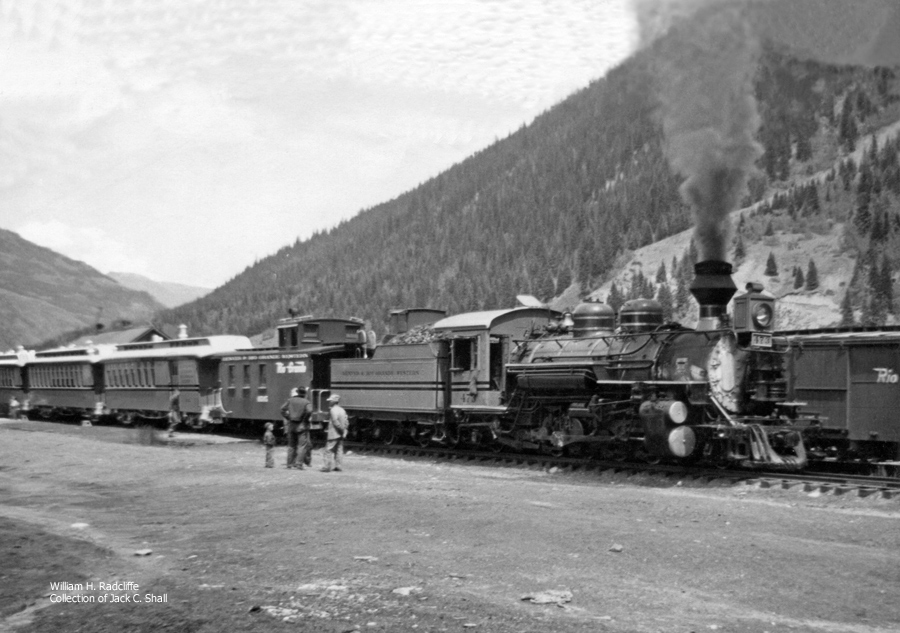
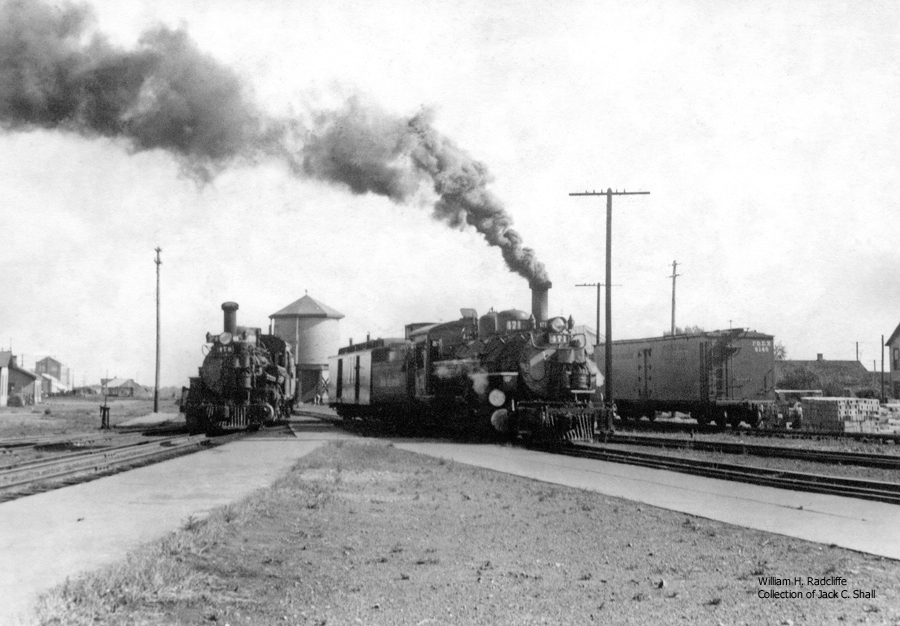
In July of 1950 Mr. Radcliffe spotted D&RGW 2-8-2 locomotive #473 with it’s train in Silverton, Colorado. The #473 is another of the class K-28 locomotives built by Alco in 1923. She is still in service today with the Durango & Silverton Railroad.
In the late 1940s Hollywood noticed this locomotive and it was featured in several movies. In an unfortunate attempt to make it look older than she was, she was adorned with a fake “diamond” stack, and a box headlight (an attempt to make it appear as a kerosene light). They also applied what became known as the “Bumblebee” paint scheme. The locomotive cab and the tender were yellow with black stripes. The headlight was yellow, and the smokebox and cylinder head covers were aluminum.
The train appears to be ready for it’s run, with the tender piled high with coal. It looks like a man and his young son have engaged the engineer and fireman in conversation prior to their trip.
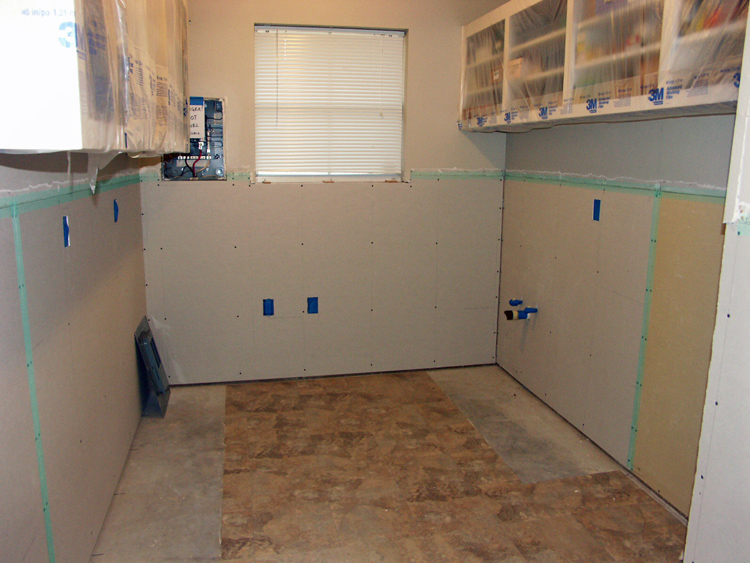
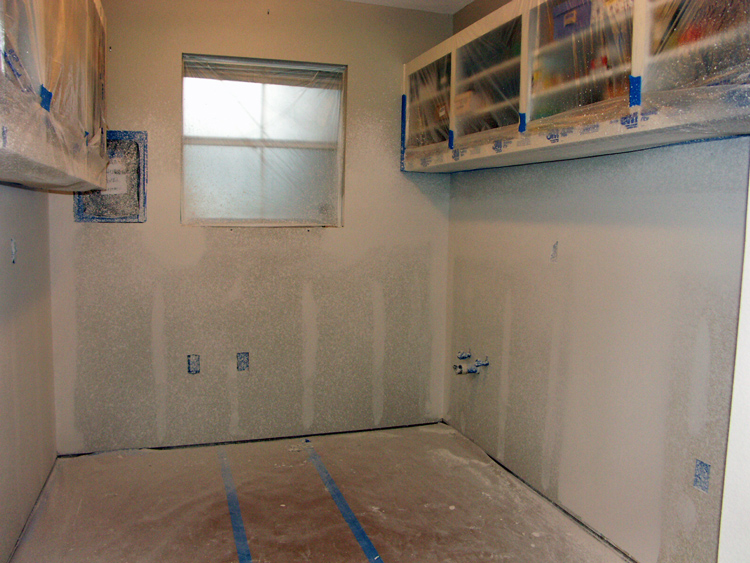
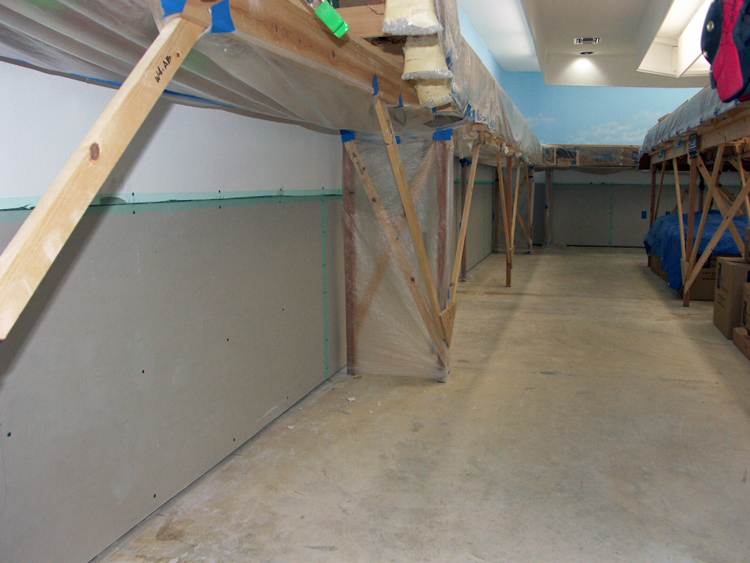
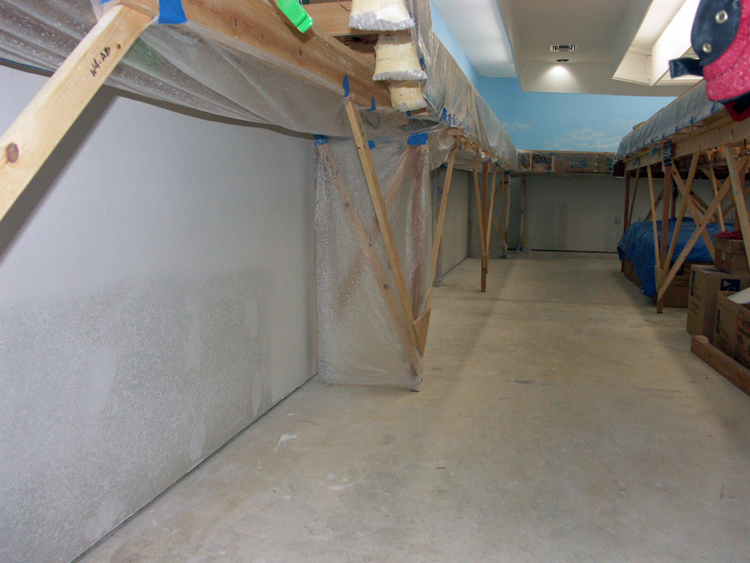
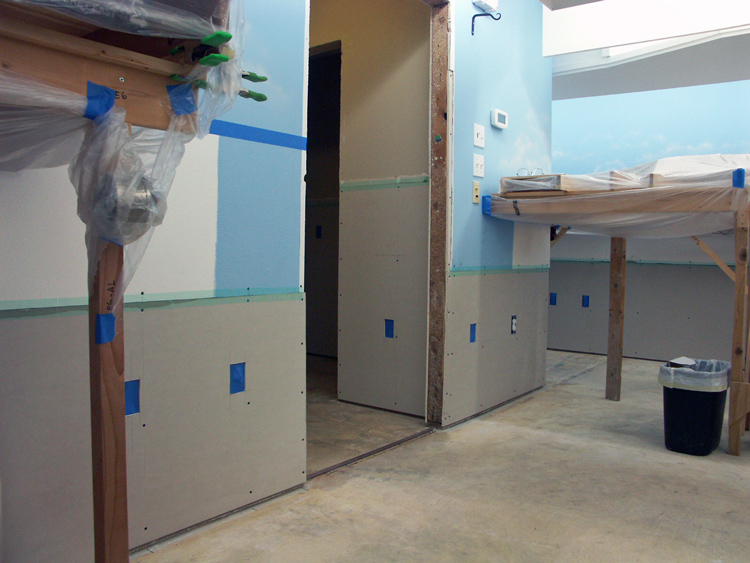
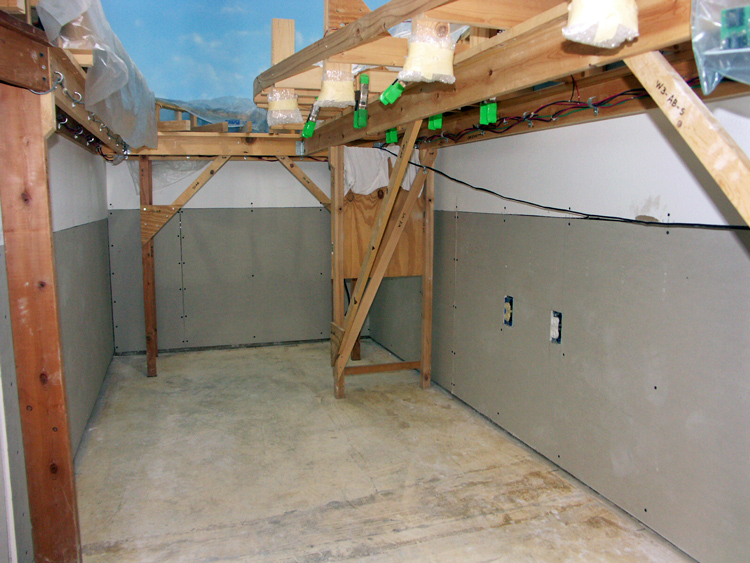
A major milestone has been reached, with the drywall installation and finishing completed! In my last couple updates I showed hanging the drywall with the help of my (now) skilled helpers, Wayne Robichaux and Ron Findley. For the finishing, which included taping, floating and texturing (to match the upper half of the walls), I surrendered to a professional. I had spoken with a few pros several years ago, and none were interested in the job because of the extra difficulty of working below the train layout benchwork, and all the “special requirements” that I had. Fortunately I was able to find a fellow who was willing to undergo this project, and here are a sampling of photos to show the finished result.
A before photo of the shop, with only minimal taping of the joints.And the finished walls of the shop.A before photo of the layout room, with only minimal taping of the joints.And the finished walls of the layout room.Another before photo of the layout room, with only minimal taping of the joints.And the finished walls of this area of the layout room.
In a few more days (after I’m sure the texture is thoroughly dry and hardened), I’ll start the painting process with primer followed by a couple coats of color. At that point, only some trim will be needed to complete the walls.
A pair of D&RGW 2-8-2 steamers are patiently waiting as their trains are prepared for departure. The location is Antonito, Colorado and the date is August 10th of 1940. The train at left, headed up by the #470, is the San Juan. At right, locomotive #471 is in charge of a mixed train (both passenger and freight) that is headed for Santa Fe, New Mexico. Antonito is where the branch to Santa Fe leaves the Rio Grande’s mainline.
Both of these locomotives are a class K-28, and were built by Alco Schenectady in 1923. The K-28s are easy to identify with their cross compound air pumps mounted on the front of their smokeboxes. Both of these locomotives would be sent to Alaska for service on the White Pass & Yukon railroad, this soon after the entry of the United States into WWII.
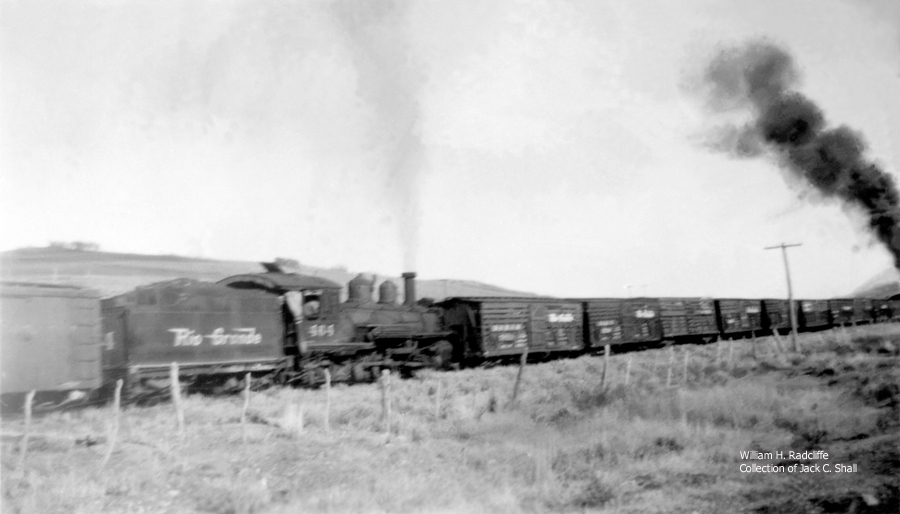
D&RGW 2-8-2 locomotive #464, another of the K-27 Mudhens, is helping a train of cattle cars get over the mountains. In this slightly out-of-focus view, we see the train on it’s journey between Placerville and Dallas Divide, Colorado. This image was recorded by Mr. Radcliffe on October 8, 1950.
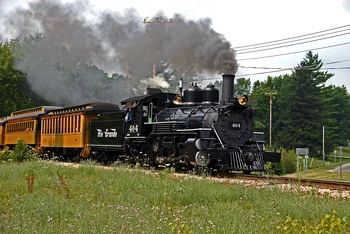
The #464 was built by the Baldwin Locomotive Works of Philadelphia, Pennsylvania in 1903, and she still exists. Withdrawn from service in August of 1957, she was officially retired from the Rio Grande in 1962. According to the Locomotive Wiki, in 1973 she went to the Knott’s Berry Farm amusement park in Buena Park, California, but wasn’t successful there as it had trouble negotiating the tight curves. In 1981 she was sold to the Huckleberry Railroad in Genesee Township, Michigan and underwent restoration in 1989. She hauled tourist excursion trains there until being taken out of service in late 2019. #464 is currently awaiting a future overhaul. The photo below is from the Locomotive Wiki website.
D&RGW #464 running on the Huckleberry Railroad
Black and white image by William H. Radcliffe, collection of Jack C. Shall
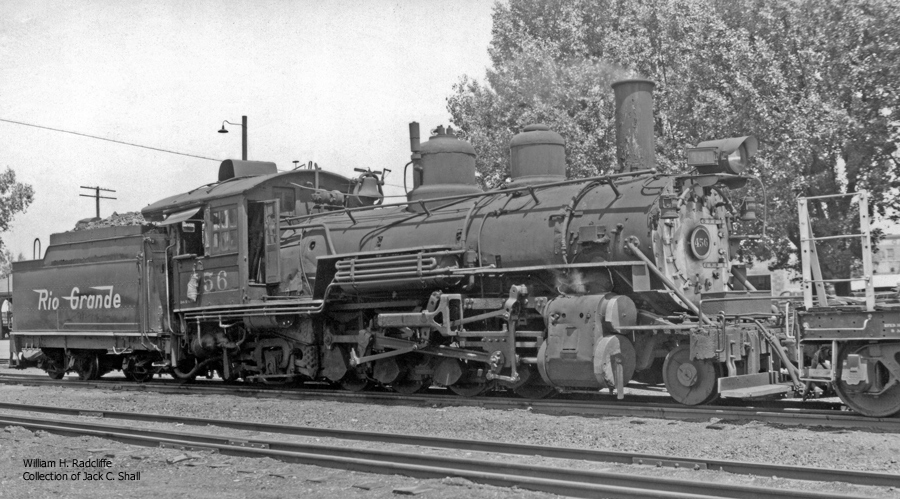
D&RGW 2-8-2 locomotive #456 is simmering quietly waiting for it’s next assignment. She’s a class K-27 locomotive which were affectionately known as “Mudhens”. She was built by Baldwin in 1903. The date and location of this image are unknown.
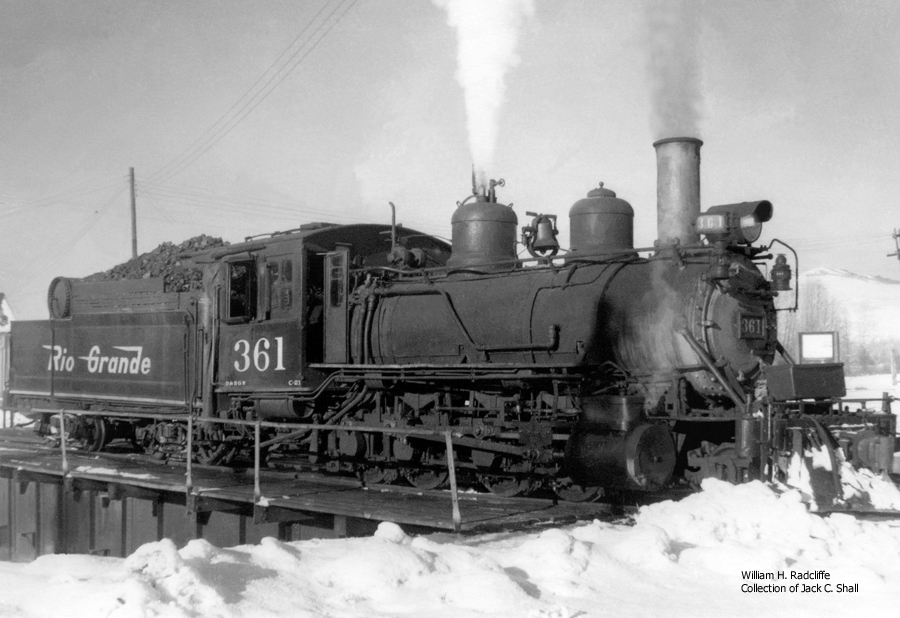
Mr. Radcliffe recorded this view of D&RGW 2-8-0 #361 on the turntable at Gunnison, Colorado on a winter day in December of 1950. We’ve seen several scenes of this locomotive in action over the years, and this final portrait shows her up close. It appears she’s ready for another crawl over the mountains, with the tender piled high with coal and the safety valve lifted, revealing that the steam pressure is up. She won’t be long for this world though as she was scrapped in 1951.
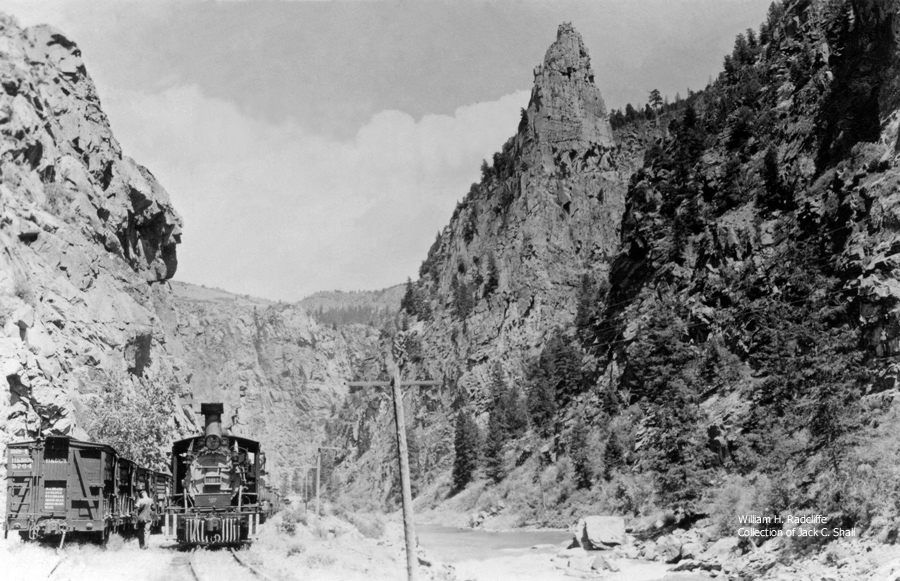
A freight train headed up by D&RGW 2-8-0 locomotive #361 has paused at the siding located in the Black Canyon of the Gunnison located at Curecanti, Colorado. She’s flying white flags indicating that the train is an extra (not a scheduled train). A crewman is on the ground at left, likely the head-end brakeman checking his switch list, while the engineer and fireman keep watch toward the rear of the train from their positions in the cab. It appears that they may be picking up some of those cars in the siding.
There isn’t much room in this rocky canyon, and that’s an impressive spire seen at right. It’s amazing that men were able to penetrate this terrain to lay the track for the trains to cross the mountains.
Photograph recorded in 1940, William H. Radcliffe, collection of Jack C. Shall
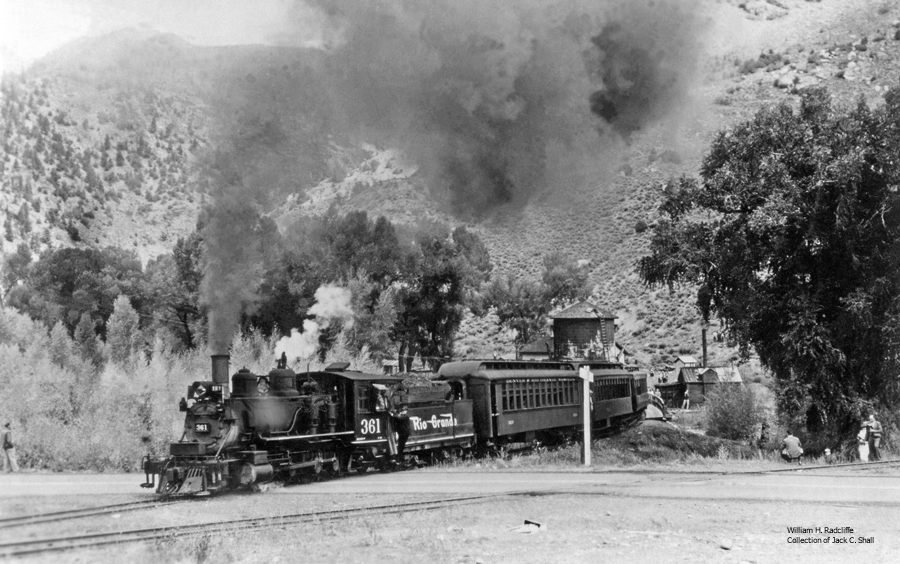
In what appears to be a photo run-by, Rio Grande locomotive #361 charges over a crossing with a passenger train. Note the “rail fans” stationed around the photo, with cameras to capture the event. Also note that most are in suits, and the lady has on her finest white.
We’re in Cimarron, Colorado, and the year is 1946.
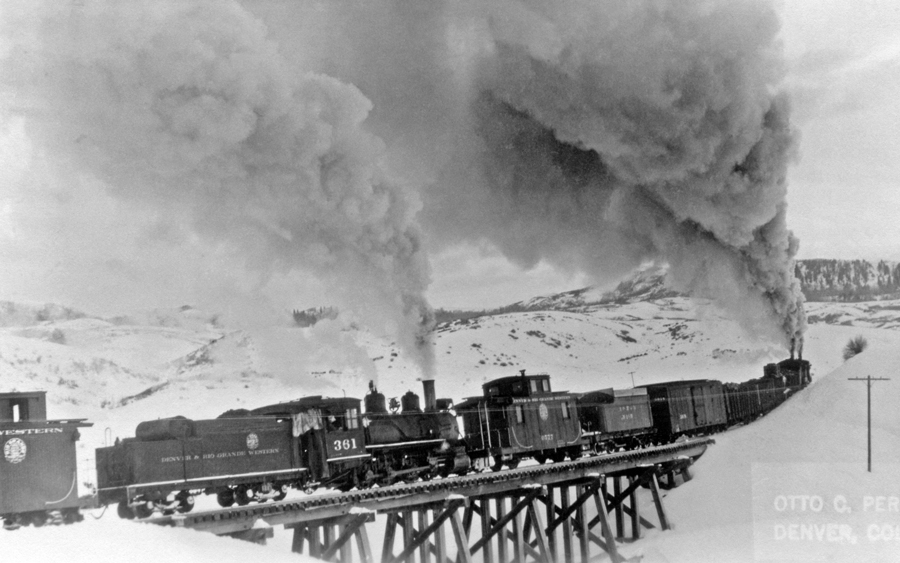
On a cold winter’s day Otto C. Perry captured this scene of a D&RGW freight train in its attempt to get over the mountainous line. We’re on the east side of Cerro Summit and the two locomotives on the head of the train aren’t enough power. Locomotive #361 is lending a hand on the rear, and the trio is managing to struggle up the hill.
D&RGW 2-8-0 locomotive #361 is a Class C-21, built in 1900 by Baldwin. She was originally Crystal River Railroad #102, and she was scrapped in 1951.
The date of the photo is unknown. Former collection of William H. Radcliffe, collection of Jack C. Shall
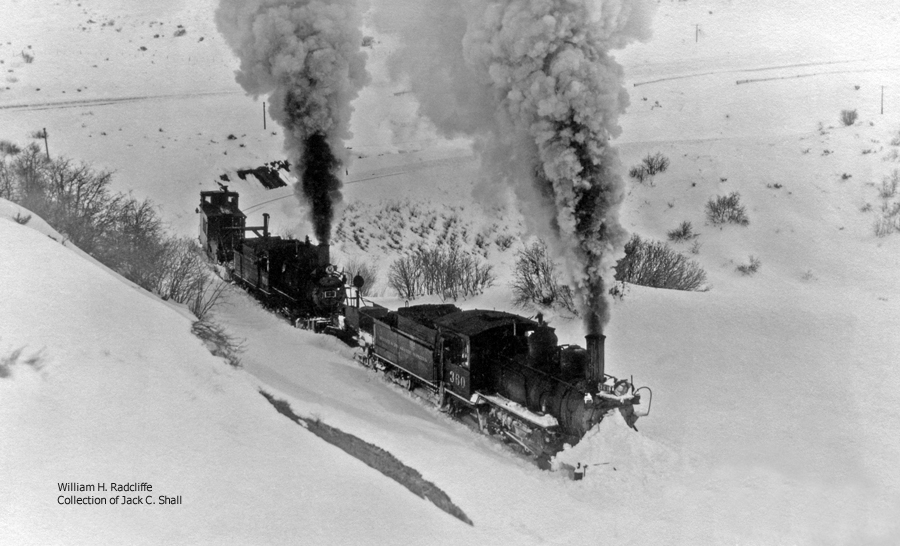
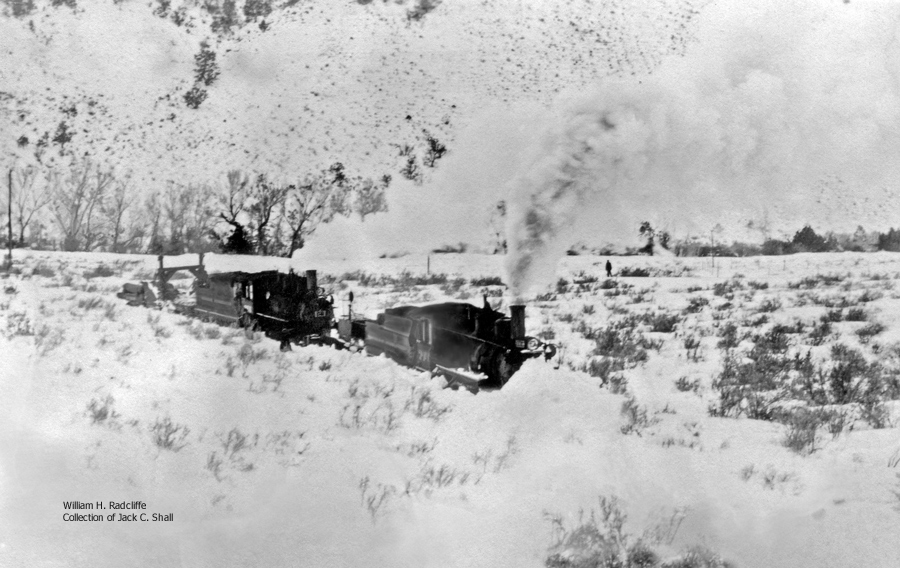
Rio Grande steamers #360 and #361 are double headed today for the plow train. The 360 handles the snow over the track, and the spreader behind each locomotive adds a bit of clearance, and moves the snow a bit further away. Hopefully the conductor has some hot coffee sitting on the stove in the caboose, ready for the crew when they take a break.
Mr. Radcliffe penned that these scenes are at Cedar Creek, Colorado, but the date wasn’t indicated. I think it is likely 1939.
In the view below, we’ve lost the caboose! I wonder if the fellow in the distance at right is looking for it?
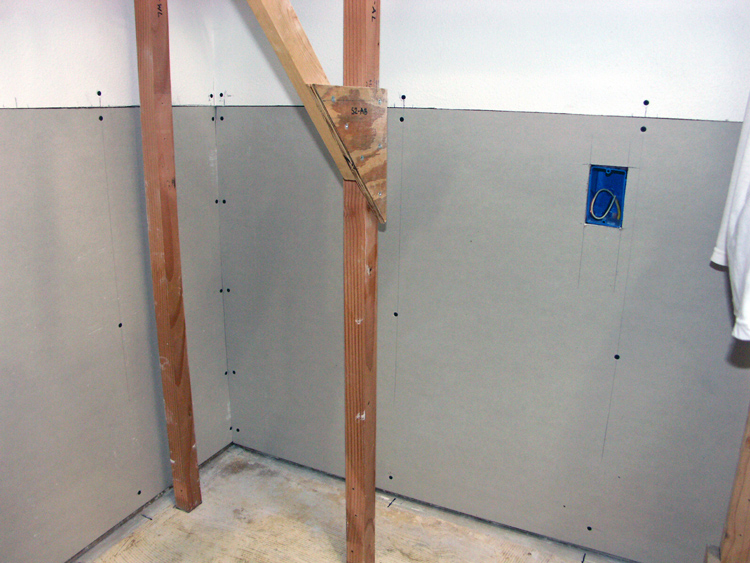
A milestone was reached on the Louisiana Central Railroad this week . . . the last sheet of drywall has been screwed to the walls! It was quite an adventure for this rookie and his able-bodied assistants (who were also rookies). But we got ‘er done! It’s not pretty, and there are a lot of gaps here and there, but it’s up, and it’ll stay that way.
The last 8 foot sheet of drywall was split in two. The first panel is at the far end of this alcove, extending from the seam near the left leg, to the corner at right (virtually blocked in this view by the plywood “panel” on the leg-set). Most of the bracing has been temporarily removed from the leg-sets adjacent to the walls.And here is the rest of the view. The first panel is at left, the second panel extending from the corner, right about ten inches past the photo edge. That electrical box was the last hole to be cut into drywall (whew!).
The next major step is the taping, floating and texturing of the drywall to match the upper part of the room. But first, there is plenty of preparation work to do. I have to tidy up and tape down all the plastic protecting the top of the layout. I also want to wrap all important things below the layout surface such as Tortoise switch motors, wiring junction points, throttle plug-ins, etc. I hope to avoid drywall dust getting onto and into these things. I am also considering wrapping all the leg sets to avoid spraying drywall texture on those as well. And finally, I want to eliminate as much “clutter” under the layout and aisles as possible to make access better, and to avoid the possibility of having everything covered in drywall dust.
I also have the restroom lavatory’s vanity “under construction” (it’s a kit, and I’m modifying and strengthening it). I hope to have it ready to slip into place as soon as the finishing is complete in the restroom.
There’s plenty left to do, but the first major milestone is complete! My thanks again to Wayne and Ron for their assistance in getting to this point.
For those new to the blog, you can see the post Rising From the Ashes (Part Deux) for a starting point to read the story behind this work.
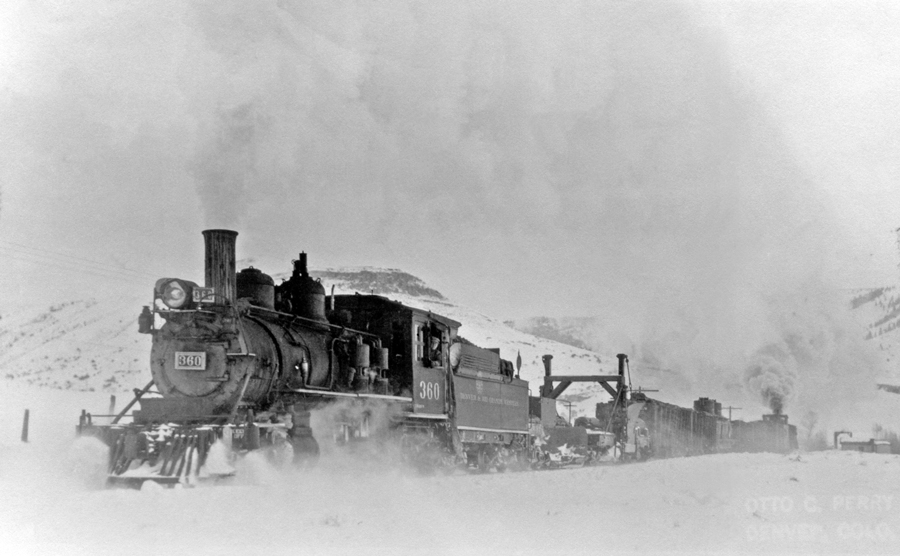
D&RGW Consolidation #360 is seen here heading up a line clearing train during the winter snow season. Note the spreader behind the locomotive, used to plow and clear snow away from the track. That looks like a rotary plow at the very end of the train, ready with a head of steam. The crew will have to re-order it to the head of the train once they reach the area of deeper snow drifts. They’ll likely have to add another locomotive to the consist at that time.
Otto C. Perry recorded this image somewhere near Sapinero, Colorado at an unknown date. Note the different style of lettering on it’s tender compared to the “modern” Rio Grande lettering she sported in 1948 which we saw in last week’s post.
Former collection of William H. Radcliffe, collection of Jack C. Shall