I.C. Freight Depot, Chicago

A view of the Illinois Central’s South Water Street freight depot in Chicago, Illinois. Jack Delano recorded this facility on a beautiful spring day in May of 1943. It’s 11:26 in the morning according to the clock on the iconic neon Pabst Blue Ribbon sign looming above.

Note the blue flags on each cut of cars, along with a carman at right. At left those appear to be blocks of ice in a trough, and behind that one can spot the roofs of a few passenger cars (commuter cars or express?). Studying the boxcars themselves, one can easily see the evolution of this workhorse as they grew larger and larger over the years.

ICRR Freight Depot - Chicago, Ill.

Cleaning the Headlight

Jack Delano has continued his trek into the west, reaching Needles, California. And here he has captured this image of Electrician B. Fitzgerald cleaning the headlight on AT&SF steamer #3891.

The date is March of 1943, and all locomotives operating west of Needles were equipped with hooded headlights in accordance with the wartime blackout regulations. Sharp-eyed readers may have spied the hood on the Santa Fe streamliner diesel locomotive just a few posts back.

Cleaning the Headlight, ATSF #3891

Snatching the Orders

In the days of written train orders, a passing train could, under certain conditions, be passed orders as it rolled by a station. The operator would write out a couple sets of orders, then attach them to a wye shaped affair on the end of a handle, or to a wooden hoop as shown in the photos below. These order hoops could either be held up to the crew to snatch as the train rolled by, or could be attached to a train order post. In either case, the operator would alert the crew that they had train orders to receive by the use of a train order signal, or “board”.

Jack Delano was visiting the Atchison, Topeka and Santa Fe Railway back in March of 1943, and he recorded the ritual of the passing of orders to a freight train in Isleta, New Mexico as it was rumbling by. The first photo shows the train orders attached to their hoops, and ready for the approaching train . . . the actual orders can be seen tied to the end of the hoop where it joins the shaft.

ATSF Train Orders - Iseta, New Mexico

Here we see the fireman of the steamer leaning out of his window, and he is capturing the order hoop with his arm. He’ll immediately give a copy of the orders to the engineer.

Fireman Catching the Hoop

And now the conductor snatches up the remaining lower hoop with it’s orders. He and the brakeman will each have their copy.

Conductor Catching the Hoop

Nowadays train crews can receive their orders directly from the dispatcher via radio, and this time-honored way of doing things is virtually extinct.

Servicing the Super Chief

It’s March of 1943, and Jack Delano has ventured westward to visit the Atchison, Topeka and Santa Fe Railway. And here he has captured their streamliner, the “Super Chief”, being serviced at the depot in Albuquerque, New Mexico. Servicing these diesel streamliners with a large crew takes merely five minutes.

Servicing the AT&SF "Super Chief"

Conductor Boarding His Caboose

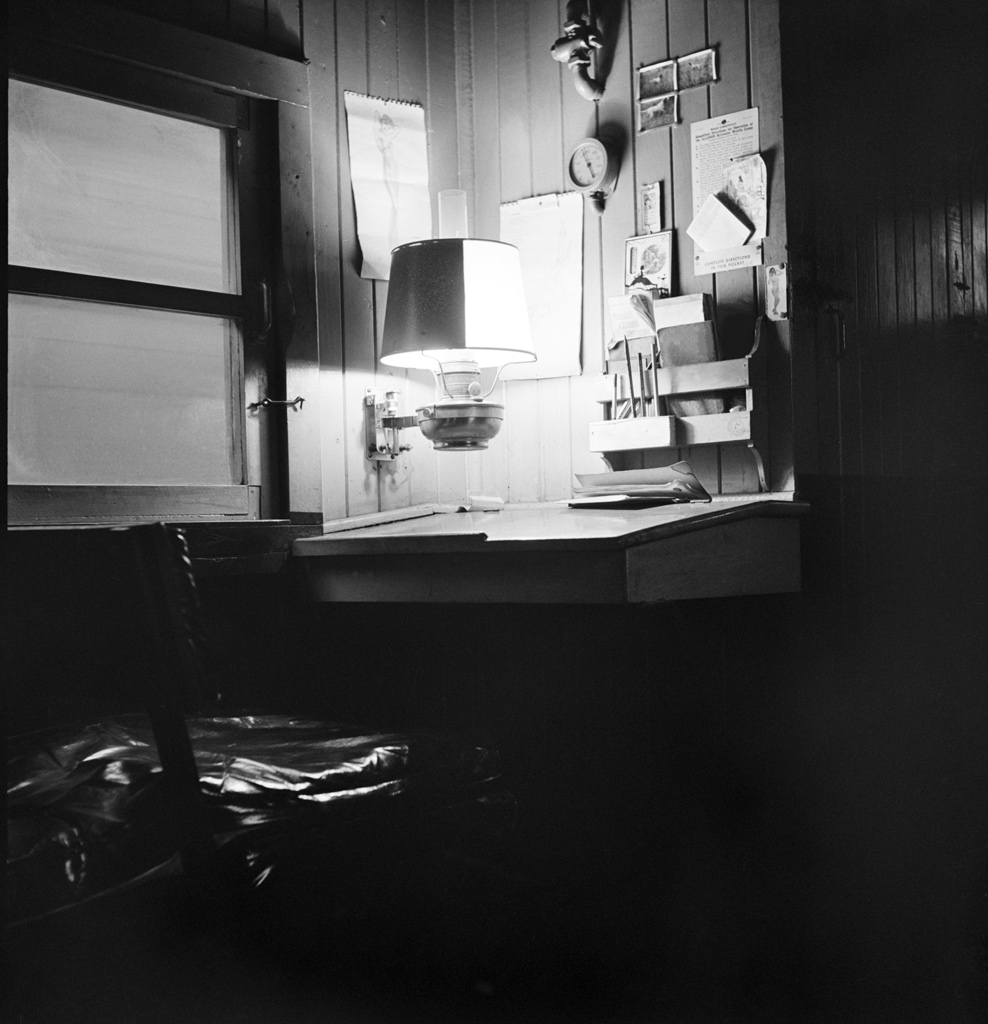
Jack Delano also spent some time visiting the Illinois Central facilities while in Chicago. It’s November of 1942, and Jack spied this conductor hopping aboard his caboose as it was pulling out of a yard track for it’s southward journey. He’ll likely settle in place at his desk, with a cup of hot java handy . . . there is still paper work to do during the ride.

Conductor Boarding Caboose

Smokebox Inspection & Repairs

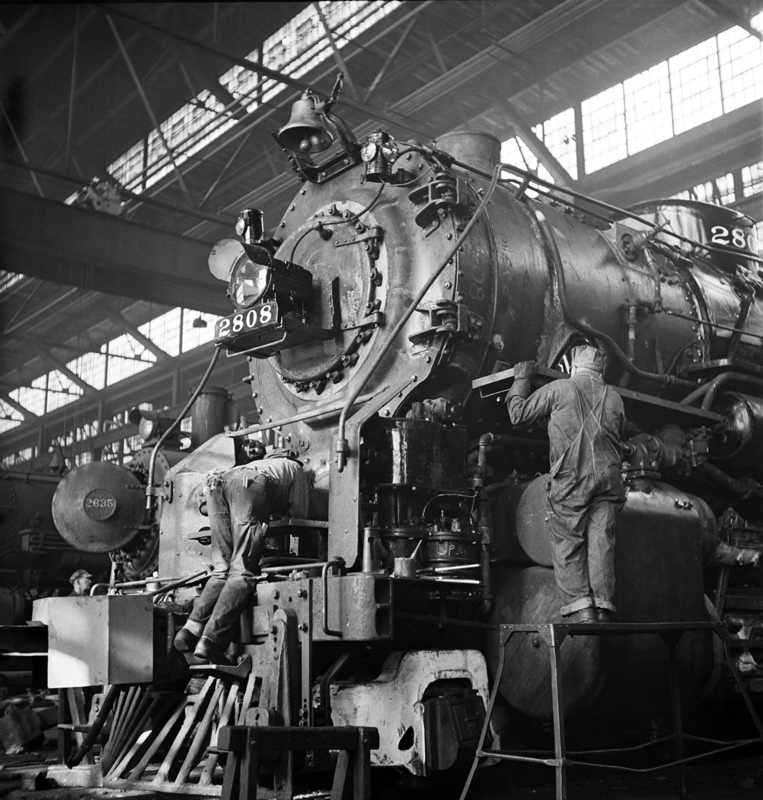
Jack Delano visited the Chicago and North Western railroad’s locomotive backshop in December of 1942. Shown here are a couple workers doing inspection and repairs to a steam locomotive. Opening the smokebox was an important part of the inspection, as it enabled the mechanic to see the tube ends for the boiler, as well as the exhaust components for the steam cylinders. The worker on the left appears to be an electrician performing some work on a class light.

Smokebox Work, C&NW RR -1942

Water, Sand and Fuel

Steam locomotives have a voracious appetite, and they visit the servicing facilities quite often. Here we see a line of the beasts as they replenish their supply of water, sand and coal. This is the Chicago and North Western’s coaling stage in the Proviso yard located in Chicago, Illinois. Photographer Jack Delano captured this image in December of 1942.

C&NW Coaling Stage

Site Improvement

Several things have been going on in the background in recent weeks. You might recall the problem I was having a while back with “Unwelcome Subscribers” to this blog. Happily the fix I implemented seems to have solved that problem, hopefully for good.

Last week I took another step to help provide a bit more security to the site by adding something called Secure Sockets Layer (SSL for short). This is a standard security protocol for establishing encrypted links between a web server and a browser in an online communication. You will likely recognize this by the https prefix on the site web address.

This changes the blog address (as well as the primary Louisiana Central website address) by adding that “s” to the http. If you use your old link to the site, you should be automatically re-directed to the new address. However I’d recommend that you update your link to the new one. I find that the new link will get you there a second or two faster.

In my testing last week I think I got the bugs squashed, but if you happen to encounter something else, please let me know.

In other news, the 7th annual Train Day at the Library event took place yesterday at the Jones Creek Library over in Baton Rouge. I had the privilege of assisting with the organization of the show this year, and we were rewarded with a record attendance. To be sure, nothing that I did caused that . . . I give all that credit to the absolutely gorgeous day we had, plus the reputation that the show has been building on for the six prior years.

Though not aimed at hard-core railfans and model railroaders (the general public is the targeted audience), the show does draw in many of those folks, and that’s good because I think it has helped to entice more actual display participants to the event. The library has also been thrilled with the attendance, and continues to request the show each year. Hopefully, that will continue.

The U.P. “George Bush 41”

Word was floating around that the Union Pacific’s #4141 was parked over at the U.P. yard in Addis, Louisiana today. This is the locomotive that pulled the funeral train of the late President George H. W. Bush to Texas during his recent funeral. Naturally I felt compelled to investigate, so my friend Ron Findley and I headed over across the Mississippi River late this morning. Arriving in Addis, we found the prize, along with locomotive #1943, the “Spirit of the Union Pacific”.

Here’s the U.P. #4141, the “George Bush 41” parked at the edge of the yard for all to see:

UP #4141 "George Bush 41"

This locomotive is an Electro-Motive SD70ACe, and it was manufactured in Canada in June, 2005. Below is a close-up view of the cab. The Bush Presidential Library plaque is seen on the side of the hood.

UP #4141 "George Bush 41" Cab

The weather in this area has been terrible lately, with thunderstorms and such almost daily. But today we were rewarded with sun and beautiful blue skies . . . perfect weather for a bit of railfanning.

The 4141 was paired with another interesting locomotive, an SD70AH #1943, and it’s named “Spirit of the Union Pacific”. This locomotive pays tribute to our military.

UP #1943 "Spirit of the Union Pacific"

And below is a close-up view of the rear of the 1943. Note the POW-MIA remembrance.

UP #1943 - POW*MIA

This pair of locomotives is indeed an impressive sight, and I’m thrilled that we were fortunate to see them. Even though the U.P. has published that the locomotives are touring their system for their employees to view, they were very hospitable to the crowd of “civilians” that encroached upon their property today.