Progress thru Willis

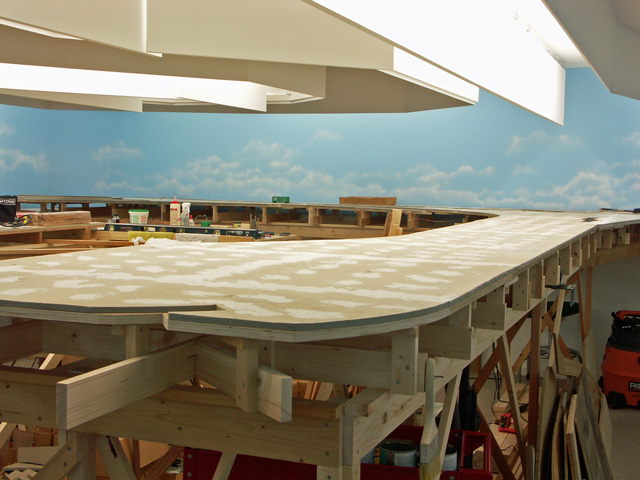
I thought I’d post a little update on the layout construction.  The staging yard trackage on the (railroad) west end of the layout is complete including wiring.  I’ve been working along the north wall of the train room these last several weeks (the area along the right side of the layout plan).  This area is the City of Willis and will have a business district along the wall (those buildings will conceal some of the hidden Louisiana Central staging trackage).  The Illinois Central also makes it’s entry into the layout here with the mainline passing through, along with a short passing siding and the interchange spur with the Louisiana Central.  I’m using sheets of plywood topped with Homasote along this wall and most of it has been installed.  I’ve installed some of the raised roadbed coming out of the IC staging yard and through the town.  I’ve one more odd-shaped piece of tabletop to install before completing that.  From there, the IC track will disappear behind an industry building and head into the hidden staging at the east end of the line.

I’ve also starting laying the tabletop sub-roadbed into the Willis yard of the Louisiana Central.  This is the peninsula coming off the benchwork along that aforementioned wall.  I’ll probably go ahead and put in the tabletop for the entire Willis yard now so that I can start working with that area.

Generally, in yard and town areas I’ll be using the plywood/Homasote tabletop surface.  In mainline areas between towns, I’ll be using just roadbed wide sub-roadbed.  I still haven’t decided what method I’ll use.  I really wanted to use spline sub-roadbed for all these areas, however since I’m usually working alone, it might be easier to simply cut out plywood sub-roadbed and top that with my Homasote roadbed.  Of course that greatly increases the cost (relative to the spline sub-roadbed), what with having to purchase so much plywood, and there is always a huge amount of waste when using this method.  But that method is much easier, I think, for one person to cut and install.

Anyway, things are beginning to take shape.  I’ll probably post a couple more photos on the website in a few weeks.  Most pictures that I post now will be after I actually get the track laid in an area.

If you have any questions about anything, please feel free to comment.

-Jack

Remembering Shawn Levy

I’m sure most of you reading this have heard that Shawn recently passed away after a brief bout with cancer.  I last saw Shawn while he was undergoing diagnosis over at the North Oaks Hospital in Hammond.  I visited with him for a couple hours and although I could see he was exhausted, he was still his usual upbeat self.  In a couple email exchanges after that (the most recent was a week or so before his passing), he had a positive attitude and didn’t even hint that this cancer was a real problem.  He was just being Shawn . . . ever optimistic.

So it was with great surprise that I received the message of his passing.  On the one hand I suppose that I should have seen it as almost inevitable, but yet with Shawn, you just can’t make that assumption as his spirit was contagious.  His loss weighs heavily on me.

For several days after his death I read a dozen or so posts on the LRMRG Yahoo Forum, and I’ve received quite a few emails about this also.  One thing that I repeatedly read was the writer’s claim that Shawn was such a close friend; in fact, many of the writers felt that their friendship with Shawn was perhaps special; closer than those other folks around him.

Then it suddenly hit me.  They were special and close to Shawn, each and every one of them.  That’s because Shawn had a way of making each person he spent time with feel that he considered them a special friend.  He would talk to you one-on-one.  He would spend time with you and listen to your stories and viewpoints.  He would relate to you and always seemed to have something in common with you.  He was a bright, gifted, funny and outgoing individual, but he never portrayed himself as superior.  It was easy to be a close friend to Shawn because he made you feel that he considered you a very close friend.

So as it turns out, everyone was accurate in what they said.

Rest in peace Shawn, my good friend.

-Jack

Control and Operation

Fellow modeler Bill Williams and I have discussed these topics, but I’ve not said much about them with others.  So I thought I would share some of my plans and ideas with the rest of you folks.

The Louisiana Central will be a somewhat laid-back type of operation.  There won’t be a parade of fast-running passenger trains or long freights running up and down the mainline such as Lou Schultz has on his C&O layout.  Rather, our operation will be closer to what you see on the Greenbrier subdivision at Lou’s.  There will be more trains than on the Greenbrier, but the atmosphere will be similar.

In overall length, the LCRR will be about the same as the Greenbrier branch, but there will only be half as many towns (five towns actually modeled), and there will be the Spencer logging operation, which will be much more involved than the Mower operation at Cass on Lou’s pike.

The railroad is designed for a rather small crew, two to -maybe- five folks at best.

I’ll be using a Lenz DCC system for train control and all track switches will be powered by Tortoise switch motors.  The Tortoises will be controlled via toggles located on the fascia (nope, I’m not interested in controlling them with my throttle).

The line will be dark territory; the only signals will be near the Little River bridge.  Here the Spencer Lumber Company has trackage rights on the Louisiana Central for just enough distance to get across the river.  The signals will be tied to the mainline switches at either side of the river where the Spencer line joins and leaves the LC main.

Primary operating authority will be by timetable and train orders.  Actually, we’ll be using a “simplified” version of this, with a minimal amount of paperwork.

I plan to generate traffic with a home-brew software program that I’ve been working on over the years.  The program is based on industries needing cars to move product and will generate waybills for each car at the start of each session.  Each waybill will contain only the information pertinent to the car’s movement for that particular session, so it should be easy using them.

My general philosophy is to keep things relatively simple.  I’m not adverse to computers connected to railroad functions and operations, but don’t feel compelled to use the computer for everything possible.

There is so much more to all this than what I’ve put forth here.  If anyone is interested in more detail than what I’ve written or wants to discuss other aspects, just post a comment and I’ll be glad to expand on it.

-Jack

“How do I comment on a post?”

This is a question I’ve been asked twice in the past week.  And I concede that WordPress (the software that this blog uses) is not particularly intuitive in that regard.

If you wish to comment on a post, click the Comment word at the bottom of the post.  IMHO this is why it isn’t intuitive.  At times the “button” will say No Comments, and at other times it’ll be something like 1 Comment or 2 Comments (or however many comments exist for that post).

Click it and you’ll come to the log in link, or if there are already some comments, go to the bottom and you’ll see the prompt to the log in link there.  Once you get logged in, you can comment to your hearts content.  Also, once logged in, you can comment on any other post without additional hassle.

The reason for all this is to help control idiots, spam and bots.  That’s the way the software is set up and I have no control over that.

So, comment away folks.  Really, it took far more time for you to read this than to log in and comment.

-Jack

P.S.  I got a chuckle when I was about to post this and the WordPress spell checker kicked in.  The word that was flagged as misspelled was WordPress.      A Big Grrin

So is the Blog Working?

A few days ago my web hosting site advised me that the blogging software was being updated.  I suppose that is good, however as I examined the various parts of the blog, I noticed that some things had changed, some things had simply disappeared and my preferences were shot to hell.  I think I have most everything put back in order now.

One of the big things that changed was the subscription plug-in.  Most folks know that you must first register with the blog (a one-time thing) to be able to post comments (that’s to help control spammers).  However, subscribing is totally optional.  Subscribing simply means that you’ll receive an email whenever I make a new post to the blog advising you that there is fresh material for you to enjoy, laugh at, sneer at, or swear at (your choice).

It is unclear to me whether the subscription list is intact after this transition.  If you receive a notice of this post and you’re not presently a subscriber (and don’t wish to be), please feel free to unsubscribe -or- drop me a line and I’ll get your name off the list.

Sorry if this inconveniences anyone.

The weekend is nearly here, and I’ve already got my plans in place for the next construction on the layout!

-Jack

More Track Going Down

Layout progress continues at a slow, but indeed at a steady pace.  As you’ve read in previous posts, I’m starting with all of the (mostly) hidden staging track as it’s the furthest away from the aisle and the most difficult to work with.  The Louisiana Central trackage is complete, including wiring, and is operational, sans a switch machine at the entry to the area.  This past weekend saw the start of trackage for the Illinois Central staging area.  I’ve got enough roadbed completed to do all of the staging track at that end of the layout.

I’ve run the power bus along with the track I’ve been installing, and tapping the bus along the way to feed the track as I progress.  I have the bus temporarily connected to the command station/booster for testing purposes.  Last week I installed a backboard and shelf for one of the three planned booster districts.  I’ll be using DCC Specialties PSX circuit breakers to further sub-divide each power district, and I’ve installed the three C/Bs for the district I’m working in.  I still have to run the interconnecting wiring between the booster and the C/Bs, and then connect the power buses.  When that is done, the wiring for the entire sub-district will be complete, and the other sub-districts can be connected as they’re run.

I don’t generally get any work done on the layout during the work week, however I thought maybe I could devote a bit of time in the evenings to working simple projects, like building car kits and such.  I have an old roll-top desk in my living room that is unused, in fact it was my hobby workbench before my permanent bench was completed out in the train building.  I’ve decided to reactivate the old desk as a secondary workbench, and have recently started to restock it with common tools and supplies….whatever is needed for the “simple” projects.  I have read several times that doing small tasks like that can have a significant impact on overall progress, so I’m going to give it a shot.

As I’ve mentioned before, I operate regularly on Lou Schultz’s C&O Railroad over in Covington.  I’m sure most of you know that Lou has been going through quite an ordeal with a health issue for the past month or so.  Please keep him in your prayers to help get him through this.

-Jack

An Historic Event

An Historic Event occurred this day on the Louisiana Central Railroad when the first trains rolled across the line.

The first train to traverse the rails was powered by engine number 5582, an ALCO RSD-5  recently purchased from the C&O Railroad.  She hauled a short train of assorted box cars over the line.  She was later followed by the railroad’s number 83, an ancient 4-4-0,  hauling the road’s ex-commuter day coach.  The car was packed with the “brass”, many railroad employees and a few railfans that managed to finagle a ride.  All went well during the festivities with nary an incident.  You can witness the event via these photos.

Full disclosure:  well, they rolled through the staging area for the railroad which is as far as the line has gotten at this point.  However, this staging area represents the line between Willis and Bude, Mississippi, and that’s a long way!  But the important thing is that trains rolled under their own power.

-Jack

Track Going In

Well January and early February were just chock full of railroading events.  I think there are a couple more things coming, the Louisiana Rail Run for one.  Now that things are slowing down a bit, I’ve had more time to put in on the layout.

I have installed the hidden staging track for the Louisiana Central.  Last week it became apparent that I was short on rail joiners for the Atlas code 83 track that I’m using in the staging areas.  Due to production problems in China, Atlas track and accessories are extremely hard to come by presently.  Art Houston stepped up to the plate and mailed a bunch of joiners to me so that track laying can continue unimpeded.  Thanks Art!

I also soldered the electrical feeders to the installed track and pulled the track bus wiring below the area.  I’ll be hooking up the feeders to the track bus this weekend.  I’m going to sub-divide my booster districts into several smaller districts fed through DCC Specialties PSX series circuit breakers.  I have three on hand presently, so I can complete the wiring to this track.  I hope to do that this weekend so that I can actually run a train!

Next trackwork will be the Illinois Central hidden staging track.  The sub-roadbed is already done, so track laying will come soon.

-Jack

January – It’s Been a Busy Month

January has been a great month for railroading.  I’ve been attending events for the past three weekends, and have yet another this Saturday coming.

The Crescent City Model Railroad Club in New Orleans held their annual open house early in the month.  They’re in the process of converting their layout to DCC operation, and since the layout would be down, they decided to remodel several major sections.  Wayne Robichaux and I went down to inspect their progress and also to hit the few remaining hobby shops in the area.  Unfortunately there doesn’t seem to be a single decent model railroad shop left in south Louisiana.  A few shops we hit had nice selections of Lionel and similar, but us “scale” guys are left in the cold.

The following weekend Ron Findley and I drove over to Hattiesburg, Mississippi to attend the annual banquet of the Mississippi Great Southern Chapter of the NRHS.  Those folks put on a fine get-together.  There were several vendors displaying their wares, the dinner was good, and the guest speaker was quite interesting.  It was good seeing old friends and acquaintances over there.

This past Saturday several of us drove over to Covington to operate on Lou Schultz’s C&O layout.  Overall the session went well, there were plenty of snacks to chow down on, and as usual, it was good to meet with fellow model railroaders.

And finally, this Saturday, January 26th, there will be the Train Day at the Library event at one of the local libraries here in Baton Rouge.  There will be numerous displays about railroading (prototype and modeling), possibly a display layout, and many slide presentations by Forrest Becht, a noted railfan and photographer.

Oh, BTW . . . I actually managed to get a bit of track laid on the Louisiana Central.  I’ve been struggling back in the corner of the room it seems forever, but we’re finally getting rail down.  I’m using Atlas code 83 track and switches for my hidden track (which is what I’m laying presently), and I’m not too impressed with the construction of the switches with regards to soldering jumper wires to them.  Soldering rail feeders isn’t too big a deal, but soldering jumpers to the points is!  They’re just formed sheet metal and I found it quite difficult to tack a wire to the lower portion of the point so it would clear wheel flanges.  Despite my efforts, I had to do considerable filing afterwards to clear the NMRA gauge nubs.  And the frog . . . what a pain!  The frog doesn’t accept solder well, but there is a small tab with a hole sticking out to one side of the frog.  I couldn’t find my taps, so drove to a friend’s house for him to tap the holes for me.  Then I screwed a 1-72 screw to each and added a nut to the bottom.  I placed a dab of solder below the nut so it will never come loose, then soldered a jumper to the screw.  Despite the precautions I took (good hot iron with freshly tinned tip, and a fast in and out technique) the thin plastic surrounding the tab melted away and the cast frog on one switch came loose from its mounting in the switch.  Now I need to figure out what kind of adhesive I need to use to adhere metal to slippery plastic so as to permanently reattach the frog on that switch.

That’s about it for now.  My main focus on the layout will be to get track laid, hopefully at a steady rate.  Leave a comment if you have any questions or suggestions.

-Jack

Another Progress Report

Benchwork construction is making slow, but steady progress.  I manage to get more done each weekend.  I’m still working the corner of the room that I wrote about in my last post, but I see the light at the end of the tunnel.  I have the risers and roadbed complete along a 35′ length of layout now, and that will contain about 120 lineal feet of track.  About two-thirds of that will be hidden staging track, and that track is ready to be laid.  This past weekend saw the completion of the roadbed for that, and I’ve drawn the track centerlines out.  I spent Sunday afternoon (after watching the Giants crush the Saints…ouch!) studying the wiring diagrams for the Atlas code 83 switches that I’ll be using in the staging areas.  My intention is to solder a jumper onto every single piece of rail, not depending on rail joiners or pressed joints for electrical continuity.  That will probably be a PITA, but not nearly as much as trying to find open circuits a few years down the road when mechanical connections begin to fail.

I’ve had a couple folks comment about my slow progress.  Well, it’s been quite a few years since I did any layout construction, and even though I know generally what to do, I still feel like (and make the mistakes of) a rookie.  Since I haven’t established myself as a famous model railroading guru, I find that I don’t have legions of volunteers begging for the chance to assist in the construction of the next great model railroad.  Therefore I’m mostly stuck with doing this virtually alone, save for some occasional help from my friend Wayne (he provides those extra hands for ripping lumber and things of that nature).  The result of my inexperience and generally slow nature, and lack of experienced help, is somewhat tepid progress.

But, progress is being made!

After I get some track down, I’ll file another report, and probably post a couple photos on the website.

Merry Christmas to all…

-Jack

It’s Fall …and it’s Railroading Time

We’re getting into my favorite time of the year for model railroading and railfanning.  The temps have come down and the rains have slacked off . . . we’ve had some beautiful days these past several weeks.  Last weekend was the annual open house for the railroad club up in Jackson, Louisiana.  As usual, they had all of their layouts on display and operating.  I don’t think many clubs can boast of having an operating layout in each of the major scales.  And the outdoor operations are fun to watch also.  Their G scale garden railroad is pretty cool, and of course, the operating live steam loop always has some really nice equipment under steam.  I got there about lunch time (and consumed one of their complimentary lunches), but ran out of time before I got to visit all of the layouts.  It appeared to me that they had a nice turnout for the event.

This weekend coming Lou Schultz over in Covington will be having an operating session on his C&O layout.  There is also the annual railroading event over in Meridian, Mississippi this weekend.  It’s too bad that it conflicts with Lou’s session, as I would like to do both.  And the weekend following this will see another operating session down at Art Houston’s layout in Houma.  This is also the time of year that we occasionally have a train show, either in Covington or Gonzales (unfortunately, there is no show scheduled for this year).

It’s also a great time to spend next to the tracks, with the mild days and crisp weather.

I’m still working on my layout, though at a bit of a reduced pace.  As I reported earlier, the basic framework of the benchwork is all but complete.  I’ve turned my attention to the sub-roadbed and risers this past month.  I am working in one corner of the room where several of the tracks going into the hidden staging area will be located.  It turns out that this is a difficult area to lay out and build.  A couple of the tracks at the rear are on curves and are descending at the same time.  They start at different places, but ultimately end up on the same hidden roadbed.  It is challenging to say the least.  I would have rather started in an area of straight, level track to kind of ease into things, but the more I thought about it, the more I realized that it would be much easier in the long run to install this complex area, then build out away from it, than to do it the other way round.

I haven’t posted any pictures lately as I want to wait until I have some track actually spiked down.  Trackwork in place signifies to me that the section is complete, thus ready to photograph.

I have my vacation time coming up later this year, and I hope I am able to use some (most) of it working on the layout.

-Jack

The Spencer Logging Operation

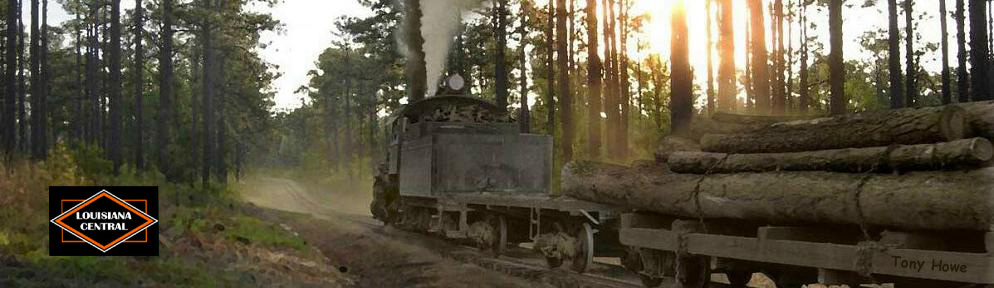
One of the featured industries on the layout will be the logging operation of the Spencer Lumber Company.  Spencer’s mill will be located at the town of Oneida (on one of the layout’s peninsulas), and will be patterned somewhat loosely on the real-life mill of the former Crowell Long Leaf Lumber Company.  The Crowell facility still lives as a museum here in Louisiana and I wrote a little piece about it in the blog post The Southern Forest Heritage Museum back in June of 2011.

The Crowell property has all the pieces in place for one to photograph and study, and while I can’t model the facility literally due to space constraints, it will at least allow me to include the vital infrastructure necessary for a lumber mill.  Once you understand the work-flow and the function of the various buildings, planning a “correct” model should be much easier.

However, the other part of the operation – the actual harvesting of the timber – had me scratching my head.  I have a nice run from the mill up to the logging area, which even includes a double switchback, and I have a loading area at the top.  But the space is so limited, especially in depth, that I just didn’t have any idea how I was going to model any sort of reasonable logging activity.  A few weeks ago I spied a copy of Kalmbach’s book, The Model Railroader’s Guide to Logging Railroads, so I purchased it.  In general it is a nice book, with a good description of all the various facets of the logging industry.  Admittedly if falls far short of being the definitive volume that one needs to pull off such a modeling endeavor; that would take many volumes to accomplish.  However there was one short section in the book that provided me with my salvation.  In short, it was the “reload” operation.  This was a situation where trucks were used to haul the logs out of the woods, and to a reloading point where the logs were transferred from the trucks to the railhead.  This became very common in the later years of railroad logging operations (which I will be modeling in 1964) as trucks and equipment were better able to penetrate into the forest.  In fact, this method often became more economical than re-laying track to all the various cutting sites.  This idea will be perfect for my line.  All I need do is add some kind of loader at the high end (a McGiffert or a Barnhart) and I’ll be in business.

While the logging operation won’t be the biggest traffic generator on the layout, I think it will be the most interesting, and I look forward to actually building it.

-Jack