Second Time’s the Charm

If you are regularly following this blog, you’ll recall the comedy of errors I committed while installing the wiring for the optical detectors a few weeks ago.  I mentioned in that post that I’d decided to rip everything out and start over.

This past weekend I did finish ripping out the old work and I completed the new and improved wiring installation for the phototransistors in the west staging area.  The results were much better than my original efforts.  Armed with the success, I will now repeat the lessons learned over at the east staging area (which is twice the size).

I also have to put in the illumination for all those PT’s.  I’ll be using infrared (IR) LEDs attached to overhead supports, one over each PT.  I have no specs for the IR LEDs that I have, so I’m going to have to assume their characteristics in order to select the current limiting resistors that will be required.  I’ve never worked with IR stuff before, but I’m told that if you look at an IR LED that is turned on through a digital camera, that you can see the light.  I hope that is so, as I think aiming and adjusting will be much more difficult if I can’t even see what I’m trying to do.

Plenty of other things have occurred over the last couple weeks, though mostly things that don’t really show any progress.  I finished installing all the cable hangers for the main cable runs throughout all of the benchwork (a significant task itself).  I finalized what control panels will be required and their locations.  I’ve even started some preliminary drawings for panel layouts.  I’ve coordinated where other things will be on or under the layout’s fascia once it’s installed, particularly the work shelves and throttle plug-ins.  I’ve got the Willis yard ready for track installation now.  I keep a marker board filled with a running list of tasks that need to be done, and I manage to erase a couple each weekend.

I’ll likely be doing wiring for at least several more weeks before moving back to the roadbed and track.  But I figure it’s good to try keeping the electrical and roadbed/track current with each other.

Most of you that are subscribers to this blog are relatively local, so if you’d like to visit to see things for yourself, you’d be more than welcome.  Just drop me a line, and we’ll make it happen.

-Jack

Electrical Wiring…Arrghhh!

Let me start by stating that I don’t consider myself electrically inept.  In fact, I have formal training in the electronics field.  But sometimes you can let a project get the best of you.

Let me back up a bit.  The Louisiana Central will have four staging areas.  On the west end of the layout, there will be a hidden staging track for an Illinois Central train and another for a Texas and Pacific train.  Over on the east side, there will be four staging tracks, two for the Illinois Central and two for the Louisiana Central.  Since the tracks will be hidden from normal viewing angles, I decided to install an optical detection system which will light up LED indicators on panels showing when a train is nearing the end of a track, and also the clearance point at the entrance to the track.  Simple enough.  In researching the task, I found a fellow up in Canada who offers nice, tidy, little circuit boards that will fill the bill perfectly.  All one has to do is install the phototransistors (hereinafter referred to as P.T.s), the infrared LED light sources, and the LED panel indicators.  Bring all the wiring from these devices to the little circuit boards, hook up a wall-wart power supply, and you’re done.

I have procrastinated for months starting this installation.  It wasn’t because I was intimidated by the wiring, rather it was because I just didn’t feel up to the tedium of the task…running all the wire, making the hundreds of wiring connections, fabricating mounting brackets for the devices, making the panels, etc.  The time to do the task is while the staging track is visible and easily accessible.  I don’t want to install any sub-road in front of the staging until that is complete.  Well, that time has come.  Further progress cannot be made at Monterey (the west end of the line) or to the LC mainline, or the Spencer logging operation between Whitcomb and Maynard until this work is done.  So I resolved myself to installing the system at Monterey this past weekend.

Things started out well enough.  I bored holes at the appropriate locations in the track to receive the P.T.s.  They slipped right in and held firm just by the friction in the hole…great!  I planned to use a recycled 25 pair telephone cable (donated by a friend), so I unrolled the cable and stretched it out along the top of the joists adjacent to the staging tracks.  The only way I could think of to splice into the cable at various points was to go ahead and pull open the outer jacket for much of the length of the cable, a task made easy by the little ripping string provided within the cable bundle.  I figured I would wrap electrical tape around the cable every 8 inches or so to keep things together.  So far, so good.

This is where things started going south.  I decided to use the black/white striped wire along with the white/black striped wire in parallel as the common negative wire (using two wires for less resistance and for a margin of “backup safety”).  I selected those and one other cable and soldered them to the pigtail leads from the first P.T.  To insulate the joint I had planned to use small wire nuts which I thought were made for this light gauge wire.  They didn’t work…wouldn’t bite onto the wire.  So I pulled out my Scotch 33+ electrical tape and proceeded to wrap it around the wire nut and wire to hold it all together.  After using what seemed like a yard of tape, I had the joint secure and insulated.  It looked like something from a Chevy Chase movie.  I did the next couple P.T.s like this and finally decided that this was ridiculous.  So I went searching and found an old stash of heat shrink tubing.  I clipped off an inch, slipped it on my next joint and shrunk it down.  Finally, a decent looking insulated joint!

As I progressed, I found that removing about a foot of the outer jacket at the spot where I wanted to make a connection, then forming a loop in the cable, allowed me to easily grab a wire, clip it and solder it to the P.T. pigtail.  When I got to the 7th P.T. down, I noticed my next mistake.  Despite writing all the wire colors down as I used them, out of the 50 wires available to me, I had managed to use the same color twice for two P.T.s.  Rats!  Since I had severed the twice used cable at the 7th connection, I had to go back to the 1st (where the color had initially been used) and select another wire to re-do that connection.  Plus, the pigtail was now a tad too short, so I had to make an extension for it to reach the bundle.

OK, now I have all the P.T.s connected and I have to anchor the cable down.  I performed that task without incident.  But the joy wasn’t to last long.  As I began inserting the P.T.s into their respective holes, when I got down to number 7, I found that the leads weren’t near long enough for it to reach it’s hole.  While connecting the P.T.s the entire cable had shifted on me without my knowledge since I hadn’t anchored it at the beginning.  Arrghhh!  About then, two other realizations hit me.  One, I had attached the cable to the top of the joists.  But now I realized that once the sub-roadbed for the Monterey yard was installed, those cable mounts would be forever inaccessible.  This means that the cable would automatically be in the way of every future thing that would have to be done under the layout and there would be no way to move it.  Realization number two: I had forgotten to run the cable to the indicator panel location.  Aw, geez!  I put the tools down, killed the lights and retired to the house for the night.

Sunday morning I mulled over the entire fiasco while consuming a couple cups of coffee.  I analyzed all that had gone wrong, what was needed to correct the mistakes and what course of action I should take.  I finally decided that the only reasonable thing to do to fix everything was to simply tear out what I had done and start over from scratch.  Painful, yes.  But not nearly as painful as the potential headaches I would face later if I simply tried to patch what I’d already done.  So armed with the knowledge gained, and a renewed hope of success, I headed back out there later that afternoon (after watching the sweet Saints victory over the Texans).

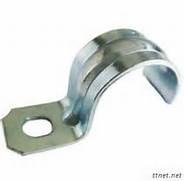
I started where I should have in the beginning…at the indicator panel, then routed the cable over to the back by the staging tracks.  This time I routed the cable below the joists and supported it by the hangers (simple EMT conduit clamps) screwed to the bottom of each joist (screwed is key to easy shifting or removal of the clamp later if need be).  I taped the opened outer jack at each hanger and also between hangers and that has worked nicely to keep things orderly.  I stopped when I reached the first P.T. location; this is where I’ll pick-up at the next work session.  I plan to attach new longer leads to the P.T.s and simply coil the excess length so I have it if I need it later.  The loops I make in the cable will be directly at joists so they may be supported properly rather than drooping down between the joists as they were initially.  And the cable will be anchored as I go so it will stay in place.

I feel much more confident in this latest approach, as I’m trying to think this through much more thoroughly and apply what I’ve learned from the mistakes I’ve already made.

But just in case, wish me luck!

-Jack

Willis Yard Sub-Roadbed Down

The Willis yard sub-roadbed (the tabletop) is installed and after a bit of surfacing work, it will be ready for track.  The surfacing work is primarily sanding and filling around the joints in the Homasote panels.  As I’ve mentioned in other posts, the Homasote sold today isn’t very consistent in it’s thickness and there is invariably a height mismatch when butting panels up to each other.

Benchwork-Willis_Yard-05But the really good thing about getting this area done is the fact that the actual Louisiana Central mainline can now be laid.  Up to this point, the only LC trackage was that in staging and the lead up to the crossing with the Illinois Central.  This is a new milestone in the construction.  In addition, the sub-roadbed can now proceed west of Willis, heading down the backside of the peninsula and up through Maynard.  This will be some real progress when that is done, and it shouldn’t be that far into the future.

In keeping with my preference for construction first at the wall, then progressing toward the aisle, it is near time for me to start thinking about the Spencer logging operation.  The line going up into the woods (between Maynard and Whitcomb) must be constructed before the LC main (which is near the aisle) between those points can be installed.  These next several months will be quite busy.

Wiring is keeping up nicely.  Four of the seven booster districts have been completed; only track feeders have to be added as additional track is laid.  The other three will be required as the track I just wrote about is installed.

I’m also starting to think about the fascia for the layout edge.  While I don’t plan to install it immediately, I do plan to build sections soon after the trackage in an area is essentially completed.  Since all the controls will be mounted on the fascia, it would be nice to have it installed when I start wiring up all those controls so there is a place to put them.

-Jack

A New Look

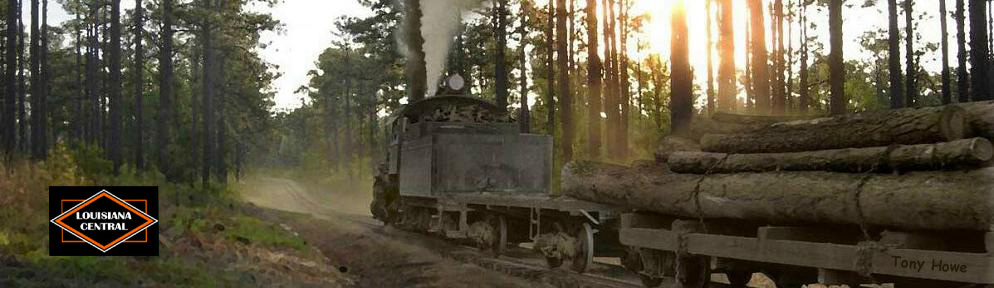
As I think you’ve noticed, the home page here has a bit of a new look. The beautiful logging railroad scene is by Tony Howe, and is used here with his gracious permission. I think it really adds life to the blog, and I hope y’all enjoy it as well. Tony is a prolific rail artist and his work can be seen (and purchased) at his web site Tony Howe Railroad Art.  He and his cohort David Price also have a nice railroad historical website, Mississippi Rails.  Be sure to check it out (where you’ll also see the full version of the logging scene pictured above).

And as usual, my progress update: the layout is moving right along. The Willis yard peninsula is about 80% complete and the track will soon start going down there. The DCC bus wiring is complete for all areas constructed and those near completion. Wayne and I made another lumber run earlier in the week, and today we ripped enough joist, riser and cleat material to carry me for quite awhile.

I still haven’t posted any new photos on the web site, the last being taken in late May. But I really should take a break and shoot a few more. A good bit of work has been completed since the last pictures were posted.

Edit: some new pics have been posted on the website.  Click the link in the header to go there.

-Jack

I.C. Mainline Complete

The Illinois Central mainline has been completed.  I.C. trains can now roll from the west staging yard, through Willis, and into the east staging track.  The passing siding at Willis remains under construction.

The aforementioned siding will utilize code 70 rail (the mainline uses code 83), and is partially installed.  The interchange track with the Louisiana Central branches off of the passing siding and therein lies the hold up.  I’m using Shinohara track and switches for the layout.  Most of my code 83 switches are the newer “DCC Friendly” variety.  However Shinohara has never upgraded their code 70 products to this same standard.  The problem is that the two point rails are always at the same electrical potential, therefore it is easy to short the track if a wheel happens to bridge the gap between the stock rail and the open point.  With regular DC powered layouts, this generally doesn’t present much of a problem.  With DCC layouts however, things are a bit different.  Within milliseconds of a short, the electronic circuit breaker will shut down the district it serves.  If you are using sound decoders in your engines, this results in the decoder resetting and “starting over”.  Very irritating, indeed!

To correct this deficiency, one must rebuild the points such that they are isolated from each other.  In addition, you must isolate the frog.  The latter is simple; merely cut gaps around the frog.  However, the former is quite a chore.  I’ve read about a couple methods to perform the necessary modifications, but haven’t actually done one yet.  Since I need this code 70 switch installed in order to complete the I.C. trackage, the day of reckoning has come.

I’m also ready to push the sub-roadbed (tabletop in this instance) into the Louisiana Central’s Willis yard area.  The plywood and Homasote have already been cut out.  I only have to build the risers and then install everything.  Once I get the L.C. mainline through Willis, I’ll be free to install quite a large chunk of the L.C. mainline beyond Willis…all the way to Maynard, the next town down the line.

Since I want the entire Louisiana Central mainline installed over the course of this, the second year of construction, I’d best get cracking!

-Jack

Clyde F. “Bill” Williams

I would suspect that by now, most of you reading this blog have received word of Bill’s passing. It seems like only yesterday we lost Shawn Levy, and now this.

I am still in a state of shock. Even though in the past couple decades I only saw Bill roughly every six weeks, I considered him one of my best friends. Bill and I met years ago when he and I were both members of the Crescent City Model Railroad Club in New Orleans. At that time we were operating at Lou Schultz’s place in Lakeview, on the layout located up in the attic.

Bill and I have always kept up a spirited banter, though it’s always been in the spirit of friendship. I can’t imagine going to operating sessions now and not seeing and hearing him.

Bill had a lot of eccentricities, but I wouldn’t change a single one because that is what made Bill such an interesting character. I’ll miss him dearly.

Another one of the truly good guys is gone…

R.I.P. Bill

-Jack

Lenz Equipment – SOLD

I’ve got some surplus Lenz DCC equipment that I’ve decided to sell.  I could use the cash for some of the other things that I need for the new railroad.  For sale is an LZ100 Command Station and an LV101 Power Station (booster).


Photo of Lenz LZ100 Command Station This LZ100 Command Station has been upgraded to version 3.6, which is the current Lenz software.  It has all the features of the current Lenz product except Railcom.


Photo of Lenz LV101 Power Station (booster)The LV101 Power Station (booster) is fully opto-isolated and produces 4-5 amps of power, depending on the power supply voltage.


These items are in absolutely perfect condition…no scratches or dents, they have all the connection plugs, and are in the original box.  They have very little time on them as I only used them for testing locomotives on a test track after decoder installs. The only thing you have to add for a complete system is a power supply and a throttle. And for those of you wondering, I remain a committed Lenz user…these are merely surplus items.

I’ll let the pair go for $199.00 (plus shipping if not local).  If you’re hunting for an inexpensive full-featured DCC system, don’t let this one get by you!  If interested, just leave a comment and I’ll get back to you via email.  Or you can go to the Louisiana Central website and click the email link on the home page.

-Jack

Blog Conversion Complete

As many of you know by now, I’ve been in the process of converting and re-building this blog for the past week.  The original blog was a “canned” application offered by my web hosting site.  It was limited in options, wasn’t powered by the current version of WordPress, and I found out that I couldn’t even back up the site!

Well this last revelation caught me by surprise.  So the solution was to build an entirely new blog by establishing my own database and using the full and current version of WordPress.  It was a lot of work.  The only thing I could pull off the old site were the posts and comments themselves.  Everything else, including the user database, had to be built from scratch.  But what you see here is the result.  I hope y’all are pleased with what you see.

Thanks to those who helped me debug and test things out.  And I apologize for the inconvenience caused to the registered users (by having to re-establish their profile).

Now, let’s get back to railroading!

-Jack

The First Anniversary

This week marks the first anniversary since the start of my layout construction.  On July 10th of 2012 I completed the backdrop sky and cloud painting, and on July 15th I installed the first section of L-girder benchwork.  This past weekend I stood back and surveyed the state of this 645 square foot layout and pondered the progress.

The entire basic structure for the benchwork was completed.  All of the staging roadbed and structure is complete, along with that of Willis (Willis is the long area to the right of the trackplan, and is where the Louisiana Central and the Illinois Central railroads enter the visible portion of the layout from staging).

The staging track has been laid and the Illinois Central visible trackage is about 70% complete.  The Louisiana Central track from staging has reached the crossing with the IC and will soon be entering the LC’s Willis yard.

The two electrical track buses for this area are in, the track feeders have been installed and the DCC system is complete for these areas.

Much of the sub-roadbed for the Willis yard (located on one of the peninsulas), and the heavy industrial area at Monterey, has been cut out (but not yet installed).

All-in-all, not too bad for a years worth of weekends.

But at the same time it is a bit discouraging to think that this is all that has been accomplished over the course of a year.  I’d estimate that I’m only about 20% done with sub-roadbed and about 13% with track.  That means I have a loooong way to go!

But one bright realization is becoming apparent.  The longer I work at this thing, the less time it takes to do many of the tasks as I begin to hone in on the best way (for me) to do things.

My goal for this next year is to get the entire mainline installed and operational.  A bit ambitious you say?

No hill for a stepper!

-Jack

Disclaimer:  Even with the completed mainline, I will only be at 43% of the total trackage.

Ready for Track

I’ve had limited time to work on the layout the last couple weekends, but did manage to complete the IC mainline roadbed through Willis and around to the east staging track.  The Louisiana Central roadbed coming out of staging and then crossing the IC main is also complete.  I’ve created tapers from the roadbed down to the base Homasote layer (sub-roadbed) where needed for the IC passing siding and the interchange track to the LC.  And I also managed to do a whole bunch of little nitty tasks to finish off areas that were at about 98%.  All-in-all, not too bad for the time I had available.

This weekend I have to start putting track down.  I’ve always spiked down my track in the past and had good results with doing that.  However over these past several years I’ve been reading about folks simply gluing their track down using caulk.  Even Andy Sperandeo seems to have adapted this method.  So (with a somewhat jaded attitude) I decided to give it a try several weeks ago.  I happened to have a partial tube of Dap Adhesive Tub and Tile caulk on hand, so I laid a test section of track down using it.  I was pleased with the result.  So I laid the IC track coming out of staging onto the visible portion of the layout using the caulk.  Again, success.  I think I’ll continue to use the caulk for at least a few more sections to build further confidence in the method before declaring it my new standard, but I’m optimistic about the method now.

I’m getting perilously close to running out of plywood and other materials at this point, so another trip to the lumber yard is in order.  I don’t want to hold up progress on the railroad for lack of materials.

I’ll be seeing many of you folks this Saturday at Lou’s.  Until then, happy railroading!

-Jack

A Surprise from Testors

I was somewhat distressed to read the Testor Corporation announcement a few weeks ago regarding the impending demise of Floquil paint.  In fact, they are discontinuing not only the Floquil line, but also the PollyScale and Pactra lines of paint.  I don’t use the latter brands, but Floquil has been my mainstay paint since back in the 60s.

Floquil has undergone “renovation” at least twice since it was brought into the Testors fold, primarily changing the solvent in the paint to something less volatile and smelly.  I haven’t used the latest formulation, but have read that, while still good, it isn’t quite the same as the old Floquil.

Nevertheless, in my paranoia about having to switch to (probably) an acrylic type of paint (which I’ve never had any particular success with), I decided to stock up with enough Floquil to last me for at least a few years.  Fortunately, MicroMark recently ran a sale with their final price being about 30% off the (ridiculous) retail price.  I ordered 28 different colors, getting multiple bottles of my favorites, to hopefully last me a while.

R.I.P. Floquil.

I’ve done a bit more on the layout since my post a few weeks ago, finishing up those tasks last mentioned.  One of the things I’ve noticed about the Homasote now available is the inconsistency of its thickness.  This is most noticeable (and problematic) when butting sheets against each other.  I’ve tried sanding the high side to match the lower edge, but with limited success.  I’ve had better results using drywall compound to build up the low side.  It’s easy, but time consuming because it generally requires 2-4 applications to do a nice job of feathering the two surfaces into something roughly even.  I’ve done a bunch of that where track crosses the boundaries.  I’ve also roughly filled the seams in where there will be no track.

I prefer yellow wood glue for attaching my Homasote to the plywood base.  At wide panels, I use drywall screws to hold the Homasote to the plywood while the glue dries.  Afterward, I remove the screws for re-use elsewhere.  I back-filled all the holes created to date with the mud so I wouldn’t have scenery materials being swallowed up later by those holes.

I’ve started laying more of the raised roadbed for the mainline, and now have the tracks from the west staging yard actually entering the visible portion of the layout.

This weekend I plan to lay more roadbed and perhaps more track.  Stay tuned for further news.

-Jack

Operations to Resume on the C&O

Operations will resume on Lou Schultz’s C&O Railroad next month after a long embargo.  As you may recall, back in (about) February Lou had some health issues to deal with and that led to a temporary suspension of operating and work sessions on his layout.  Lou’s doing better now and for several weeks work crews have been feverishly working on the layout in an attempt to correct some bugs and other problems.  The next operating session is scheduled for June 22nd, and I’m looking forward to seeing the crew again.

This session will be in 1951 which means we’ll have a mix of steam and diesels running.  I really love seeing those Alleghenies running down the mainline, but have to confess that I’d much rather operate a lash-up of diesels because they simply operate better on Lou’s layout.

Photo of C&O Railway 2-6-6-6 Allegheny Locomotive

When the time moves up to 1955 in sessions later this summer, I’ll be bringing my trusty (Atlas/Kato) ALCO RSD-5 to the sessions.  She is equipped with a Tsunami decoder and she runs and sounds great!

I’ve been busy each weekend working on the Louisiana Central.  The sub-roadbed (tabletop) is complete along the entire north wall of the room (that’s the wall on the right side of the track plan).  The Illinois Central sub-roadbed leading into the staging area on the east wall (bottom wall in the plan) is almost complete…just one more “section” to go on to the end to finish that.  While doing that, I’ll probably go ahead and extend that sub-roadbed to the far side of Monterey as this will become the Texas and Pacific hidden staging track at that point (again, check the plan so what I’m saying becomes clear).

The sub-roadbed (and tabletop where applicable) is starting to get “easier” as I learn and find better ways to get the construction done.  I’m lagging on the trackwork itself because of my focus on the supporting structure, but that’s okay because trains won’t roll until ALL of it is done.

As usual, comments are welcome.

-Jack