LCRR Avatar

About Jack Shall

I've been a model railroader and railfan for well over 60 years now. My interests lie in the steam era and the early diesel era. My modeling has been in HO, but I do have a closet interest in Fn3 :-) It's been a number of years since I've done any layout construction, and the new Louisiana Central pike under construction is by far my most ambitious effort. Follow along with me on this new adventure of the Louisiana Central.

It’s Fall …and it’s Railroading Time

We’re getting into my favorite time of the year for model railroading and railfanning.  The temps have come down and the rains have slacked off . . . we’ve had some beautiful days these past several weeks.  Last weekend was the annual open house for the railroad club up in Jackson, Louisiana.  As usual, they had all of their layouts on display and operating.  I don’t think many clubs can boast of having an operating layout in each of the major scales.  And the outdoor operations are fun to watch also.  Their G scale garden railroad is pretty cool, and of course, the operating live steam loop always has some really nice equipment under steam.  I got there about lunch time (and consumed one of their complimentary lunches), but ran out of time before I got to visit all of the layouts.  It appeared to me that they had a nice turnout for the event.

This weekend coming Lou Schultz over in Covington will be having an operating session on his C&O layout.  There is also the annual railroading event over in Meridian, Mississippi this weekend.  It’s too bad that it conflicts with Lou’s session, as I would like to do both.  And the weekend following this will see another operating session down at Art Houston’s layout in Houma.  This is also the time of year that we occasionally have a train show, either in Covington or Gonzales (unfortunately, there is no show scheduled for this year).

It’s also a great time to spend next to the tracks, with the mild days and crisp weather.

I’m still working on my layout, though at a bit of a reduced pace.  As I reported earlier, the basic framework of the benchwork is all but complete.  I’ve turned my attention to the sub-roadbed and risers this past month.  I am working in one corner of the room where several of the tracks going into the hidden staging area will be located.  It turns out that this is a difficult area to lay out and build.  A couple of the tracks at the rear are on curves and are descending at the same time.  They start at different places, but ultimately end up on the same hidden roadbed.  It is challenging to say the least.  I would have rather started in an area of straight, level track to kind of ease into things, but the more I thought about it, the more I realized that it would be much easier in the long run to install this complex area, then build out away from it, than to do it the other way round.

I haven’t posted any pictures lately as I want to wait until I have some track actually spiked down.  Trackwork in place signifies to me that the section is complete, thus ready to photograph.

I have my vacation time coming up later this year, and I hope I am able to use some (most) of it working on the layout.

-Jack

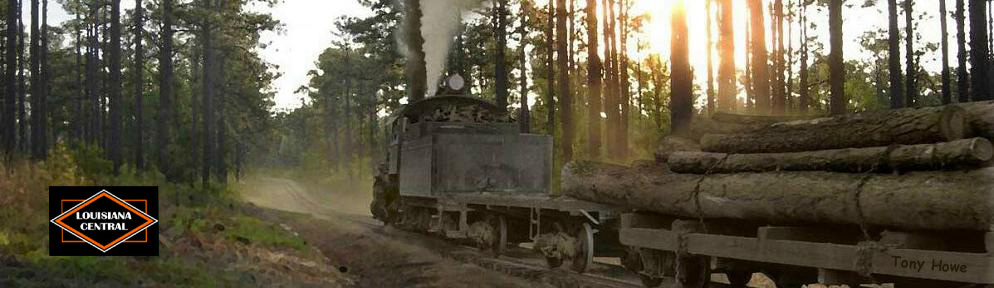
The Spencer Logging Operation

One of the featured industries on the layout will be the logging operation of the Spencer Lumber Company.  Spencer’s mill will be located at the town of Oneida (on one of the layout’s peninsulas), and will be patterned somewhat loosely on the real-life mill of the former Crowell Long Leaf Lumber Company.  The Crowell facility still lives as a museum here in Louisiana and I wrote a little piece about it in the blog post The Southern Forest Heritage Museum back in June of 2011.

The Crowell property has all the pieces in place for one to photograph and study, and while I can’t model the facility literally due to space constraints, it will at least allow me to include the vital infrastructure necessary for a lumber mill.  Once you understand the work-flow and the function of the various buildings, planning a “correct” model should be much easier.

However, the other part of the operation – the actual harvesting of the timber – had me scratching my head.  I have a nice run from the mill up to the logging area, which even includes a double switchback, and I have a loading area at the top.  But the space is so limited, especially in depth, that I just didn’t have any idea how I was going to model any sort of reasonable logging activity.  A few weeks ago I spied a copy of Kalmbach’s book, The Model Railroader’s Guide to Logging Railroads, so I purchased it.  In general it is a nice book, with a good description of all the various facets of the logging industry.  Admittedly if falls far short of being the definitive volume that one needs to pull off such a modeling endeavor; that would take many volumes to accomplish.  However there was one short section in the book that provided me with my salvation.  In short, it was the “reload” operation.  This was a situation where trucks were used to haul the logs out of the woods, and to a reloading point where the logs were transferred from the trucks to the railhead.  This became very common in the later years of railroad logging operations (which I will be modeling in 1964) as trucks and equipment were better able to penetrate into the forest.  In fact, this method often became more economical than re-laying track to all the various cutting sites.  This idea will be perfect for my line.  All I need do is add some kind of loader at the high end (a McGiffert or a Barnhart) and I’ll be in business.

While the logging operation won’t be the biggest traffic generator on the layout, I think it will be the most interesting, and I look forward to actually building it.

-Jack

Sub-roadbed Work Started

I haven’t posted in over a month so I thought I’d post a short update on the layout progress.  As I mentioned last month, I had slowed a bit to take a breather from the intensity of benchwork construction.  Doing so gave me the opportunity to step back and think though the next steps.  As I started looking carefully at where to start roadbed and track, it became obvious that I needed to begin at the point in Willis where the Louisiana Central and Illinois Central tracks leave the layout and go into hidden staging.  As I evaluated the design, I came to realize that from a track plotting perspective, this was going to be a complicated lay out.  I have several tracks in the area all going into curves at various points and also starting down grades, again, at various points.  I finally decided that this area may work best using the “cookie cutter” method of sub-roadbed construction.  I’ve plotted and cut out some of the plywood sub-base.  Next, I’ll use that as a template to mark and cut out the Homasote for the sub-roadbed topping.  I still have to build and install all the risers for this sub-roadbed (about 22′ so far).

It also occurred to me that if I want to install the wiring as I go along (which is what I planned to do), that I needed to start drawing up a wiring diagram.  The layout will be powered and controlled with a Lenz DCC system.  I will have three booster districts; each of those divided into two or three sub-districts; each of which will utilize a DCC Specialties PSX circuit breaker for protection.  My wiring diagram will show these components with associated wiring, as well as tie points for the wiring.  Actual connections will be a mixture of direct wire-to-wire soldered joints, and screw type terminal (barrier) strips, the latter being to aid diagnostics when it becomes necessary to troubleshoot things.  The single most important thing I want to do as I lay track is to solder the feeders to the track and drop them through the roadbed as I progress.  I want to connect the track to the electrical bus as soon as each small section is done so it can be verified and debugged if necessary.

Anyway, I’ve spent a good bit of time working through the electrical aspects of the project, at the same time compiling a list of the supplies that I’ll be needing.  I need to order my terminal strips and a few other things, and admit that I had a case of “sticker shock” when I started pricing things.  Man!, prices have soared since the last time I bought any of this stuff.  I’ve checked the prices at Mouser, Newark and All Electronics.  Anyone have a favorite supplier that they recommend?

So that’s about it for now.  I’ll likely try to get some risers done this coming weekend.  I haven’t taken any photos since the basic benchwork was put up . . . I’m waiting until I actually spike down some track, even if it’s just a few feet.  I’m excited about the next few months because I have several weeks of vacation time coming, and I hope to utilize a good chunk of it for layout construction.

-Jack

The Next Chapter

I’m taking a bit of a breather from railroad construction this week.  The benchwork supporting structure is complete except for the section that will cross past the room doorway.  Sub-roadbed and trackage are next up.

Last week I was fortunately spared any significant damage wrought by the storm Isaac.  Winds in my neck of the woods were not as severe as in the earlier hurricanes Katrina and Gustav.  But the rains . . . I don’t recall such a slow moving storm and the sheer quantity of constant rain!  My biggest fear was from ground saturation and the resultant tree toppling in the wind.  But no trees came down by me, and I only had to concern myself with a massive clean-up of leaves and branches.

But back to the railroad: now that I’ve reached the roadbed stage, I thought I should slow down a bit and think through what I’ll be doing, and where to start.  I have a ton of old material and pieces-parts from old layouts that I’ve saved and I’ve been digging out those boxes and caches of material.  Obviously I want to use as much of this existing stuff as possible before heading out to the lumber yard.

Yards and other flat areas containing industry will be built using plywood topped by Homasote.  This has worked well for me in the past, so I see no reason to do otherwise.  I’m still teetering with regard to the mainline.  I’m strongly tempted to try Masonite spline construction for the sub-roadbed, something I’ve never used before.  My biggest concern using this method though is with the layout of the track.  I want the track very precisely placed in accordance with my plan and I’m still scratching my head over just how to precisely plot track centerlines when you have nothing to work on except a bunch of skinny joists spanning the L-girders.  I’ve read several articles on spline sub-roadbed and they all were very terse on that aspect of the task.  I suspect from what I’ve read that spline users tend to be satisfied as long as the track runs approximately where they want it to go.  But I come from an engineering background and I have this hang-up about wanting everything precise (which I find quite difficult in many of the things to do with layout construction).

I’ll likely start with the roadbed and track that will be hidden along the walls of the room.  That seems to make sense since it will be the most difficult to access later.  It will also give me a chance to “practice” my construction technique with risers, sub-roadbed and track laying.  With most every task I’ve done in the room construction, and lately the benchwork construction, I’ve eventually worked out a method that produces an acceptable result while at the same time cutting construction time and effort.  I trust this will also happen during this next phase.  I’ve not done any of this construction since back in the early nineties , so it’s really like learning all over again.

Once some track is down, I’ll post photos on the website for those of you following the construction.  I should have something to see later in this month.

-Jack

Basic Benchwork Nearing Completion

The benchwork on the new layout is progressing quite nicely.  All five of the major sections have been completed.  Next I will be connecting a couple of the major sections with shorter “bridge” pieces, including the swing (or drop) section across the room’s doorway.  I also have to put in a number of angled pieces at intersections of the major sections, and I want to put in some reinforcement material in key places.

The framework is quite strong and is very light.  In fact, it is so light that it is easy to move by bumping into it.  I hope the added mass and weight of the (future) joists, risers, roadbed and scenery is enough to anchor the whole thing down.  The legs aren’t secured to the floor as I don’t want to drill holes through the carpet into the concrete.  I will be depending solely on layout weight to keep it in place.

I could probably wrap things up in about two weekends, however next weekend will be cut short while I take a break to do some railroading over at Lou Schultz’s C&O layout.  I’m looking forward to the operating session.  I also want to do one more evaluation of the roadbed elevations (heights above the floor) of his layout while there.  I’ve tentatively set the various elevations of my roadbed based on my experiences operating at Lou’s.  This will be my last chance to confirm my comfort with these elevations since my roadbed will likely start going in sometime in September.

The startling revelation has hit me recently that I need to start working on much more than the layout structure itself.  I have an entire fleet of locomotives that need to be cleaned, adjusted, lubed and have DCC decoders installed.  And only about 15% of my car fleet is assembled and ready.  Only one structure that I plan to use is ready, and that is a mere shack.  So much to do!

But the layout, after years and years of delay, is finally under construction.  And that is good and I am pleased!

-Jack

Some Thoughts About Roadbed

As the basic frame of the benchwork progresses, my thoughts are turning to the next step which is the track structure: sub-roadbed and support risers, and the roadbed itself.  For the sub-roadbed, I plan to use a mixture of flat plywood (some of which will be installed “cookie cutter” fashion) and Masonite splines.  All will be topped by Homasote roadbed.  I’ve used Homasote for many years and I’ve always had good results with it.  I have a single sheet and also plenty of scraps from my old layout that will get used, but plenty more will be needed.  A friend has several sheets that didn’t get used on his present layout that he’s willing to let go, and the last time I checked, there was a lumber yard about 60 miles from me that stocked it.  Hopefully they still do.

The two major complaints that I’ve read about Homasote over the years are expansion/contraction from the humidity, and the dust generated when cutting it.  I’ve never had significant problems with it in the former even though I don’t bother to seal it.  As for the latter, I have never let the dust deter me.  I just vacuum the area immediately after cutting to minimize the mess.  I’ll try to do major cutting outdoors and I’m also going to try using the knife type sabre saw blades if I can ever find them.  I’m told that they greatly reduce the dust produced, although they cut a good bit slower.

On my former layout, after the track was down, I had gone back with a router and cut bevels on each side, creating the ballast shoulders.  I did the cuts freehand and they came out rather well, but the process was slow and tedious.  I’ve read an article from a fellow that makes his own Homabed (a commercial Homasote roadbed that has been planed down for consistent thickness, and has beveled edges) and I’ve thought about trying to produce some small amount of that to see if it’s worth the effort.  The commercial Homabed is quite expensive and frankly, is out of my budget.

For the yard areas, I’ll just laminate sheets of Homasote to the plywood sub base and the track will not have the ballast slopes.  I want the yard and industrial trackage set in a mixture of ballast and dirt, really buried into the ground.  I can cut some shallow ballast slopes or small ditches along the perimeter of the yard area using my router as I’ve done before.

I’ll post more comments when I get to that step in the work.

-Jack

Benchwork Progress Report

Just a short post to give y’all an update on the layout.  Benchwork construction has been proceeding nicely.  Three of the five major sections have been completed (photos on the main website for those interested).  The two major sections left are the peninsulas.  There are also numerous corners to “fill out” with angled L-girder supports.

Overall, I’m pleased with the progress thus far.  Once this basic supporting framework is complete, I’ll turn my attention to the roadbed and supports, and of course, the track there upon.  I also have to deal with the bridge issue across the doorway.  Research continues on that project.

-Jack

Roundhouse Doors and Floors

I enjoy thinking ahead about some of my model railroad projects that will be down the road a bit.  Frequently I try to work out all or most of the details way ahead of the actual construction.  Or sometimes I just think about concepts and mull over different approaches to the project.  And some things, I just think about how I would like it to function or look, but don’t go much further than that.

Recently on the Model Railroad Hobbyist forum, there was a bit of discussion concerning roundhouse floors.  While I think most of us assume that their floors are concrete, the prevailing thought in the discussion thread was that back in the steam era, concrete wasn’t the dominant floor type.  Some of the things folks mentioned were dirt and/or cinder floors, brick or stone pavers and large wooden block pieces that were put down with the end grain facing up.  I had not heard of that type floor before.

I’ll have a small roundhouse on the Louisiana Central, and before reading that MRH thread, I just assumed I would be using a concrete floor in it.  But now I’m having second thoughts.  The roundhouse will be located in a small town in southern Mississippi (near the actual town of Gloster).  Any of you “old timers” remember seeing the interior of older roundhouses that were still in service in the 50s and 60s?  I’ve been in several roundhouses and rectangular engine houses, but with the exception of a few, don’t remember anything about the flooring.  I remember an engine house I saw up in north Louisiana that had a dirt floor in most of it, and some wood plank flooring along one side where some machinery resided.  And I remember the steam era engine house that used to be in the GSA depot at North Sharp in Baton Rouge (where the bauxite was stored for many years).  It had a concrete floor.

And speaking of roundhouses, I’ve seen a couple (down here in the South) that had no doors on the engine stalls.  Was this done commonly in the South, or was it somewhat of an exception?

Anyone?  Feedback would be appreciated.

-Jack

Bridging the Gap

The benchwork is coming along nicely.  There is almost 60 feet of L-girder framework erected now.  Hopefully I’ll get another 23 foot section done this weekend.

One of the construction tasks is going to be the fabrication of a bridge section to span the doorway into the room.  I’ve been thinking about this for quite some time and had briefly thought about several different options: a swing-up section, a lift-out section, a lift-up section, a swing-down arrangement, and a swing gate.

I dismissed the swing-up section (a bridge hinged on one end) because the 4 foot length of the bridge is too tall and would hit the ceiling.  Then I dismissed the lift-out because of the inconvenience of lifting out, then storing the section.  The lift-up section (the entire bridge rising vertically) seemed outlandish.  I really didn’t think much at all about the swing-down approach (another bridge with a hinge on one end); it just didn’t seem sexy.   I finally settled on the swing gate.

Now I started planning what the bridge would actually become.  I decided early on that I wanted a low lying tract of land coming out of Monterey that would feature the track crossing over a marshy area on a long, low timber trestle.  The only place such a trestle seemed to fit in the trackplan was (you guessed it) right at the point where the track goes past the doorway into the room.  I finally decided that to model the trestle in this location I would have to build essentially a box with a depressed area in its top.  The box would be about 4 feet long, 12 inches wide and likely about 8 inches deep.  I figured the bridge would normally be open, but wanted the bridge to be capable of functioning as a duck under during a session.  As the design developed (and after studying every swing gate I could find on the internet), I concluded that trying to support such a bridge with a hinge or two on the side of one end would likely not work very well in the long term; there would likely be too much twisting and wracking in such a design.  So then I added structure to the bottom of the box to essentially make something more like a Dutch door.  Of course then I lost the possibility of a duck under.

But there was another problem bugging me.  There are five wall switches for lights and receptacles located right next to the door opening.  Going straight across the doorway with the bridge section would have had benchwork blocking several of the switches.  Hence, the bridged section is at an angle as it crosses the doorway (see trackplan on the website), allowing access to the switches.  With this configuration, there is an angled section of benchwork poking out to start the bridged area.  Because of this, and my desire to keep curved track off the swing section, I found that the required hinge point would not allow the bridge to pivot and come to rest flat against the layout when open.  It would instead be sticking out into the aisle, partially obstructing it.  I was becoming unhappy with the swing gate concept.

Next up was another review of the vertical lift bridge (the lift-up section).  I had seen something along that line on Charlie Comstock’s Bear Creek and South Jackson.  He uses that idea to provide an access pop-up on his layout.  It uses a pair of drawer glides oriented vertically and seemed simple enough to build.  I figured I could build a beefier version of this as a bridge.  Then a few weeks ago while erecting the first benchwork sections, a thought occurred (sound of hand slapping forehead).  There is insufficient clearance over this section of layout for a raised bridge due to the lighting valence passing overhead.  Bam!  Idea dead!

So that leads me to my latest thoughts: the swing-down section.  Wayne Robichaux had suggested this so I did a couple quick sketches, and it seems like the idea may be better than I first thought.  By using a rod within some bearings (something akin to an axle), and placing it an inch or so down and inboard of the bridge-box, the thing would swing down nicely and would tuck up under the layout when down.  My next thoughts are ways to latch it in the up position, and whether it will need assist in the lifting operation.  For the latter, I’ll have to figure out how much the thing will weigh, which will probably require me to at least gather some materials of the approximate size required to build the bridge-box.  Once I know the weight, I can more reasonably come up with a design for these other tasks.

So that is where I’m at.  I would like to figure all this out early on, as this bridge is essential to even the earliest operation of the layout . . . Monterey is inaccessible without this bridge.

Got any other ideas?  Comments are welcome.

-Jack

Benchwork Commences!

Hallelujah!  Benchwork has started on the Louisiana Central.  After many delays, the railroad is officially under construction.  My able bodied assistant Wayne Robichaux and I got started Saturday afternoon with the first section, and today I wrapped it up.  I’m going to try making some progress at least weekly through this.  I posted a couple pictures on the web site . . . head on over there if you’d like to follow the progress (click the link over there on the right).

-Jack

Cloudy Weather on the Louisiana Central

As you local folks know, this weekend has seen the end of the “mini-drought” that we’ve been having.  Friday afternoon saw the weather beginning to change over the Louisiana Central as well.  Late in the day several clouds started appearing on the horizon over near Whitcomb, and by Saturday afternoon the entire railroad was under cloudy skies.

Yes friends, the layout construction has officially started!  And it started by getting the clouds painted onto the backdrop.  I used old fashioned “rattle” spray cans along with the cloud stencils provided by New London Industries.  Here are a couple closeup photos to whet your appetite.

Photo of Clouds - View 1Photo of Clouds - View 2Photo of Clouds - View 3

In a week or so I’ll get several larger photos uploaded to the web site for your perusal (Edit:  they’re there now).  I tried to capture typical Louisiana weather on a summer afternoon, with bands of clouds popping up on the horizon and then rapidly moving over the area (where you’re at, naturally) as an afternoon thunderstorm.

It’s hard to see in these small photos, but there is a faint line near the bottom of each picture.  That line is roughly at track level.  Much (probably most) of that bottom layer of clouds will end up behind trees, buildings and other scenic features.  But where there is a wee gap in the landscape, I want the clouds to show through.

Next up is benchwork.  I’ll likely get a start on that next weekend.

-Jack

Practice Clouds

Well, today I got a little more cloud painting practice in.  I had talked about my initial efforts a few weeks ago in the post Navigating the Roadblocks.  In that exercise, I had used white “rattle can” spray paint with modest success.  Today I fired up my new Paasche spray gun and put it through its paces.

The results were disastrous!

I was using acrylic craft paint for the test.  The paint was spraying with a very course pattern.  I tried about four different paint consistencies, from virtually un-thinned, to very watery.  With each consistency, I tried several different pressures, from about 15 psi all the way up to 40 psi.  Generally, the higher the pressure, the better the result, though none of my results were satisfactory.  At the higher pressures, the atomization of the paint improved, but the volume of paint became too great.  Also, the thicker the paint, the better result I achieved.  Problem is, I wanted a very light, translucent effect for the clouds to help imply distance at the low horizon (based on my observations of clouds these past weeks).  If I need a denser cloud, I can simply use multiple passes of the spray gun.  But I found that spraying a heavy bodied mixture at high pressure (giving an almost acceptable result) just put down too much paint in a single pass.

With this disappointing result, I decided to spray another panel using a recently purchased (therefore, fresh) can of white spray paint.  The results were much better.  No spatter like I had experienced in my first panels a few weeks ago.  The spray can (surprisingly) had a much finer spray pattern and I found it easier to control the paint volume.

Conclusion:  I will not be using the spray gun for the layout backdrop.

One of the primary reasons I had  purchased the spray gun was so I could mix some darker shades of blue and gray for cloud bottom accents.  I’m disappointed that I’ve only been able to find flat colors of spray can paint in white, black and gray primer.  Yes, I know that you can get those tiny little cans of Testors model paint in more colors, but it would cost a fortune in paint if I elected to use those little 3 ounce spray cans.

So, I’m going to buy another spray can of white and one of gray primer tomorrow, and I’m going to shoot another panel or two during my July 4th holiday.  Hopefully I’ll get a satisfactory result which I can then use on the backdrop in the train room.

In the meantime, I’ll be offering my spray gun up for sale.  Despite the course spray pattern, it does fine if one intends to actually put a solid coat of paint on an object (I tested it in a small area, and it did fine in that capacity).

Photo of Paasche Model 62-2-3 Paint Spray Gun

It’s a Paasche 62-2-3 spray gun, and it retails for $49.00.  I’ll let it go for half of that.  If you or someone you know might be interested, please drop me a line.

-Jack