While in Chicago, Jack Delano strolled through the Union Train Station and documented several of the views he saw. This image is of the station’s concourse, and it shows a typically busy day.
It’s January of 1943, and the United States has been directly involved in World War II for a bit over a year now. There are quite a few service men in the crowd, and virtually every poster and sign has a war theme. The largest banner in the background shows bombs dropping on Nazi Germany. The USO is represented, and if one looks carefully, you’ll spot signs directing the service members to the USO Lounge, as well as the Servicemen’s Canteen.
The concourse is lined with a spectacular display of international flags, presumably all of the nations involved in the allied war effort.
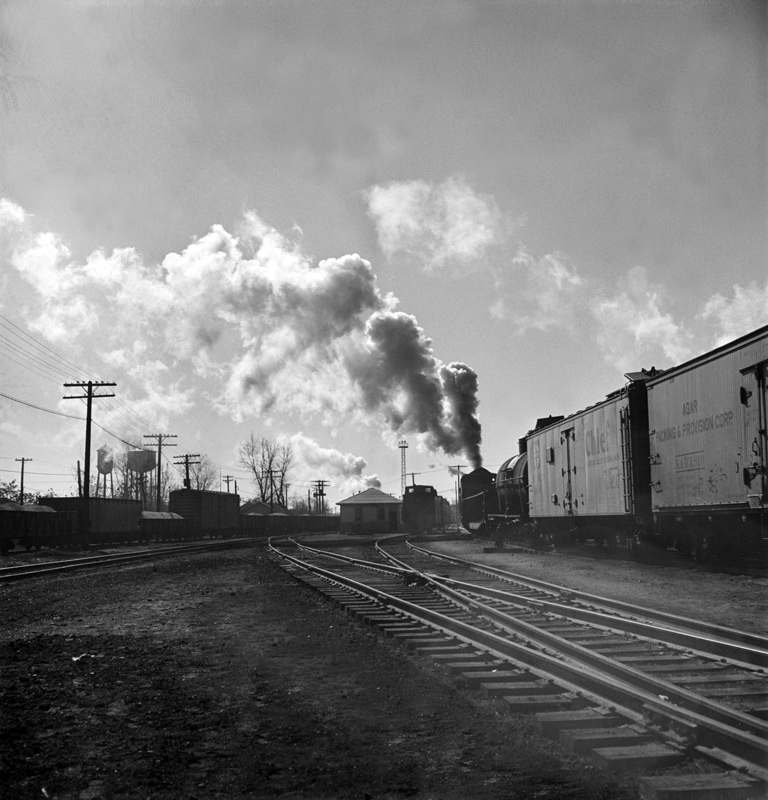
It’s quite early on New Year’s day, signaling the beginning of 1943. Jack Delano has recorded this steam powered train chuffing through a yard on the Indiana Harbor Belt Railroad. Based on the direction of the track and the proximity to the C&NW’s Proviso yard, I’d guess the location to be the IHB yard in Franklin Park near Chicago. And while speculating, I’d say the locomotive is likely one of the road’s 2-8-2 Mikados, this based only on this silhouette.
Over the years I’ve read through the label on a can of paint and one is always admonished to apply the coating in mild temperatures, generally above 60 degrees F or so. Apparently the Chicago and North Western folks have different ideas on the subject, or perhaps a new and improved paint for their freight cars.
It’s December of 1942, and Jack Delano spied this fellow applying a fresh coat of paint to a car on the RIP track in the Proviso yard near Chicago. And that has to be the longest extension I’ve ever seen for a paint sprayer! I wonder how many days it will take before one can touch that car without sticking to it.
Back over at the AT&SF Corwith yard in Chicago, Jack Delano photographed a Santa Fe freight train preparing to depart the yard. It’s March of 1943, and obviously it’s pretty chilly there. The locomotive, #3266, is a Baldwin built 2-8-2.
A curious thing I noticed is what appears to be a blue flag on the side of the locomotive. In zooming in on the original image, the flag is supported by a steel arm or bracket. I’m familiar with a flag between the rails used to protect a worker, but don’t recall seeing one on the side like this. I’ll venture a guess that perhaps the engineer places this flag while oiling around. With the heavy shroud of steam vapor emitting from the machine, it would be quite easy to get “lost” in the cloud while working up close to the valve gear. If anyone knows the correct answer, please add a comment to enlighten the rest of us.
To my eye, an engineering marvel were the massive Hulett machines built to transfer iron ore from lake freighters to railroad hopper cars. Jack Delano traveled to the Pennsylvania Railroad’s ore docks in Cleveland, Ohio in May of 1943. There he documented these huge machines at work, and I’ve selected a few samples of his work to present here.
Above is an overview of the iron ore transfer operation. The Hulett machines ride on a huge bridge carriage that travels on a set of parallel rails. Railroad tracks pass beneath the machine to handle the hopper cars to be loaded.
Here’s a close-up view of the machine. The bucket assembly is suspended from a “walking beam” affair with a smaller boom to keep the bucket arm vertical as it’s raised and lowered. The entire thing rolls back and forth on the traveling bridge, and after picking up a load of ore from the ship’s hold, it is dumped into a hopper bin located between the side rails structure of the bridge. This bin will weigh the ore, and is then rolled over the appropriate hopper car to dump it’s load. Note the tiny locomotive below the bridge, used to position the hoppers.
This is a close-up view of the huge clam-shell bucket as it is rising from the hold of the freighter after scooping up some ore. Look closely above the bucket and you’ll notice the operator of the machine smiling at the photographer. This position enabled him to precisely direct the bucket to the ore pile. Two additional Huletts can be seen beyond this machine.
And here’s the view of the hopper car loading. The traveling bin has positioned over the car, and is releasing it’s load. The bin can also travel out beyond the cars on that cantilevered section at the far right to simply dump it’s load on the ground to create a stockpile.
It must have been an impressive sight to see several of these machines working side by side to unload one of those huge freighters. Imagine the time saved from unloading them by hand!
It’s the spring of May, 1943 and Jack Delano has traveled from Chicago a short way to the east. Here he observed the loading of a lake freighter at the Pennsylvania Railroad’s docks in Sandusky, Ohio.
Huge machines would haul a railroad hopper car up a steep ramp, tie down the car, then roll it over to dump it’s contents into a chute. This would lead down to a hold on the waiting ship. After emptying, the car would be released, then rolled back down another ramp to a yard below. An enormous operation, but one which worked well.
One can see the N&W hopper car in it’s inverted position, with it’s coal load pouring out. And down on the deck of the freighter four workmen can be seen; one directing the loading, and the others battening down the hatch on an adjacent hold.
Note the Algoma Central Railway herald on the side of the ship down below it’s name.
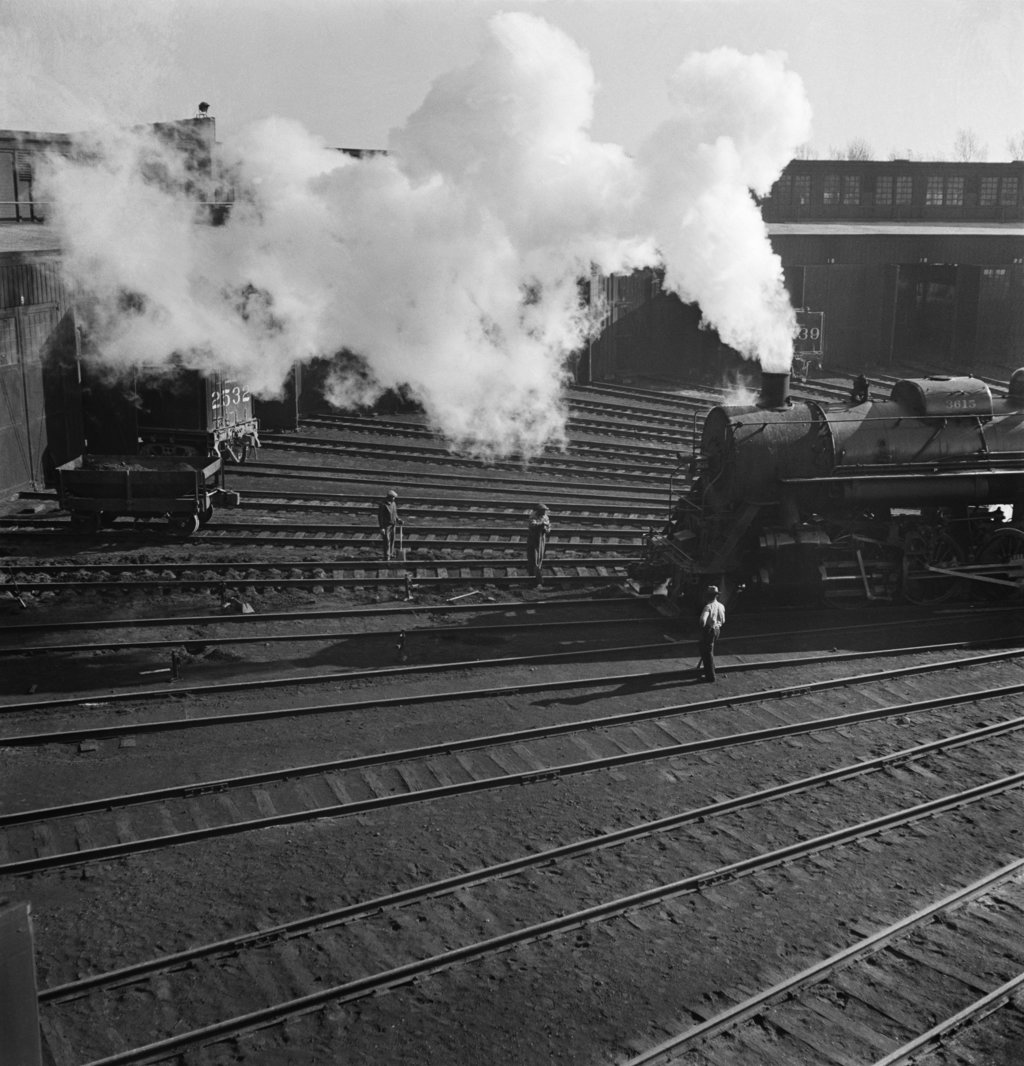
It’s a dreary and frosty day in December of 1942, and Jack Delano has arranged to get an aerial view of the Chicago and North Western’s Proviso Yard. The plumes of smoke and steam vapor provide a bit of brightness, providing an interesting contrast to the bleak surroundings.
Mr. Delano took quite a few photographs from his elevated perch, and this is perhaps my favorite. But this is only a portion of his view that day as the original slide is badly damaged and I chose to crop out a sizeable chunk on the right, resulting in this composition.
Located in Melrose Park near Chicago, this yard is presently in use by the Union Pacific Railroad.
While visiting the Chicago and North Western Railroad’s Proviso yard near Chicago, Jack Delano spied this group of workers tending to a Victory Garden on the property. It’s a chilly day in April of 1943, and there are still traces of snow here and there. But these fellows are working a tiny plot of ground with something obviously cold tolerant.
Victory Gardens were quite common during both of the world wars. They were promoted as a way to reduce the load on the normal food production, and even the savings of tin, all of which were vital to the war effort. These gardens were also considered a morale booster in that gardeners could feel empowered by their contribution of labor and rewarded by the produce grown.
. . . or perhaps more appropriately, working with fire.
We’re at the roundhouse of the Chicago, Rock Island and Pacific Railroad in Blue Island, Illinois. Jack Delano wandered into the blacksmith shop in the building one day in April of 1943. There he captured this view of Blacksmith John Kelsch (pronounced as Kelseh) working at his forge.
Steam locomotives were an interesting machine in that so many of their components were hand fashioned. When a replacement part was needed, the shop forces would literally make one. And blacksmithing was an essential part of that operation.
Jack Delano liked to visit the various back shops of the different railroads that he photographed. Seventy-seven years ago he stopped in at the Atchison, Topeka and Santa Fe’s locomotive shop in Shopton, located at the bank of the Mississippi River in Fort Madison, Iowa.
Though it’s March of 1943, he found the toasty spot in the shop when he came across the area where locomotive drivers had their tires replaced. The tire is the outer ring on the driver wheel. It forms the running surface of the driver, along with the flange of the wheel. These wear over time, and can also become damaged, therefore the driver is built to handle this by enabling the maintenance folks to replace this outer ring.
Removal and installation is accomplished by heating the tire with a gas-fired apparatus that will cause the tire to expand. It can then be either removed, or installed over the large rim portion of the wheel. When slipped on and then cooled, the tire contracts tightly around the rim, holding it firmly in place.
This operation must have been an impressive thing to witness in person!
I have to confess that this photograph surprised me. I had thought that the asbestos insulation applied to a steam locomotive boiler was in the form of blocks, similar to bricks. Perhaps that is one of the ways it was done, but this view shows the worker lathering on the asbestos mix like shaving cream. I wonder if this is just a coating over the blocks to fill in the joints and seal it all in?
Jack Delano captured this view at the Chicago and North Western’s 40th Street locomotive shops near Chicago. The date is December of 1942.
I imagine the lawyers and OSHA would have a field day if this procedure was handled this way nowadays! I’d hate to be the worker who has to clean all the dried up mixture off of the handrails and other appurtenances.
On a chilly day in December of 1942 Jack Delano visited the C&NW Railroad’s 40th Street locomotive shops. He captured this crew as they were re-installing the smokebox front on one of their 4-6-2 Pacific locomotives. If one looks closely, a worker can be seen lying on the boiler just in front of the stack as he aids in guiding the enormous cover into place. Also a bit of another worker can be seen in front of the locomotive, his foot resting on the steam chest. A third worker on the shop floor keeps his eye on the progress.
Based on the partial view of the locomotive’s number on the sand dome, this is likely a class “E” engine built by Alco’s Schenectady Works in the early 1920s.
Despite the debris seen on the shop floor, the workers apparently liked to keep the locomotive itself tidy evidenced by the broom on its running board, along with a spare on the work platform.