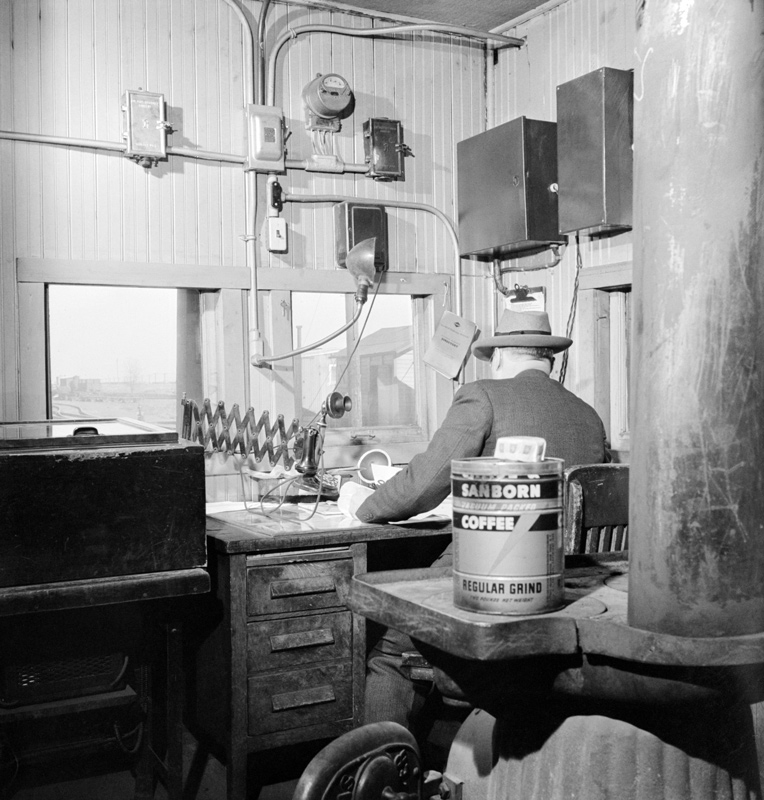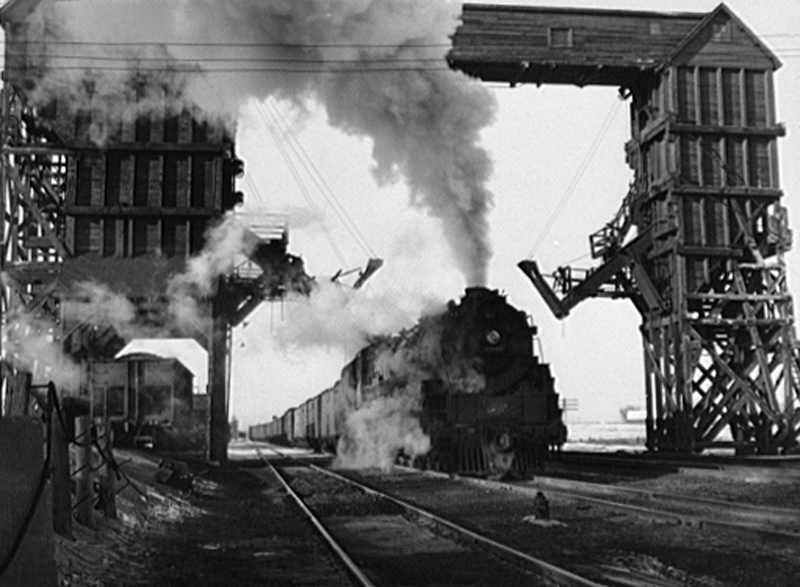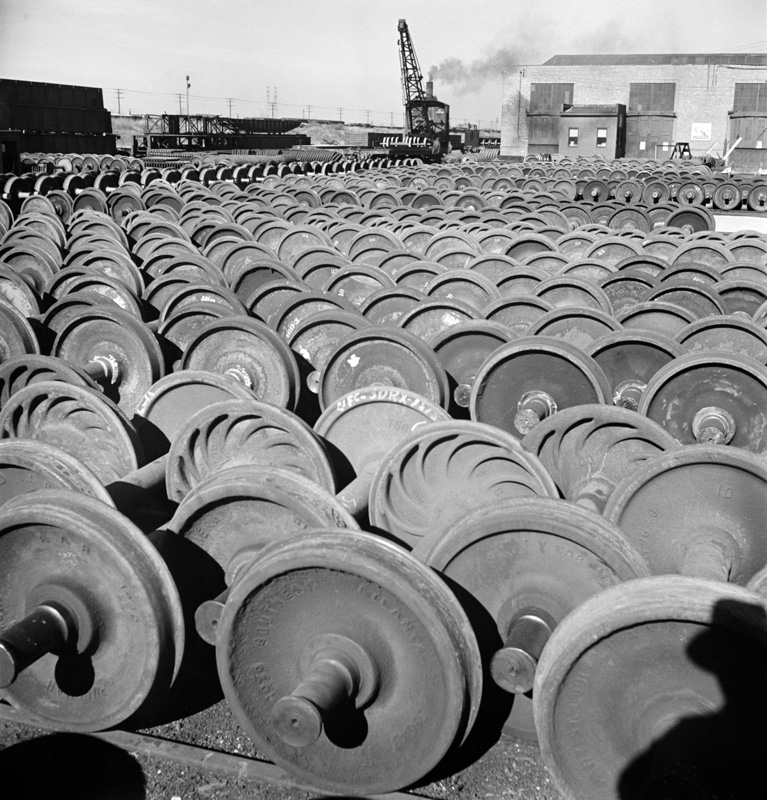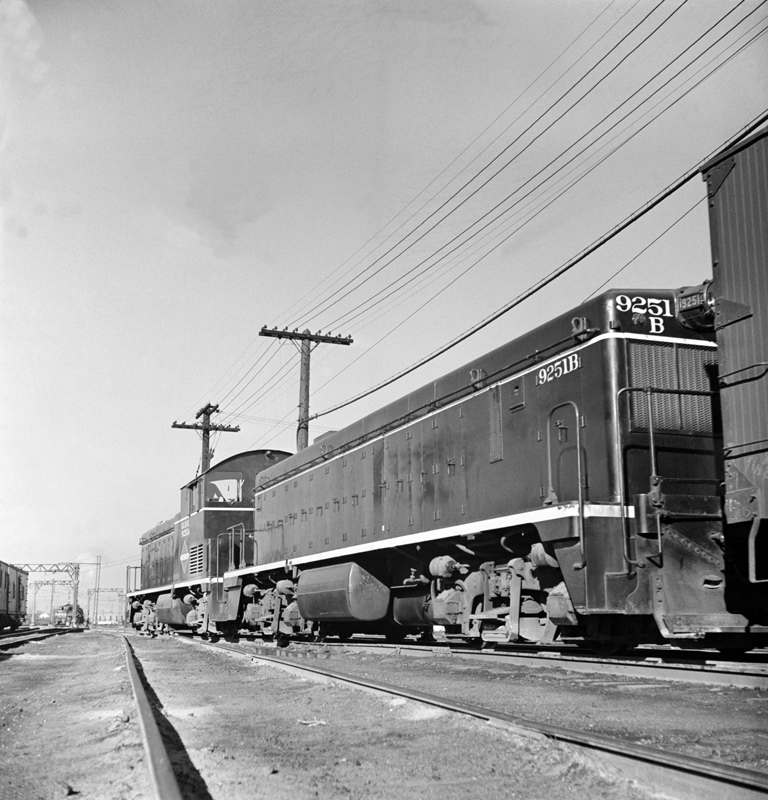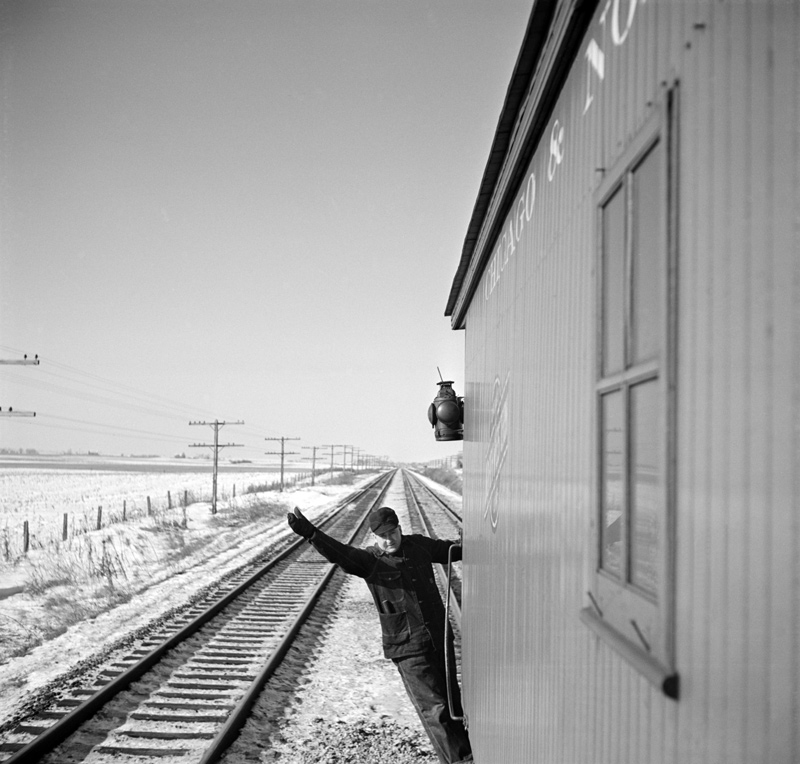
In January of 1943 Jack Delano hopped a ride on a Chicago and North Western freight train at Proviso Yard near Chicago, and made the round trip to Clinton, Iowa and return. Back in late May I posted a few photos of the tower “HM” in Elmhurst, Illinois as they were passing by.
Their train had been routed into the “hole” (a passing track), waiting for a passenger train to go by. It’s customary for the crew of the waiting train to do a “rolling inspection” of the other train as it passes by, with one crewman crossing to the far side of the track so both sides of the train get a look.
The varnish has rushed by and the rear-end brakeman is back aboard his caboose, signaling the front end crew that he’s ready to depart. The brakeman will soon be back in his perch in the cupola, likely with a hot cup of java.
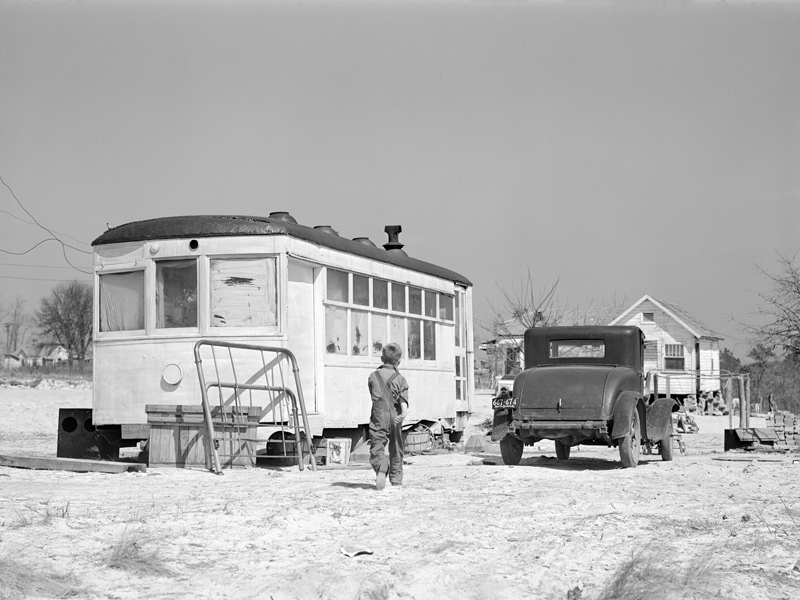
When Jack Delano was visiting North Carolina in the spring and summer of 1941, he came across this home. It’s an old streetcar converted into living quarters for a family of four. Mr. Delano wrote in his notes that the family members were born and raised in Fayetteville, but could not get a place to stay. The husband worked at Fort Bragg, just outside of Fayetteville, North Carolina.
Obviously life was still hard for some folks struggling with the depression. Direct involvement of the United States in WWII was still almost nine months away. I can’t see any signs of tread on the front tires of the family automobile. And judging from the single smoke stack on the home’s roof, it’s likely the only heat was provided by a pot-bellied stove.
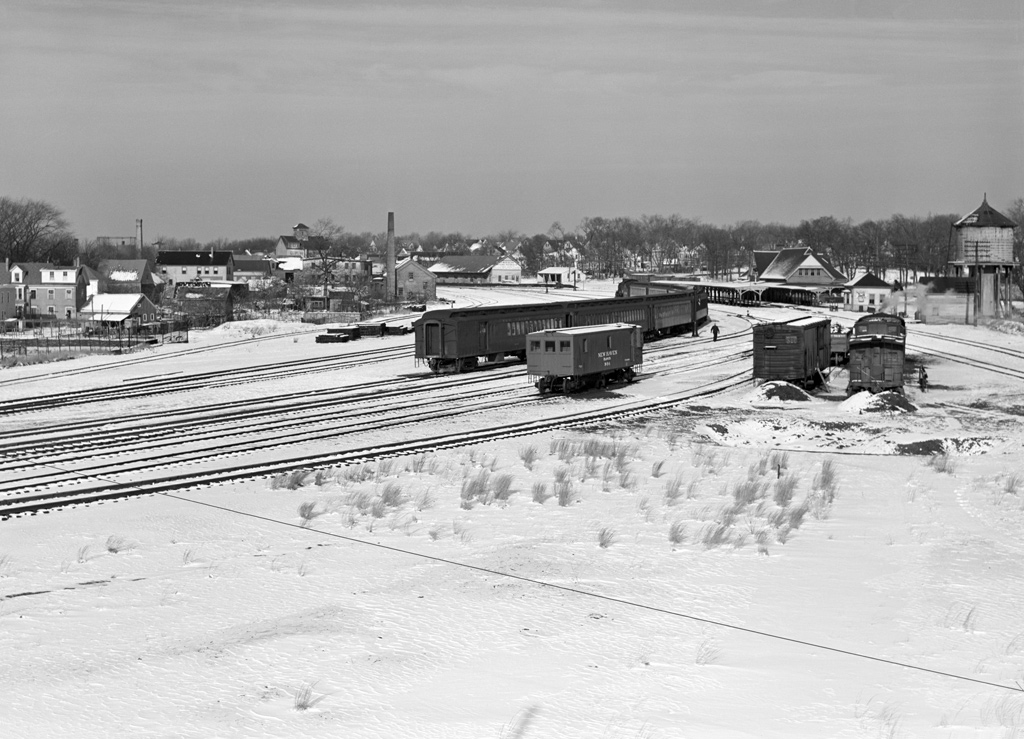
There’s still snow on the ground in this scene captured in March. A few months later Mr. Delano was in Elizabeth City, N.C. where he photographed summer scenes on the Norfolk Southern Railroad. I posted one of his images of ten-wheeler #134 just last year.
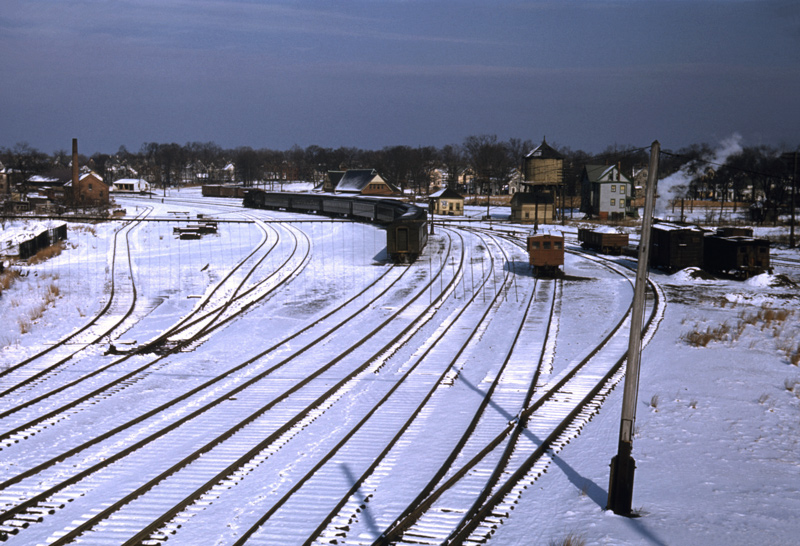
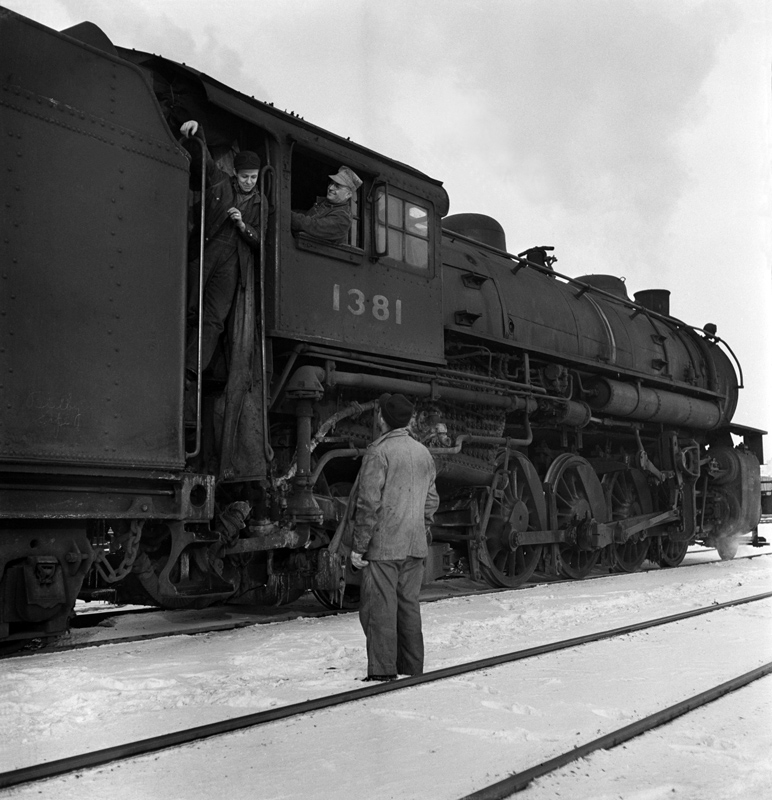
It’s another snowy day in January of 1943. Jack Delano was poking around the Indiana Harbor Belt’s yard in Chicago when he came across this locomotive and it’s crew. They have just brought the Mikado out from the roundhouse, and are waiting for their orders so work can commence.
Judging from the smile on the face of the engineer, it appears that Fireman Adams is having a humorous exchange with the brakeman on the ground. But it will be all business once they’re underway.
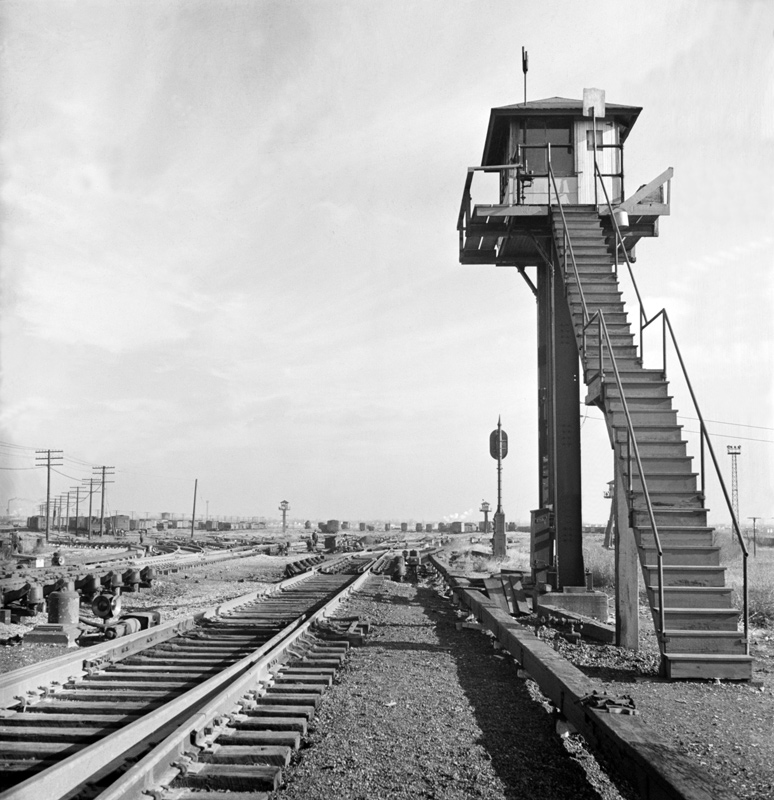
In November of 1942 Jack Delano was roaming around the Illinois Central Railroad’s vast hump yard operation in Chicago, Illinois. He spied these towers in various locations, and inquired into their function. These are the retarder operator’s towers.
When a car is sent over a hump, it rolls down into the yard by gravity through a maze of track switches, and is directed into the appropriate track. The speed of the car must be controlled, and mechanical devices (retarders) are used to typically apply pressure to the wheel flanges as they roll by, thereby slowing the car. The retarder operator controls when and where the retarders are applied. The task is to slow the car near it’s destination to prevent it from crashing into other cars. But at the same time, enough momentum must be kept that the car doesn’t stop prematurely, especially if it’s still traversing a switch. These operators control things from these lofty perches.
Imagine climbing or descending that staircase on a cold winter’s day, with snow and ice underfoot!
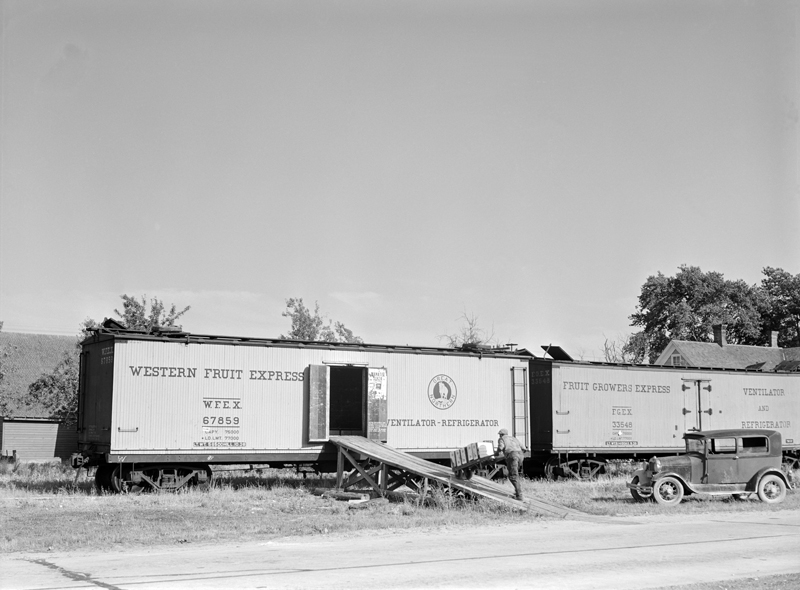
In July of 1940 Jack Delano was making his way through the northeast, documenting scenes along the way. While near Westover, Maryland, he spied this worker loading a refrigerator car with tomatoes from the Long Brothers Packing Company.
It appears that the cars are spotted on a team track, so the worker doesn’t have the benefit of a loading dock. That means a lot of trips up that ramp during mid-summer! The hatches over the ice bunkers are open on both cars, so I assume that these cars will simply be ventilated.
I’ve mentioned several times in previous posts about Jack Delano’s habit of documenting the human side of railroading. As rail enthusiasts we tend to focus on the trains themselves. And on occasion we’ll study the more common structures, such as depots, towers and roundhouses. But we seldom focus on the people behind those machines and facilities.
Even more so, we often have no idea of the many tasks required, and the enormous work force needed to keep a railroad operational. This photo is a good example of that. We’re in an Illinois Central Railroad yard in Chicago, and a yard gang is going about it’s daily business. Pictured is a worker inspecting and cleaning out debris around a track switch to insure it’s proper and dependable function. Note the oil can at right, used to squirt a bit of lubricant into moving parts where needed.
Jack Delano caught this freight train bound for New Orleans as it was leaving an Illinois Central Railroad yard in Chicago, Illinois. Note the side door caboose, sans cupola.
Even though it’s November of 1942, it’s a balmy, sunny day with nary a trace of snow. It won’t be like this much longer though.
The Indiana Harbor Belt Railroad has a mainline running between Chicago, Illinois and Hammond, Indiana. Jack Delano made the round-trip run between these points, and recorded several images during the trip. A couple weeks ago we saw brakeman Lee High taking a break as the freight train was heading out on it’s daily journey.
Now the train has made it’s delivery to the Erie Railroad, and it’s crew is preparing for the run back home. Brakeman Zerkel has removed the caboose’s kerosene marker lamps and is going to hang them on the opposite end for it’s return journey in the opposite direction.
It’s dark and snowy now as we near the end of this day in January of 1943. Once the train is underway, I suspect the crew will pour another cup of hot coffee, and settle in for the ride.
Aside from locomotives, one of my favorite things to explore on railroads are the cabooses. I started last week with a view of a brakeman taking a break during his run, and continue this week with another common activity on board.
Jack Delano was very interested in the human side of railroading, and he often documents railroaders doing their jobs. And he also records images of them at rest, or in this case, the crew preparing a meal while underway on their train.
As usual, there are many small details in the scene. We’re on the Indiana Harbor Belt Railroad, and it’s a cold winter’s day in January of 1943. Apparently the old caboose is pretty drafty, and the crew has attempted to seal things up a bit by tacking cardboard on the walls over the bunk, and also around the door down at the end. Beneath the table is a wooden box of fusees (labeled as fireworks), and note the Great Northern Railway calendar and the kerosene lamp on the wall. The conductor has taken steps to ease cleanup after the meal by spreading newspaper on the table . . . spills are likely common as the caboose is rocking along down the tracks.
Photographer Jack Delano has boarded an Indiana Harbor Belt freight train caboose, catching brakeman Lee High taking a short break. It’s a chilly day in January of 1943, and the caboose gives a place to warm up for a bit.
On the end wall we see a flag stored above the door, and an adjacent rack stocked with a supply of fusees (flares to non-railroaders). Also in view is a tool box, a cardboard box with some spare ankle-high boots, a couple jackets, and what appears to be a brakeman’s club next to the door. And someone has pinned a photo of their pooch on the wall. Imagine what else is in this cabin!
Let’s take a look at the other side of a steamer’s cab. While documenting the operations on the Indiana Harbor Belt Railroad, Jack Delano captured this image of Fireman Larry Adams as he was shoveling coal into the firebox of his locomotive. A fireman is tasked with maintaining a good head of steam by feeding and tending the boiler’s fire. He also insures that the boiler stays filled with water, and performs a myriad of other tasks around the cab.
It’s a cold winter’s day in January of 1943, but the heat from the boiler’s backhead likely provides a bit of comfort for the crew. And the fireman seldom has time to “cool off” with his job’s requirements. Note the broom leaning on the boiler . . . a good fireman also keeps his charge tidy!
A Chicago and North Western freight train from Chicago has arrived at the yard in Clinton, Iowa. The brakeman has cut off the locomotive and the crew is going to take the steamer to the roundhouse for servicing. Jack Delano has climbed into the cab for the short ride, and he documented the engineer as he was about to ease out on the throttle.
There is quite a bit of “clutter” around this backhead . . . typical of a modern steam locomotive. There are several details that I noticed which I’m not very familiar with. One in particular is what I initially thought was the boiler pressure gauge, which is indicating near zero! Upon closer inspection of the original hi-resolution image, I see that it’s labeled as “Locomotive Cut-off Control Gauge”. It also has dual needles (stacked one over the other). Just to it’s right is the air pressure gauge, with it’s dual gauges (one side mostly obscured by the larger gauge) for the braking system.
Over on the cab wall below the window is a vertical lever that I’m not familiar with. The cover of the housing has “General Railway Signal” cast into it, and the word “ACK” along with an arrow just behind the lever. The locomotive is equipped with an automatic train control mechanism (in which the key has been placed for the trip to the roundhouse), so I’ll speculate that the lever is perhaps used to acknowledge a signal as it’s passed along the line. If any of you can shed light on this, please enlighten us via a comment.
It’s likely chilly outside on this January day in 1943, evidenced by the engineer’s window opened only enough for him to glance out as required for the move. At least he has a toasty heater in front of him! Oh, and note the oil can nestled into a spot next to the backhead at the far left.