Yet Another Yard Master

We’ve seen the office of the yardmaster at the C&NW Proviso Yard near Chicago. And we took a look at the yardmaster in his office on the Indiana Harbor Belt. Today we’ll take a peek into the yardmaster’s office at the Illinois Central’s yard in Chicago.

This seems to be the sparsest and most cramped of the offices we’ve seen. Yet I’m sure the gentleman in the suit has all he needs at hand. And of course, a good supply of Sanborn coffee sitting at the edge of the stove. It’s required that a hot pot be on hand at all times, and I’m sure it’s there, likely hidden by the flue pipe.

Jack Delano recorded this photo back in November of 1942.

ICRR Yardmasters Office

Coal and Water Stop

While traveling across the Chicago and North Western’s line between Clinton, Iowa and Chicago, Illinois, Jack Delano captured this view of a large double coaling tower in Nelson, Illinois. The tower at left receives the coal from the inbound hopper cars, replenishing its bin above. Coal is also transferred to the tower at right via the enclosed conveyor at top. This arrangement allows for rapid servicing of two locomotives simultaneously on adjacent tracks.

This scene was recorded in January of 1943. It’s a bit fuzzy, as it wasn’t scanned at a high resolution. But I still thought it worthy to show, as it’s such an interesting structure.

Coal and Water Stop

The Sea of Wheels

Over these past months we’ve seen a number of photographs recorded by Jack Delano during his visit to the Illinois Central’s yard in the Chicago area back in November of 1942. While roaming around, he spotted this interesting composition of wheelsets sitting outside of one of the shops. Inspecting the original high resolution image, I can see that the majority of these wheelsets are old, coated with the typical mixture of oil and dirt. Note the presence of older ribbed back wheels in this mix. In the distance are what appear to be new wheels. I wonder if these used wheelsets will be reconditioned or simply scrapped. I suspect that those beyond a certain age will be the latter.

A steam powered crane is seen in the background loading (or unloading) wheelsets in a wheelset flatcar. At left and center there are stacks of what appear to be bridge components, one of which is similar to a turntable bridge, though it looks rather short for that purpose. And the I.C. mainline can be seen in the distance, with a couple signals visible, as well as the telegraph line.

Car Wheelsets

The Illinois Central TR1

Over the past year or so I’ve posted several of the photographs that Jack Delano shot while visiting the Illinois Central’s yard near Chicago. One of those was a view of the road’s locomotive facility there, and an interesting locomotive set can be seen at right in that image. This was an EMD TR “cow-calf” locomotive consisting of a pair of NW2 switchers, one sans cab, semi-permanently coupled together.

Below is the big brother to that locomotive, the TR1. These locomotives were essentially a pair of EMD FT road locomotives built into a switcher style car body and frame. They were each powered by EMD’s 567 16 cylinder prime mover, rated at 1,350 horsepower. This compares to the TR’s 567 12 cylinder engine rated at 1,000 horsepower. Like the TR, these units are semi-permanently coupled together via a drawbar, and note that they ride on Blomberg B road trucks rather than conventional switcher trucks. These sets were considered as one locomotive, and this pair is numbered 9251A (the cab cow unit), and 9251B (the cabless calf).

Only two of these locomotive sets were produced by EMD, both going to the I.C. in 1941. In this view recorded in November of 1942, the units are just getting broken in, and they weren’t retired until 1966.

ICRR TR1 #9251A/B Cow and Calf Set

After the Meet

In January of 1943 Jack Delano hopped a ride on a Chicago and North Western freight train at Proviso Yard near Chicago, and made the round trip to Clinton, Iowa and return. Back in late May I posted a few photos of the tower “HM” in Elmhurst, Illinois as they were passing by.

Their train had been routed into the “hole” (a passing track), waiting for a passenger train to go by. It’s customary for the crew of the waiting train to do a “rolling inspection” of the other train as it passes by, with one crewman crossing to the far side of the track so both sides of the train get a look.

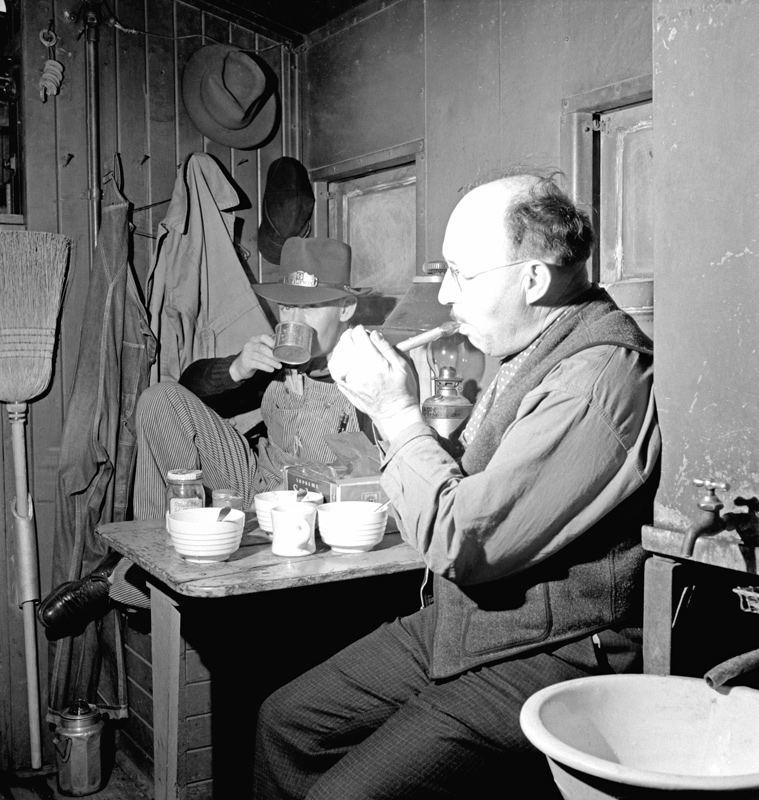
The varnish has rushed by and the rear-end brakeman is back aboard his caboose, signaling the front end crew that he’s ready to depart. The brakeman will soon be back in his perch in the cupola, likely with a hot cup of java.

Pulling Out After a Meet

Life in a Streetcar

When Jack Delano was visiting North Carolina in the spring and summer of 1941, he came across this home. It’s an old streetcar converted into living quarters for a family of four. Mr. Delano wrote in his notes that the family members were born and raised in Fayetteville, but could not get a place to stay. The husband worked at Fort Bragg, just outside of Fayetteville, North Carolina.

Old Street Car Home

Obviously life was still hard for some folks struggling with the depression. Direct involvement of the United States in WWII was still almost nine months away. I can’t see any signs of tread on the front tires of the family automobile. And judging from the single smoke stack on the home’s roof, it’s likely the only heat was provided by a pot-bellied stove.

There’s still snow on the ground in this scene captured in March. A few months later Mr. Delano was in Elizabeth City, N.C. where he photographed summer scenes on the Norfolk Southern Railroad. I posted one of his images of ten-wheeler #134 just last year.

Waiting for Orders

It’s another snowy day in January of 1943. Jack Delano was poking around the Indiana Harbor Belt’s yard in Chicago when he came across this locomotive and it’s crew. They have just brought the Mikado out from the roundhouse, and are waiting for their orders so work can commence.

Judging from the smile on the face of the engineer, it appears that Fireman Adams is having a humorous exchange with the brakeman on the ground. But it will be all business once they’re underway.

IHB Crew Waiting for Orders

ICRR Retarder Operator’s Tower

In November of 1942 Jack Delano was roaming around the Illinois Central Railroad’s vast hump yard operation in Chicago, Illinois. He spied these towers in various locations, and inquired into their function. These are the retarder operator’s towers.

When a car is sent over a hump, it rolls down into the yard by gravity through a maze of track switches, and is directed into the appropriate track. The speed of the car must be controlled, and mechanical devices (retarders) are used to typically apply pressure to the wheel flanges as they roll by, thereby slowing the car. The retarder operator controls when and where the retarders are applied. The task is to slow the car near it’s destination to prevent it from crashing into other cars. But at the same time, enough momentum must be kept that the car doesn’t stop prematurely, especially if it’s still traversing a switch. These operators control things from these lofty perches.

Imagine climbing or descending that staircase on a cold winter’s day, with snow and ice underfoot!

ICRR Retarder Operator's Tower

Loading Tomatoes (the Hard Way)

In July of 1940 Jack Delano was making his way through the northeast, documenting scenes along the way. While near Westover, Maryland, he spied this worker loading a refrigerator car with tomatoes from the Long Brothers Packing Company.

It appears that the cars are spotted on a team track, so the worker doesn’t have the benefit of a loading dock. That means a lot of trips up that ramp during mid-summer! The hatches over the ice bunkers are open on both cars, so I assume that these cars will simply be ventilated.

Loading Tomatoes

Cleaning Out Switches

I’ve mentioned several times in previous posts about Jack Delano’s habit of documenting the human side of railroading. As rail enthusiasts we tend to focus on the trains themselves. And on occasion we’ll study the more common structures, such as depots, towers and roundhouses. But we seldom focus on the people behind those machines and facilities.

Even more so, we often have no idea of the many tasks required, and the enormous work force needed to keep a railroad operational. This photo is a good example of that. We’re in an Illinois Central Railroad yard in Chicago, and a yard gang is going about it’s daily business. Pictured is a worker inspecting and cleaning out debris around a track switch to insure it’s proper and dependable function. Note the oil can at right, used to squirt a bit of lubricant into moving parts where needed.

Image by Jack Delano, November 1942.

Cleaning Out Switches

Rising From the Ashes

Okay, a bit melodramatic, but I’m happy and relieved to announce that the re-construction effort has finally started on the Louisiana Central Railroad physical plant (in other words, the building housing the railroad). For those of you that are relatively new readers of this blog, my town suffered a horrific flood on August 13, 2016. You can read the post detailing the flooding event here, and the aftermath (with photos) is reported here.

It took about 15 months to get my home restored and to move back in, then another year to get the place refurnished and back to somewhat the way it was before the flood. Then one thing after another stood in the way of working on the train building. But mostly, it was because I’ve had significant trouble mustering the will and energy to get out in the train building to do the work. But I’ve started the process, and hope to continue on a regular basis with the work.

Fortunately the building has been remediated, that is, the flooded areas of the building were removed right after the flood, including flooring, drywall, insulation, cabinets, etc. The building was cleaned up, sprayed for mold, and is thoroughly dried out. I’ve taken advantage of the walls being open below that level to add several new electrical receptacles (about ten in all) in places where I had wished I had some. I’ve also covered the entire layout with plastic to protect it from drywall dust. The work that I’m doing now is a little more demolition. I know that demolition doesn’t sound like re-construction, but what I’m doing is removing a bit more drywall to get it up to a joint at the four foot level. This should help ease the task of hanging the new drywall.

Progress may be erratic at times because I’ll be hoping to procure some volunteer labor to do some things that I won’t be able to handle alone (hanging the drywall is one of those things).

I’m still debating what flooring to use now. The original flooring was a commercial grade, short pile carpet glued to the floor. I really liked that flooring, but won’t be able to replace it, as there are now 46 legs supporting a layout in the way of installing another roll of carpeting. One option I’m considering is LVT flooring planks, installed as a “floating” floor. This, I think, would be doable, as I believe I could temporarily remove individual legs in order to install the plank below it.

Wish me luck!

-Jack

Leaving Town

Jack Delano caught this freight train bound for New Orleans as it was leaving an Illinois Central Railroad yard in Chicago, Illinois. Note the side door caboose, sans cupola.

Even though it’s November of 1942, it’s a balmy, sunny day with nary a trace of snow. It won’t be like this much longer though.

ICRR Freight Leaving Yard