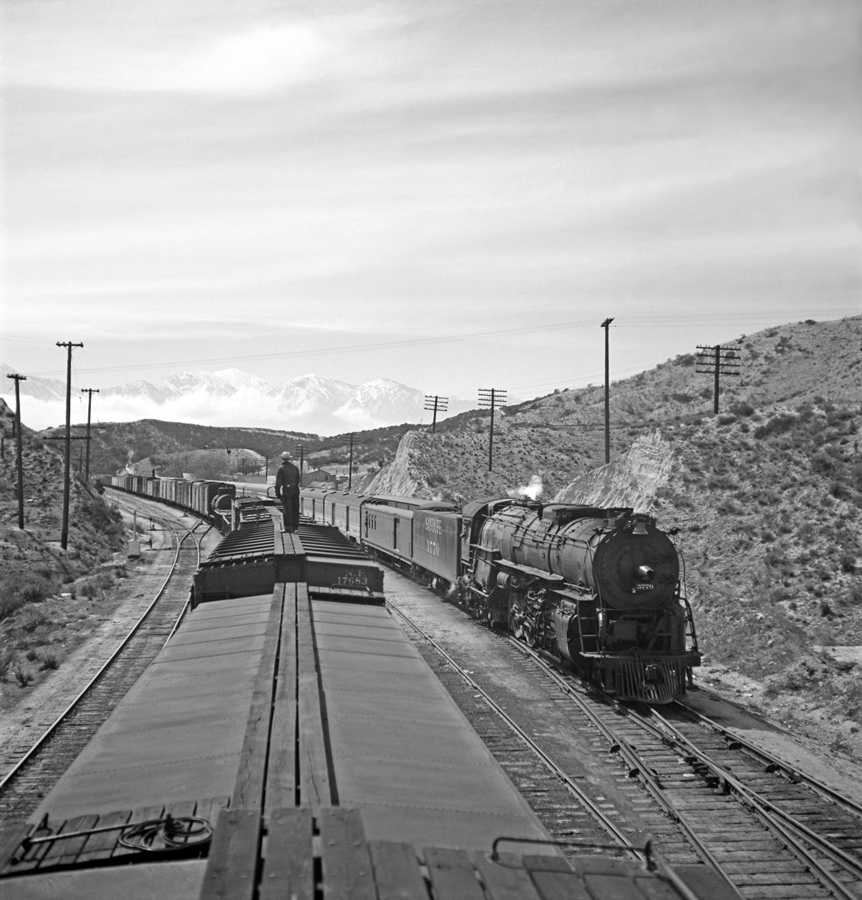
The Union Pacific “Big Boy”

This past week a few friends and I spent some time trackside to view the Union Pacific’s 4-8-8-4 steam locomotive #4014 during its visit to Louisiana. On Thursday two of us traveled west across the Mississippi River to the area south of the U.P. yard in Livonia, Louisiana to scout out some potential photo locations for the next day. On Friday morning the train would be departing from Livonia, heading down to its next destination, New Orleans. After finalizing a good photo spot, we headed north to above the Livonia yard to await the train’s arrival from Beaumont, Texas. It was due to arrive at 5:00 pm, and they arrived only minutes late.

Click on each photo below to see a larger version without the comment imprinted on it.

Later today (Sunday) a few of us plan to run over to Donaldsonville, Louisiana to see the train heading back north from New Orleans on the next leg of its journey. If I’m lucky I may get a few more shots of this spectacular locomotive!

The Other Side of the Cab

Last week we saw Santa Fe Engineer B. F. Hale at the throttle of his locomotive as they were accelerating, having just left Kiowa, Kansas. The train then traveled through Oklahoma, a part of Texas, and has now progressed into New Mexico. We’re in Ricardo, somewhere between Clovis and Vaughn (the only sign of Ricardo I could find on the map was a cemetery by that name, located about midway between these points).

Jack Delano has swung around to capture Fireman C.P. Fryer at the firing stand of the locomotive. He’s charged with maintaining the proper fire in this oil burning steamer, as well as keeping the boiler full of water. He’ll keep his eye on the steam pressure gauge and on the stack, making sure he’s minimizing the smoke.

Since it’s March of 1943, the temperature shouldn’t be too bad as the train travels through this desert territory on its way to the west coast.

The Other Side of the Cab

At the Throttle

In March of 1943 while Jack Delano was working his way out west on the Atchison, Topeka and Santa Fe, he managed to get a little cab time while the steam locomotive was under way. Pictured below is Engineer B. F. Hale at the throttle of his charge.

The train has left Wellington, Kansas and is passing through Kiowa on it’s way to Waynoka, Oklahoma. Mr. Hale has the throttle pulled pretty far back, and the Johnson bar (barely visible) appears to be far in the corner, so it’s likely the locomotive is pulling hard as it leaves town.

At the Throttle

An AT&SF Passenger Train in Kansas

Back in the winter of 2019/2020 we saw a few photographs that Jack Delano had taken during his trip out west on the Atchison, Topeka and Santa Fe Railroad in March of 1943. Mr. Delano had recorded quite a few images during that trip, so I went back to the Library of Congress to review them. As a change of pace, I thought I’d share some of what I found.

Featured below is a Santa Fe passenger train passing through the Flint Hills district of Kansas. This is a famous stock feeding area. Heading up the consist is locomotive #3771, a 4-8-4 ‘Northern’ type machine. Built by Baldwin in 1938, this locomotive had 80″ drivers, boasted a 300 psi steam pressure, and produced a massive 79,968 lbs. of tractive effort. Suited for high speed runs all the way to the West Coast, she is shown here with her consist of at least 15 cars. Note the “tight” visor on the headlight, required for West Coast traffic during the war years.

An AT&SF Passenger Train in Kansas

And below is a view of the right side of the locomotive (photographer unknown).

AT&SF Loco #3771

The Watch Inspector

A very critical aspect of railroading is time. When a railroad has multiple trains running simultaneously, it is imperative that all operating people know exactly what time it is. Most folks know that the trains may be running on a schedule. But they also must meet opposing trains at particular places and times where they can pass safely. To do this, all employees carry an approved time piece (in this era, usually a pocket watch).

At the start of a run the conductor will synchronize his watch to the “official” clock at the station where the run originates. Then all of the crew members will synchronize their watches to his. This will ensure that everyone involved knows the correct time.

As I mentioned above, all watches must be approved. A railroad will publish a list of watches that have been approved based on their accuracy and dependability. It’s the employee’s responsibility to purchase, then keep his time piece in good condition. One of the requirements is to have the watch inspected on a regular basis with an official watch inspector. These trainmen are at the watch inspector’s office in the Union Station in Chicago, Illinois doing just that. The inspector will verify the watch’s accuracy, and make adjustments to the mechanism if required.

Jack Delano photograph, January, 1943.

Watch Inspections

‘TO TRAINS’ at Chicago Union Station

A neon sign prominently affixed near the center of the waiting room in the Chicago Union Station points the way to the trains. A temporary sign attached to the top of this fixture is directing military personnel to the USO lounge. And the poster at left encourages the folks to use transportation wisely . . . these last two, reminders of the war effort in full swing. Jack Delano captured this scene during his visit there in January of 1943.

Neon was quite popular for signage in those days, and other examples can be seen in the background. Note the arrow pointing to the Fred Harvey Cafeteria, and another sign for Parmelee Limousines.

We’ve already viewed a couple of scenes in this terminal. A couple years ago I posted a view of this location from a slightly different angle. And last year we saw this view of the station concourse.

TO TRAINS at Chicago Union Station

Getting Coal From Ship to Railcar

Getting coal from ships to a railroad can be quite an operation. In December of 1942 Jack Delano visited the operations of the Milwaukee Western Fuel Company in Milwaukee, Wisconsin. The coal comes in on huge lake freighter ships, where it is unloaded and stockpiled. The photograph below is an overview of a pair of large bridge cranes, one on either side of the ship channel at the Seventeenth Street dock. The traveling bucket scoops the coal from the ship holds, then dumps it into piles.

Coal Loading Dock

And below is a close-up of the loading end of the machine. Mr. Delano has recorded this view from the opposite side of the bridge. The bucket drops coal into the hopper at the top, it is sized over screens, the proper size coal goes down the chute on the left into the car, and the rest goes down the chute on the right back onto the coal pile.

Loading End of Coal Loading Dock

Discussing the Assignment

During his tour of the Indiana Harbor Belt Railroad in January of 1943, Jack Delano recorded this view of IHB Conductor Cunningham discussing the train he is to pick up with the Chicago and North Western yardmaster. Though not identified, I would assume the yardmaster is the gentleman with the fedora and necktie.

I like the composition of this image, with the steamer at center, and two others flanking these railroaders on either side.

Discussing the Assignment

Boarding the Locomotive

It’s another frosty day in January of 1943, and Jack Delano was there to see the engineer and fireman boarding their locomotive for another day’s labor. We’re on the Indiana Harbor Belt Railroad which runs between Chicago, Illinois and Hammond, Indiana.

In these temperatures it doesn’t take long for dripping water to turn into ice cycles as seen on the piping at left. Also note the canvas curtains surrounding the backside of the cab in an effort to preserve a bit of heat inside for the crew.

As I studied this image, the faces seemed familiar. Turns out we’ve seen these fellows and their charge in an earlier post as they were waiting for their orders to start work.

Boarding the Locomotive

Locomotives Over the Ash Pit

I’ve always liked photographs of the locomotive servicing facilities on railroads. And the facilities that service steam locomotives are especially exciting, what with all the smoke and steam in the air.

Jack Delano must have been interested in them also, as he recorded quite a few images of the beasts as they were marshaled through the facility. In this view he captured the line of locomotives as they were fed and watered at the Chicago and North Western’s service area in their Proviso yard near Chicago. The locomotives receive coal, water, sand and lubrication here, and they drop the ashes from their fire boxes into the ash pit. In a large facility such as this, there was almost always a constant line of locomotives going through as seen here.

It’s a cold winter’s day in December of 1942, and if you look carefully, you can see ice cycles hanging on the trailing truck of the 2576!

Locomotives Over the Ash Pit

Loading Critters on the Train

In January of 1943 Jack Delano made his way to the Calumet Park stockyards in Calumet City, Illinois. There he found workers busily loading stock cars that day. In the photograph below steers are being loaded into a Missouri Pacific car. It seems that one of the beasts is wise to what’s going on, and has decided she isn’t going to have any part of it!

Loading Cattle on the Train

And here is a group of sheep being loaded into the upper deck of a Burlington stock car. They all appear to be compliant, even giving the worker wide berth.

Loading Sheep on the Train

These stockyards are operated by the Indiana Harbor Belt railroad.

Switching Cars on the Rock

In May of 1943 Jack Delano made a brief visit to a Chicago, Rock Island and Pacific Railroad yard (presumably) in Chicago. While there he recorded some of the switching operations of a crew. Their power was this EMC Winton powered NW1 (relatively rare – only 27 were built). Note the headlight with a visor, and the steam locomotive style bell.

Looks like a couple of “suits” from the front office are observing the crew (or perhaps the locomotive) on this overcast day.