Wrapping Up Lunch

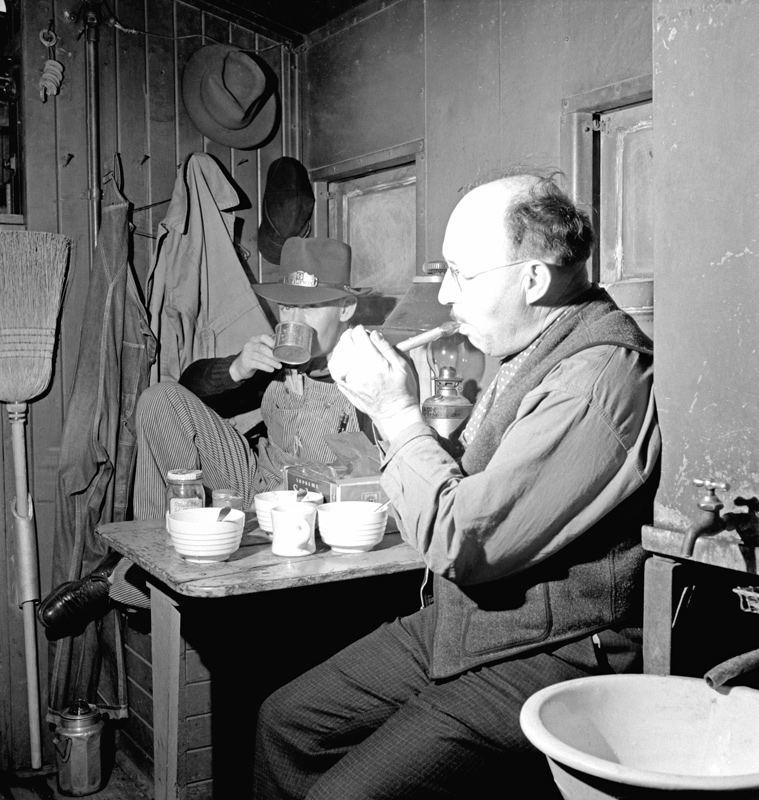
Jack Delano rode a number of trains on the Santa Fe railroad during his trip out west in March of 1943. This scene was recorded in the caboose while traveling the run between Waynoka, Oklahoma and Canadian, Texas. Conductor James M. Johnson and Brakeman Jack Torbet have just wrapped up their lunch, with Brakeman Torbet washing down the last of his meal, while Conductor Johnson lights up his cigar.

I like the clever way they have stored a supply of air hose gaskets (seen at upper left), making a holder from a scrap of wire and a pair of those rubber gaskets. And I note that Conductor Johnson has acquired a new broom to keep his caboose tidy.
Wrapping Up Lunch

Going Down the Mountain

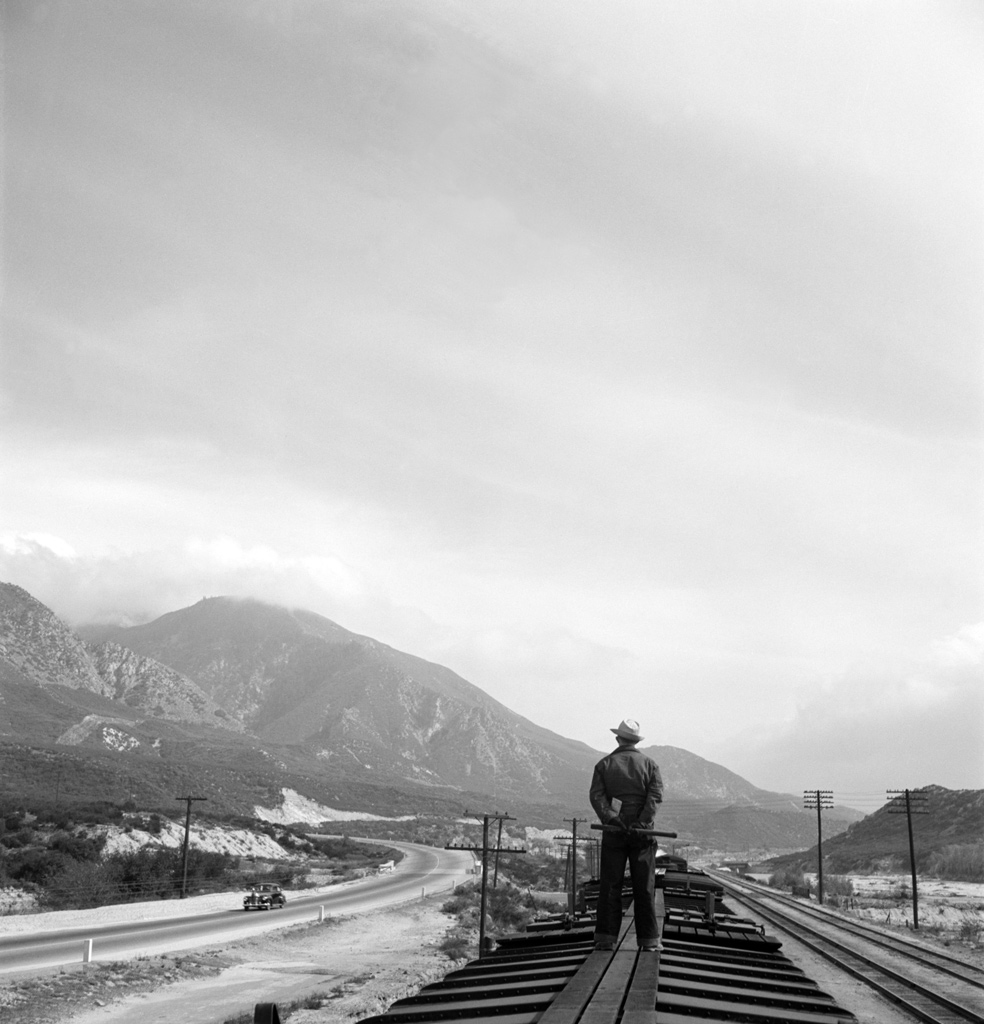
When Jack Delano traveled out to California on the Atchison, Topeka and Santa Fe in March of 1943, he recorded this view of a brakeman riding on the roof of their freight train as they were descending slowly down a grade. They’re in the vicinity of Summit, California on the line running between Barstow and San Bernardino.

I suspect that the train had stopped to let the brakes cool a bit when this photograph was taken. I doubt Mr. Delano would have been atop a moving train with his large camera! Note that the brakeman is carrying a brake club, used primarily to tighten vertical staff brake wheels. And also note the wooden running boards atop the reefer (refrigerated car) that the brakeman is riding. Can you imagine walking those in inclement weather wearing leather-soled shoes?

Going Down the Mountain

NYC at the ICRR in Chicago

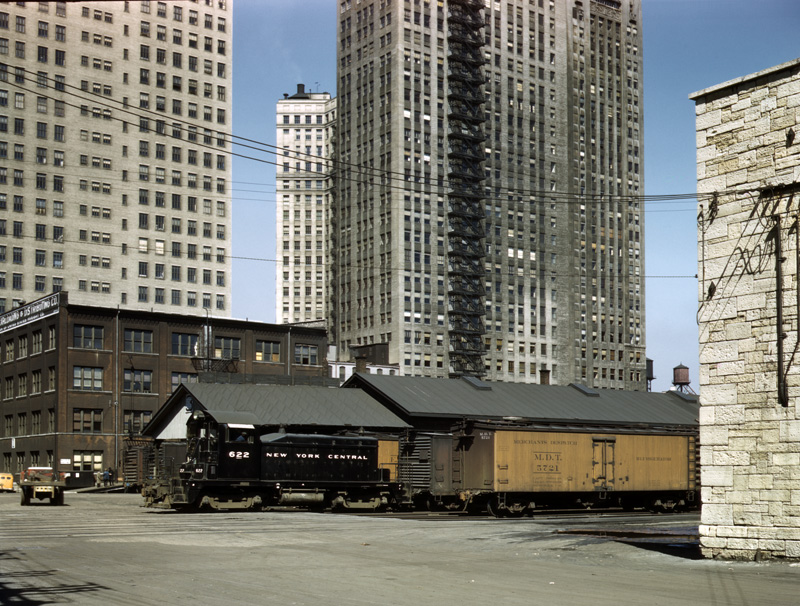
In April of 1943 Jack Delano was visiting an Illinois Central rail yard, along with some of their facilities in Chicago. He spied this New York Central locomotive spotting cars at the I.C. freight terminal located on South Water Street. The locomotive is a 600 HP model SW1 switcher built by EMD. The number 622 was in the N.Y.C.’s second order of this type.

The N.Y.C. was one of the railroads that leased terminal facilities from the I.C.R.R. in Chicago.

NYC Switcher at ICRR Freight Terminal

Cloe Weaver, Turntable Operator

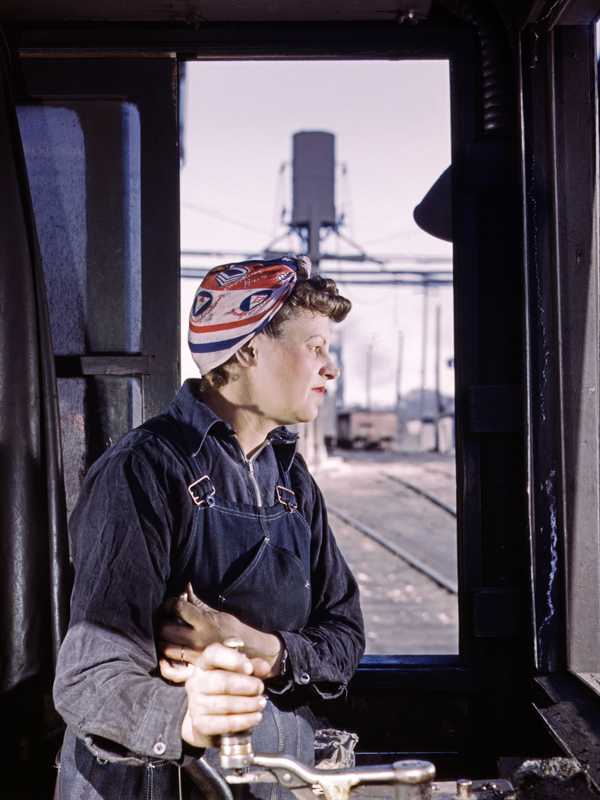
One of my favorite areas around a railroad is the roundhouse, and the attendant turntable. We’ve seen several images these past few years showing railroaders at work in these areas, and also the nearby shops. We’ve also seen photographs of women at work on the railroad. With the war going on and men becoming short in supply, women stepped up to fill many of the roles traditionally done by men. They weren’t afraid to don a pair of dungarees and get their hands dirty.

We’re at the C&NW roundhouse located in Clinton, Iowa. Mrs. Cloe Weaver, employed as a helper, is learning to operate the turntable. She’s the mother of four, and her husband is employed by a structural steel company.

Image by Jack Delano, April, 1943.

Cloe Weaver Operating C&NW Turntable

Housing for Railroad Workers

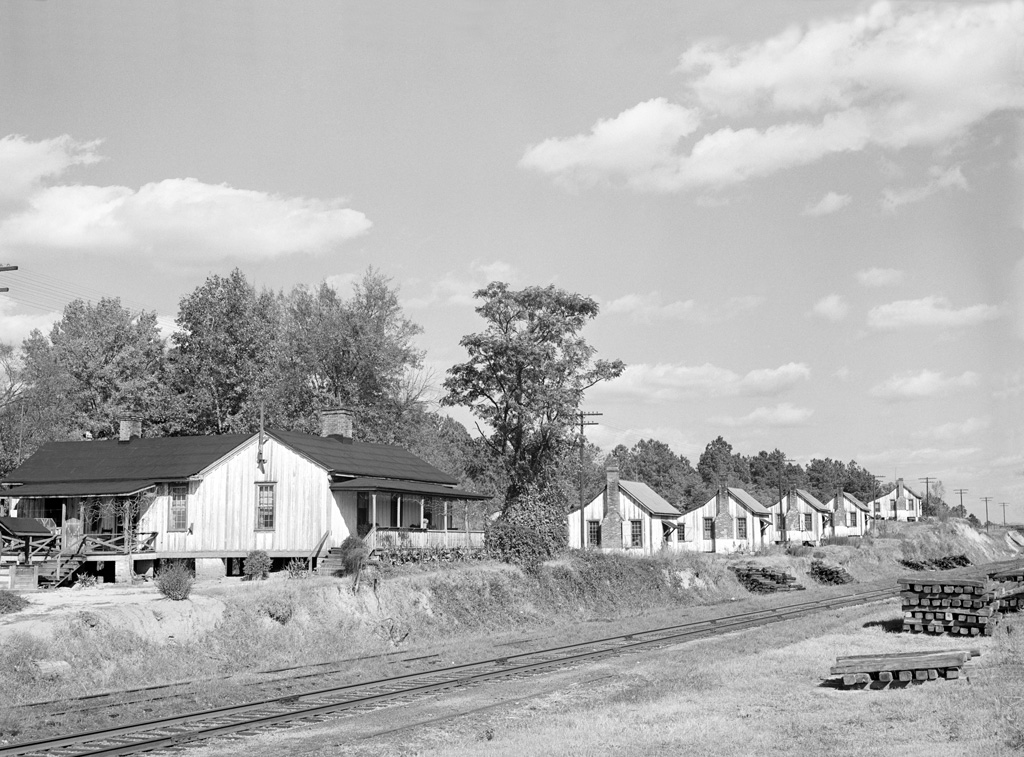
In November of 1941 Jack Delano was traveling through the South and was recording views along the way. This image was taken in Greene County, Georgia. Not much is noted with the photograph other than these were houses for railroad workers. Judging from the scene, I’d venture a guess that this housing is for a section gang.

Section gangs (often referred to as Gandy Dancers in the early years) were charged with maintaining a given stretch of railroad track. The foreman of the gang likely resides in the large house at left, with his workers in the others.

Houses for Railroad Workers

B&O Shops in Du Bois, Pa.

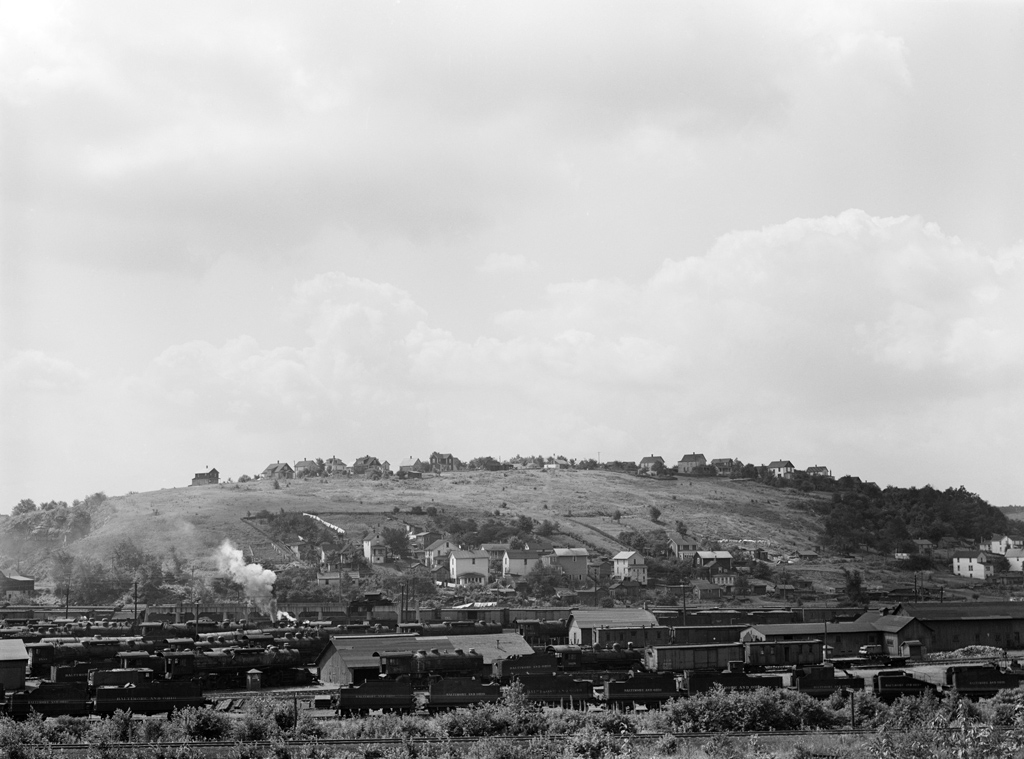
Jack Delano visited the city of Du Bois, Pennsylvania back in September of 1940. He took this panoramic view of the shop facility there, and the housing located on the hillside adjacent to the yard. There was no information recorded about this scene beyond the date and location. And I’m not very familiar with the Baltimore and Ohio Railroad which we are seeing here.

I’m speculating that this might be a deadline for steam locomotives. There is a line of empty locomotive tenders in the foreground. And virtually none of the locomotives behind this have their tenders. Several have their stacks capped, and at least one has the back of the cab boarded up. We can see a traveling crane at left-rear, so outdoor heavy lifting is done here. But I can’t spot any locomotive being cut up. So the mystery remains for me.

I notice a good bit of laundry hanging on the lines in the background, so assume we aren’t near a large yard. Indeed, the only hot locomotive appears to be the shop switcher. You can click on the image to see a much larger version if you wish to study it. Feel free to comment if you can shed more light on this scene.

B&O Railroad Yard, Du Bois, Pa.

A Doodlebug Picking Up Orders

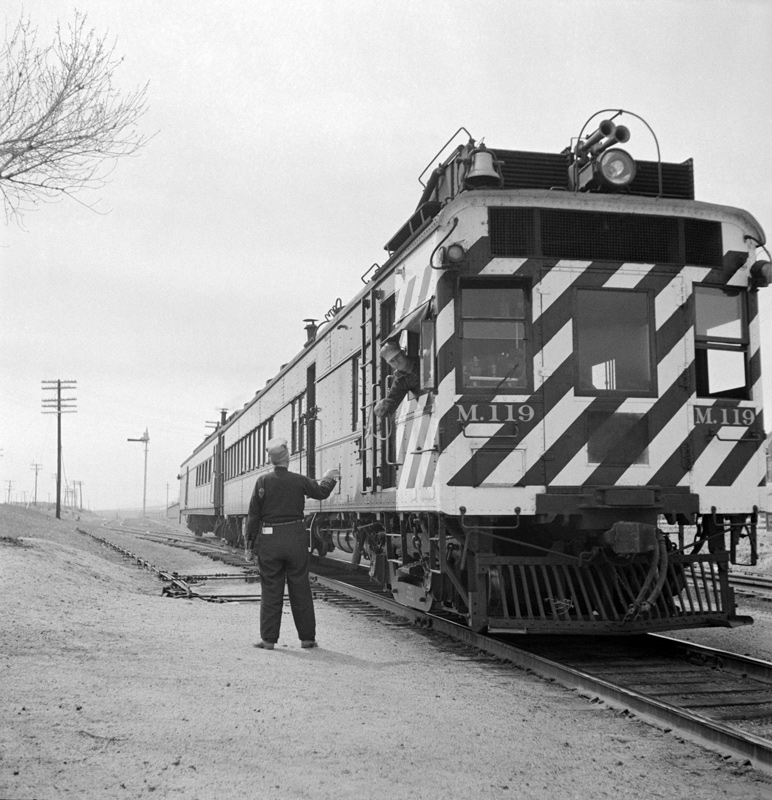
In the spring of 2019 I posted a few photographs taken by Jack Delano while visiting Isleta, New Mexico during March of 1943. While there, he witnessed the tower operator at work routing trains through his interlocking plant. He then recorded a train crew picking up their orders on the fly. Mr. Delano also captured this scene of the operator passing orders to the engineer of AT&SF M.119, a self-powered railcar affectionately known as a “doodlebug”.

These railcars were used for lightly traveled lines, making stops at each town (the local train). It’s a combine style car, that is, it has a forward section to carry baggage, mail and express, and the rear coach section for passengers. Initially these railcars were gas-electrics, using a gasoline or distillate engine powering a generator. This in turn powered the electric motors actually driving the wheels. Most were re-powered to use diesel engines during the 1940s. As seen here, they often towed another combine or coach car if the traffic warranted it.

AT&SF Doodlebug Picking Up Orders

Train Arrival Board

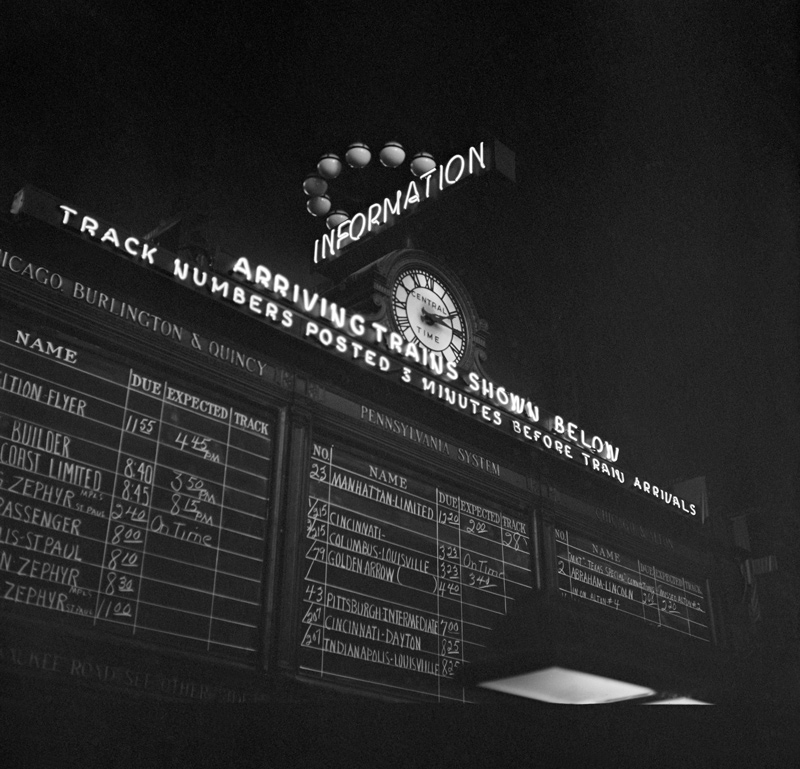
We’ve seen a few photographs that Jack Delano recorded at the Chicago Union Station back in January of 1943. One featured a beautiful scene of sun rays penetrating the main concourse of the station, the other depicting an overall view of that space.

This image zooms in on that information counter in the latter photograph, and shows the train arrival board. It’s an interesting combination of neon and chalk board, with the train arrival times and comments updated continually. We’ve all read about the pride the railroads had in running trains on time back in the day. Looking over the arrivals times below shows something a bit lackluster. Perhaps it’s simply a result of the sheer volume of the war time traffic.

Train Arrivals at Chicago Union Station

Rail Yard in Middleboro, Mass.

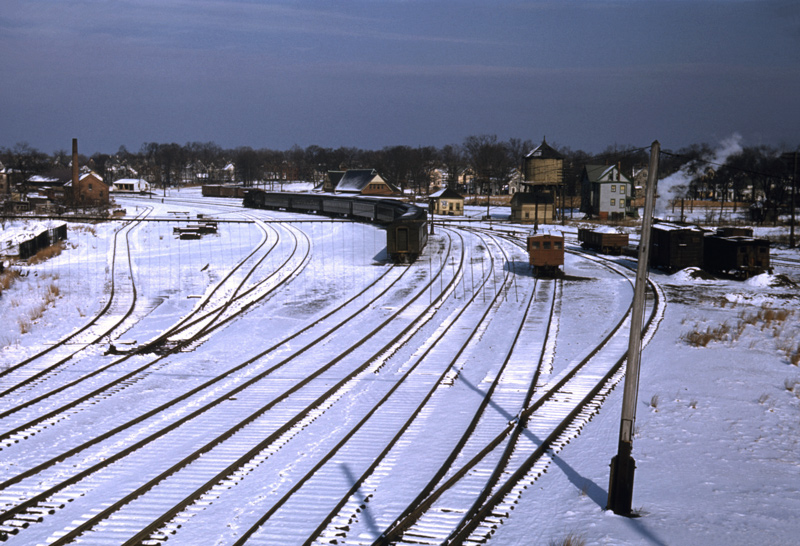
Jack Delano traveled through a few areas of the Northeast during the winter of 1940-41. He stopped briefly in the city of Middleboro, Massachusetts to record these, and several other scenes of the railroad yard there. The Library of Congress records seem to be a bit confused as to the date, but most of the images are listed with the date of January 1941.

Mr. Delano recorded this birds-eye view of the rail yard as a passenger train was arriving at the depot there. Judging from the tell-tale strung across the tracks, I’m assuming that he was perched on a street overpass . . . a convenient spot indeed. Look carefully and you’ll spot a steamer and caboose tucked away on a spur at far right.

Passenger Train in Middleboro, Massachusetts

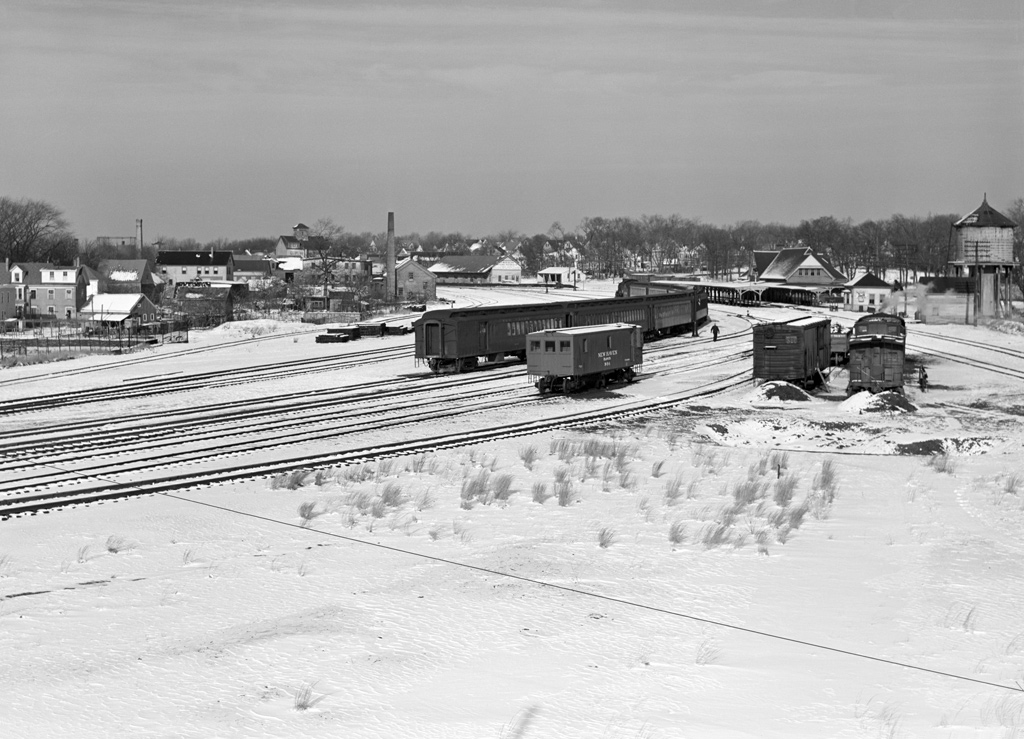
Here’s an image recorded in black and white, taken from a different angle. This photograph has a higher resolution and has a myriad of details to study. This appears to be the New York, New Haven and Hartford Railroad, this assumption due to the name New Haven on the flanger car in the foreground.

Railroad Yard in Middleboro, Massachusetts

Yet Another Yard Master

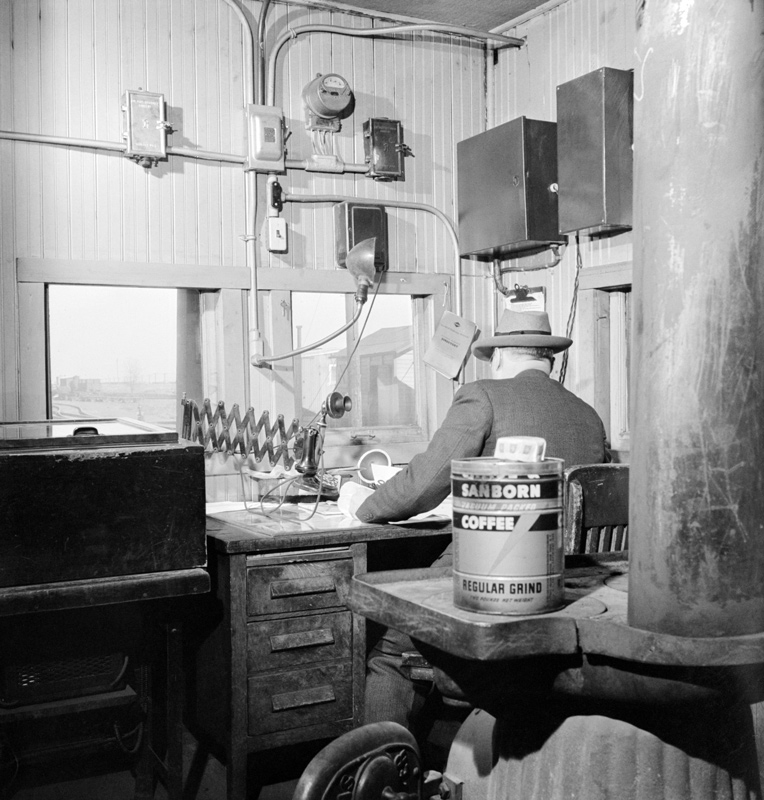
We’ve seen the office of the yardmaster at the C&NW Proviso Yard near Chicago. And we took a look at the yardmaster in his office on the Indiana Harbor Belt. Today we’ll take a peek into the yardmaster’s office at the Illinois Central’s yard in Chicago.

This seems to be the sparsest and most cramped of the offices we’ve seen. Yet I’m sure the gentleman in the suit has all he needs at hand. And of course, a good supply of Sanborn coffee sitting at the edge of the stove. It’s required that a hot pot be on hand at all times, and I’m sure it’s there, likely hidden by the flue pipe.

Jack Delano recorded this photo back in November of 1942.

ICRR Yardmasters Office

Coal and Water Stop

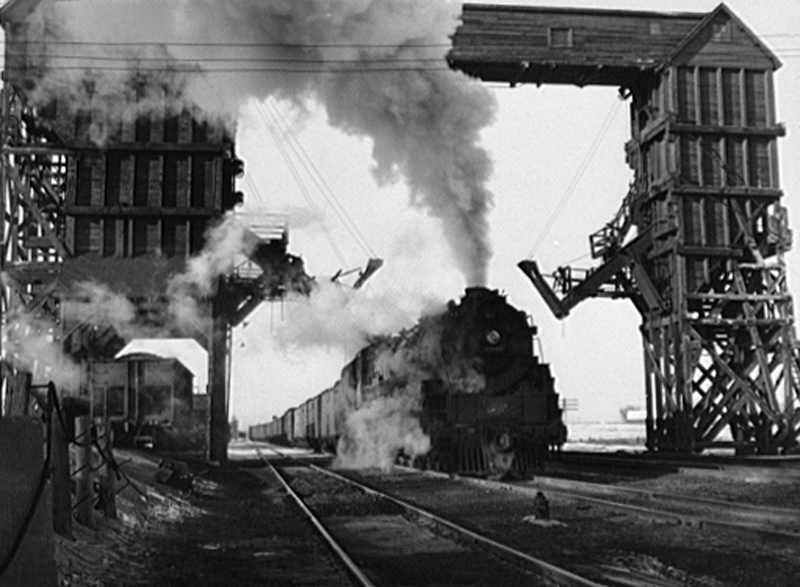
While traveling across the Chicago and North Western’s line between Clinton, Iowa and Chicago, Illinois, Jack Delano captured this view of a large double coaling tower in Nelson, Illinois. The tower at left receives the coal from the inbound hopper cars, replenishing its bin above. Coal is also transferred to the tower at right via the enclosed conveyor at top. This arrangement allows for rapid servicing of two locomotives simultaneously on adjacent tracks.

This scene was recorded in January of 1943. It’s a bit fuzzy, as it wasn’t scanned at a high resolution. But I still thought it worthy to show, as it’s such an interesting structure.

Coal and Water Stop

The Sea of Wheels

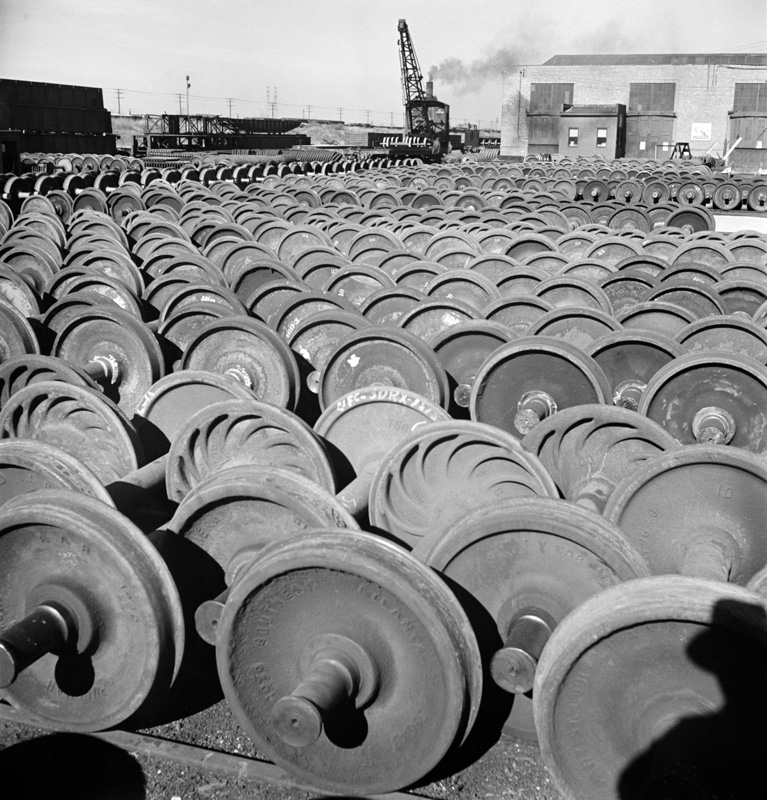
Over these past months we’ve seen a number of photographs recorded by Jack Delano during his visit to the Illinois Central’s yard in the Chicago area back in November of 1942. While roaming around, he spotted this interesting composition of wheelsets sitting outside of one of the shops. Inspecting the original high resolution image, I can see that the majority of these wheelsets are old, coated with the typical mixture of oil and dirt. Note the presence of older ribbed back wheels in this mix. In the distance are what appear to be new wheels. I wonder if these used wheelsets will be reconditioned or simply scrapped. I suspect that those beyond a certain age will be the latter.

A steam powered crane is seen in the background loading (or unloading) wheelsets in a wheelset flatcar. At left and center there are stacks of what appear to be bridge components, one of which is similar to a turntable bridge, though it looks rather short for that purpose. And the I.C. mainline can be seen in the distance, with a couple signals visible, as well as the telegraph line.

Car Wheelsets