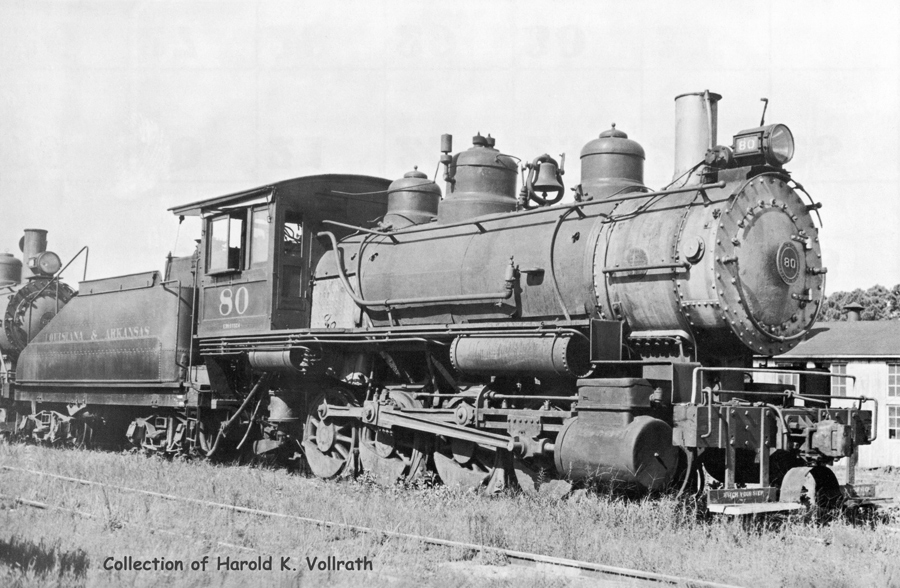
M.P. (St.LB&M) Ten-Wheeler #260

For this first posting in the month of September, I’m featuring a photograph from the 1986 calendar published by the Louisiana State Railroad Museum, it being for their month of September. The caption for the image follows below.

“Trim Ten Wheeler #260 of the Missouri Pacific Lines still carries the reporting marks of subsidiary St.LB&M in this October 1948 photo at DeQuincy, Louisiana. The 1907 Baldwin product is posed by her proud engineer in front of the long since departed enginehouse but still remaining water tower. (Photo from the collection of Harold K. Vollrath)”

MP Ten-Wheeler #260

Actually, the locomotive is lettered for the Missouri Pacific Lines (barely visible on the tender), and sub-lettered for the St.LB&M, the St. Louis, Brownsville and Mexico Railway. She was originally lettered for the St.LB&M, then for later acquisitions: the Gulf Coast Lines, and finally the MoPac. This tidy little oil-burner was one of twelve ordered by the St.LB&M from Baldwin between June of 1905 and December of 1907, numbered 251 – 262.

IC #1536 Traveling Through Downtown Murphysboro

In studying Mr. Gelman’s series of photos featuring the last days of steam on the Illinois Central in southern Illinois, this photograph was one of the first that caught my attention. Many would say it’s a lousy shot, it doesn’t even capture the entire locomotive. But the more I look at this image, the better I like it. Here is this massive piece of machinery traveling right through the center of a typical small city in the U.S.A., surrounded by buildings filled with shops and offices. And stopping the traffic on the main drag in doing so. The locomotive was likely backing, as the engineer is leaning out and looking toward the rear. The photograph was taken in 1952 or later (based on the ’52 Chevy and ’52 Ford). The posting below contains the original caption listed for the image.

Illinois Central Railroad Engine 1536 Travels Through Downtown Murphysboro
“Illinois Central Railroad Engine 1536, a Mikado 2-8-2 locomotive, travels through downtown Murphysboro. These train tracks are no longer located here, and have since moved to the east of the city. An alleyway remains where these tracks once were. The building to the near left is now a parking lot, and the Ross clothing store building still stands but contains modifications to the architecture.”

In zooming in on the image, I notice that there is a street sign at the left, and it reads “13th Street”. So that led me to research the photograph location. Using Google Maps, I have exactly located where this image was taken. The view above is looking west while standing on Walnut Street (Hwy. 149) and the cross street is indeed 13th Street, with the track actually on (or in) the street. The alleyway referred to above is a half block further west, midway between 13th and 14th Streets. The parking lot referred to is presently a Regions Bank with parking on its right side adjacent to the alleyway. The actual location (seen at left in this photo) now has a park-like setting that also has that Regions Bank drive-thru teller machine. Whew!

And I got a surprising (and confirming) find while studying the map. There is a splendid looking depot on 13th Street just a block to the north (to the right in the photo above). Below is that depot.

Murphysboro, Ill. Train Depot
The depot in Murphysboro, still in use today, however repurposed as the START facility (Specialized Training for Adult RehabiliTation). I’m assuming that it was originally the depot for the Illinois Central. My 1948 Railroad Atlas shows the GM&O entering Murphysboro from the south, but continuing as the IC for 26 miles further north, where it becomes the GM&O again. There are also other IC and MP tracks coming from the south and east. Perhaps this was a joint station along with joint trackage? It appears that Murphysboro had quite a bit of railroad activity in the day. Photo from Google Maps.

Mr. Gelman took a series of photos featuring the last days of steam on the Illinois Central in southern Illinois. This image is one of many contained in the Special Collections Research Center of the Southern Illinois University Carbondale.

KCS F3 #30A/B Locomotives

Kansas City Southern EMD F3 units #30A/B were used on the Southern Belle passenger train, running between Kansas City, Missouri and Shreveport, Louisiana. This image was recorded in LaGrange, Illinois during their delivery in November of 1947. It was scanned from a Vanishing Vistas postcard that I have.

KCS F3 #30A/B Locomotives

In the early days of diesel locomotives, it was common to semi-permanently couple multiple units together with drawbars to achieve a desired total horsepower. As I understand, at this point in time union rules required a crew on each individual locomotive. This drawbar arrangement allowed multiple locomotives to count as one unit, thus allowing the use of a single crew. This locomotive (consist) was numbered 30. To identify the individual units within the consist, a suffix of A or B (or C, etc. as needed) was added to the number on each unit. In the case of this consist, we have 30A (the lead unit) and 30B.

Note the black paint extending up onto the roof at the rear of the second unit. This was done in an effort to “blend” the arrangement of paint colors on the locomotives to the arrangement of the colors on the passenger cars. Below is a post card showing the result.

KCS Southern Belle

At some point the union rules were changed and the units were separated and had the drawbar replaced with conventional couplers. This made maintenance and the mixing/matching of units much easier. #30A was eventually renumbered to 4050. And that unit was eventually rebuilt as a slug in 1981.

The I.C. “Miss Lou” in Ponchatoula

I came across this image recently and it was labeled as “The Green Diamond in Ponchatoula”. I have seen photographs of this Illinois Central train before, but didn’t remember it ever running through Ponchatoula (in Louisiana). Researching the train, I learned that it only ran between Chicago and St. Louis. So digging further yet, I learned that this trainset eventually ceased operation as the Green Diamond, and was renamed the Miss Lou. This new train operated between Jackson, Mississippi and New Orleans, Louisiana. Read on below for further details.

IC "Miss Lou" in Ponchatoula

The Green Diamond was a five-unit articulated trainset (each truck supported the ends of two cars). The problem with this arrangement is that the consist was fixed . . . couldn’t be added to, thus couldn’t handle the additional traffic as the train became popular. Therefore, management decided to retire this trainset as the Green Diamond, and transferred that name to a conventional train with separate locomotives and cars.

The Green Diamond trainset was built in 1936 by Pullman-Standard and powered by Electro-Motive Corporation with a single 1200 H.P. engine. The four cars it pulled were a baggage/mail, two coaches, and a diner/lounge/observation car. The train operated between 1936–1947. After it’s discontinuance as the Green Diamond, the train set was shipped to the ICRR’s shops at Paducah, Kentucky for a complete overhaul. The train emerged still in its two-tone green, but with the Green Diamond names completely removed. It then re-entered service on April 27, 1947, as the Miss Lou.

The trainset was finally retired on August 8, 1950, and sold for scrap. Unfortunately I don’t have the name of the photographer, or date of this image. Here are a couple links with more detailed information about this trainset: Illinois Central 121 (Wikipedia) and Green Diamond Train (no longer extant) – Chicago IL (Living New Deal)

IC #1536 Preparing to Depart

A couple weeks ago we got a glimpse of the Illinois Central Mikado #1536 as she was being watered at a penstock in her usual servicing at the end of a run. Photographer Ben Gelman stayed with the locomotive and captured another view as she was preparing to leave with another train in tow. Stopped just short of a grade crossing, I speculate that the fireman is building a good head of steam in preparation of starting their train, that based on the heavy smoke plume being belched from the beast. I’m also speculating that this view is at the edge of the yard in Carbondale, Illinois. Again, the exact date is unknown, but I believe this to be in early 1959 toward the end of steam on the I.C.

Mr. Gelman took a series of photos featuring the last days of steam on the Illinois Central in southern Illinois. This image is one of many contained in the Special Collections Research Center of the Southern Illinois University Carbondale.

Illinois Central Railroad Engine 1536 at Railroad Crossing

A Burly 2-8-0 Steamer on the KCS

Once again, for this first posting in the month of August, I’m featuring a photograph from the 1986 calendar published by the Louisiana State Railroad Museum, it being for their month of August. The caption for the image follows below.

“March 1950, and Kansas City Southern’s class E-4 Consolidation, a 1913 graduate of Richmond, awaits her next assignment at Shreveport, Louisiana, the operating headquarters of the KCS Lines. (Photo from the collection of Harold K. Vollrath)”

The “1913 graduate of Richmond” referred to above is fully Alco-Richmond. By 1901 Richmond Locomotive Works had merged with seven other manufacturing companies to form the American Locomotive Company (ALCO). Locomotive production at Richmond ceased in September 1927.

KCS 2-8-0 #554

There seems to be relatively few photographs of KCS locomotives, and information about them is scant (at least in my search). I was able to unearth only a bit of information about this burly 2-8-0. Built in 1913, she had 57″ drivers, and her boiler fed 175 psi steam to a pair of 24″ x 30″ cylinders. This produced 45,095 lbs of tractive effort. She underwent a re-building at some point, with the receipt of 63″ drivers, and her boiler pressure increased to 200 psi. Cylinder diameter was increased to 26″, and the tractive effort increased to 54,725 lbs. It appears she was one of eight class E-4s to be switched from coal burning to oil firing, that observation based on the Vanderbilt tender she tows. She was scrapped in 1952.

This information was uncovered at the website https://www.steamlocomotive.com, and also from handwritten notes of an unknown author, found in the collection of Lester L. Dickson at the Youngstown State University website https://digital.maag.ysu.edu/xmlui/handle/1989/43

Watering the ICRR Steamer #1536

Photographer Ben Gelman recorded this view of Illinois Central steam locomotive #1536 as she takes on water from a penstock in the yard at Carbondale, Illinois. Look closely and you’ll see the nearby wash stand with its lance and hose used to wash down the locomotives with steamy water. It looks like she has already been to the coal chute as the coal bunker is practically overflowing. She will likely next be parked on the ready track to wait for her next assignment. The exact date is unknown, but I believe this to be in early 1959 toward the end of steam on the I.C.

I was able to find just a few specs on the #1536: she ran at a boiler pressure of 185 psi which supplied its 27″x30″ cylinders, and she rode on 63″ drivers. She had a tractive effort of 54,158 lbs, and was a product of the Baldwin Locomotive Works in 1914. She obviously had been run through the Paducah shops for overhaul as she had the large, squared sand dome atop its boiler.

Illinois Central Railroad Engine #1536 at Penstock

Mr. Gelman took a series of photos featuring the last days of steam on the Illinois Central in southern Illinois. This image is one of many contained in the Special Collections Research Center of the Southern Illinois University Carbondale.

Southern Railway NW5 Locomotive #2100

In late 2023 I published a photograph of the Southern’s rare NW5 locomotive, the #2100. The locomotive and train it pulled were largely backlit with a setting sun, and the details of the locomotive weren’t easily discernible. That image was recorded in June of 1965. Today I’m offering a couple other views of the #2100 taken in later years.

A bit over five years later, in August of 1970, Mike Walsdorf recorded this view of the #2100. One noticeable change made to the locomotive is the headlight, now using twin sealed beam lamps.

Southern NW5 Locomotive #2100
The Southern NW5 Locomotive #2100 is crossing St. Claude Avenue to the median, New Orleans, Louisiana. -Mike Walsdorf

Photographer Mike Palmieri captured this view of the #2100 in April of 1976. She now sports spark arrestors atop her stacks, but has lost the class lights on the long hood.

Southern NW5 #2100
The 2100 was the only NW5 on the Southern, and one of only 13 locomotives of this model. It was built in January 1947, and spent most of its life in and around New Orleans. It finally left after the arrival of some new MP15DC’s in August 1977, and was retired two years later. The passenger car is ex-New York Central 4-4-2 IMPERIAL EMBLEM, which was owned by the New Orleans Chapter of the National Railway Historical Society. -Mike Palmieri

The NW5 was EMD’s response to the Alco RS1 locomotive. It was a 1000 hp NW2 switcher built over a stretched frame which allowed the use of Blomberg trucks* and larger fuel and water tanks. They also added the short hood to house a steam generator for use with passenger equipment. It isn’t clear (to me) whether this Southern unit had that option within its short hood. *These were smoother riding “road” trucks, designed for the F and later GP unit locomotives.

The Railcar Ferry “Carrier” in New Orleans

Railroad car ferries were fairly common in Louisiana many years ago. And one of those ferries was a part of the Southern Pacific. I came across the image below sometime back and it was a ferry that I’d never seen before. I decided to learn a bit more about it and digging around on the internet, I found pieces and parts which I’ve tried stitching together here.

The first thing I noticed when studying the photograph was the large “Southern” on its side. I didn’t recall the Southern Railway as having car ferries in the New Orleans area, so wondered if the word “Pacific” was hidden behind the curvature of the hull. The second clue were the initials “ML&TRR”. That turned out to be Morgan’s Louisiana and Texas Railroad or more fully, Morgan’s Louisiana and Texas Railroad and Steamship Company. Wow! Reading a bit more on Wikipedia, the ML&TRR had become an operating subsidiary of the SP. The SP at one time had quite the maritime empire, including both ships and ferryboat operations. In the New Orleans area they had railroad car ferries operating between Avondale and Harahan, and Algiers and New Orleans. This photograph appears to be the latter location, with the docks in New Orleans on the east bank of the Mississippi. There is much more information at these Wikipedia links if you’d care to learn more about these operations: History of the S.P. and T&NO Railroad.

Car Ferry "Carrier", New Orleans

The freight cars shown are interesting, the Orient car is the Kansas City, Mexico and Orient Railway (KCM&O). The other car appears to be the Chicago, Milwaukee, St. Paul & Pacific (CMSP&P), better known as “The Milwaukee Road”. Both appear to be all wooden cars utilizing truss rod construction, and supported on arch bar type trucks.

After doing all the research, I found this same photograph on Shorpy (which has a huge library of images dating back into the 1800s). Some of the information that I had already discovered was on their description of the photo, and in the comments therein, and they date the time as circa 1910. Unfortunately, even Shorpy doesn’t identify the photographer.

The Other End of the Bridge

A couple weeks ago I posted a view of a Kansas City Southern train as it was descending the bridge that crosses the Mississippi River in Baton Rouge, Louisiana. That view of the bridge was its east side, which is in the City of Baton Rouge. Not many photographs are taken over on the west bank of the river as there isn’t the interesting combination of bridge over bridge over roadway. Nevertheless, the western side is much more serene, and fortunately photographer Tom Blackwell documented that side as well.

This image was taken in July of 1982, and KCS train #84 is slowly descending the bridge. So typical of the KCS, motive power is all EMD power and consists of F3A #4052, F7B #73B, GP7 #4150 and an unidentified SW1500. If you look closely, you can see a bit of the river levee just behind the road that crosses beneath the bridge. The levees prevent flooding in the spring when the river is surging.

KCS Train #84 on Miss. River Bridge

Photo by Tom Blackwell, from the collection of Michael Palmieri

Louisiana Cypress Lumber Co. #1

The Louisiana Cypress Lumber Company was a fairly extensive operation in the first half of the 20th century.  They had a store and mill complex located on U.S. Highway 51 just south of Ponchatoula, Louisiana. The company harvested a huge amount of cypress over the years, transporting the logs over an unusual railroad that was largely built over swamps.

Steam locomotive #1 was the company’s “mainline” power used for hauling the log trains from the swamps to the mill. In March of 1948 C.W. Witbeck recorded this view of the locomotive at rest at the mill. She is a standard gauge 2-6-2 “Prairie” built in April of 1921 by H.K. Porter. She’s powered by 12″x16″ cylinders using 170 psi steam and has 9,250 lbs. of tractive effort. She’s a coal burner and has 37″ drivers. I was fortunate to see this little steamer back in the early 70s. I had photographed the mill’s #3 which was on display out by the highway. Then driving down the gravel road alongside the mill, I spotted a whistle poking up from behind (I believe) lumber stacks. I stopped and walked around and there she was! I did take several photos, but they were unfortunately lost in a flood many years later.

Louisiana Cypress Steam Locomotive #1

According to the last information I was able to find, she was last owned by Samuel Warren Frye of Griffin, Georgia, and was on display at the Roosevelt Railroad Museum. Ralph Hawkins has several more photographs of the little Prairie on his website HawkinsRails. Be sure to scroll all the way down to see the #1 at work. Herron Rail Services produced a VHS tape years ago titled “Glory Machines 5”. It has some nice footage of the #1 at work in the swamps.

Photograph by C.W. Witbeck; Phil Kotheimer Collection

Descending the H.P. Long Bridge

The date is January 19th of 1985, and photographer Tom Blackwell has positioned himself to capture a Kansas City Southern train as it slowly descends from the Huey P. Long – O.K. Allen Bridge. This bridge crosses the Mississippi River in Baton Rouge, Louisiana.

The train is the #55, and is powered by GP40s #785 and #758, along with an unidentified GP38-2. The train has come from Dallas, and was headed to the Norfolk Southern Railway in New Orleans.

KCS Train #55 on Miss. River Bridge

The bridge was built in 1940, and is similar to another bridge built down in New Orleans named the Huey P. Long Bridge. This bridge (known locally as the Old Bridge) is named after two of Louisiana’s past governors. At this time there was a large Kaiser Aluminum plant built on the bank of the river, and adjacent to the bridge. The bridge was constantly coated with bauxite dust from the plant, and in the mid 60s was repainted an orange color so that it matched the dust color for the length of the bridge. Eventually the aluminum plant was closed and dismantled, and the next bridge repainting brought it back to its original light grey color.

You’ve likely noticed the concrete/steel rail bridge crossing beneath the railroad bridge viaduct. This is the Illinois Central Gulf Railroad (now the Canadian National). The roadway beneath it all is U.S. Hwy. 190, the eastbound lanes at left, and the westbound lanes barely discernible through the bridge structure at right.

Photo by Tom Blackwell, from the collection of Michael Palmieri