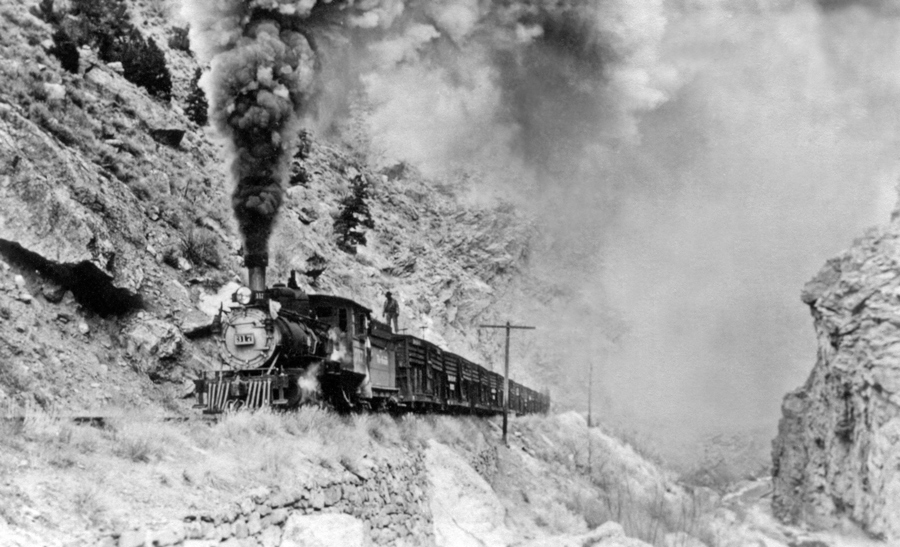
D&RGW 2-8-0 steam locomotive #317 is seen heading up a cattle train through a canyon. She appears to be working hard and a brakeman is keeping watch atop one of the cattle cars.
There is some conflict as to the exact location, with a note on the photo indicating that this is the Black Canyon of the Gunnison in Colorado. Another source says this is in the Cimarron Canyon near Cimarron, Colorado. Both locations are very close together, so only Otto Perry knows.
She’s a Class C-18 and a Baldwin product of 1895. Originally owned by the Florence and Cripple Creek Railroad as their #5 “Florence”, and was scrapped in 1946 (some sources indicate the date as 1948).
Photograph by Otto C. Perry; former collection of William H. Radcliffe; collection of Jack C. Shall.
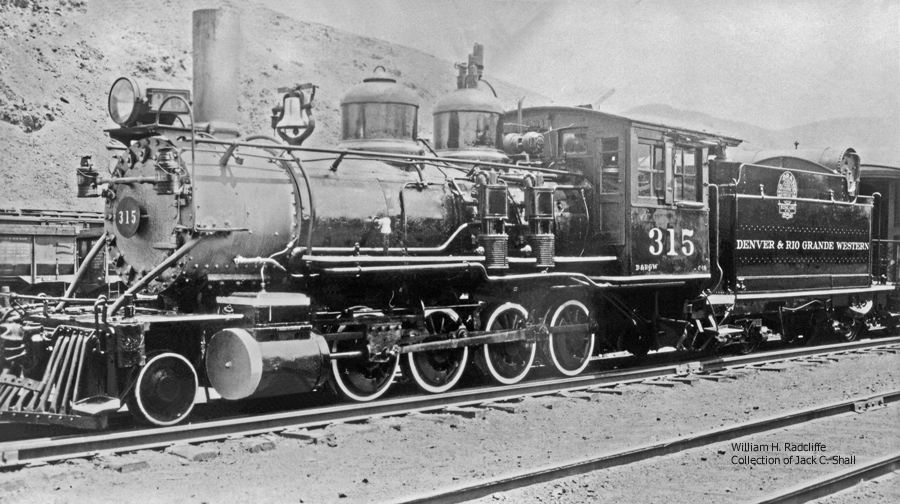
Bill Radcliffe was in Colorado back in July of 1938, and while there he recorded this view of the Denver & Rio Grande Western’s 3-foot gauge 2-8-0 locomotive #315. She’s a Class C-18 and a Baldwin product of 1895. Originally owned by the Florence and Cripple Creek Railroad as their #3, she is seen here in Salida sporting what appears to be a fresh coat of paint.
I understand that she was restored to operational condition in the early 2000s, and has operated on both the Durango and Silverton Railroad, and the Cumbres and Toltec Scenic Railroad.
Photograph by William H. Radcliffe; collection of Jack C. Shall
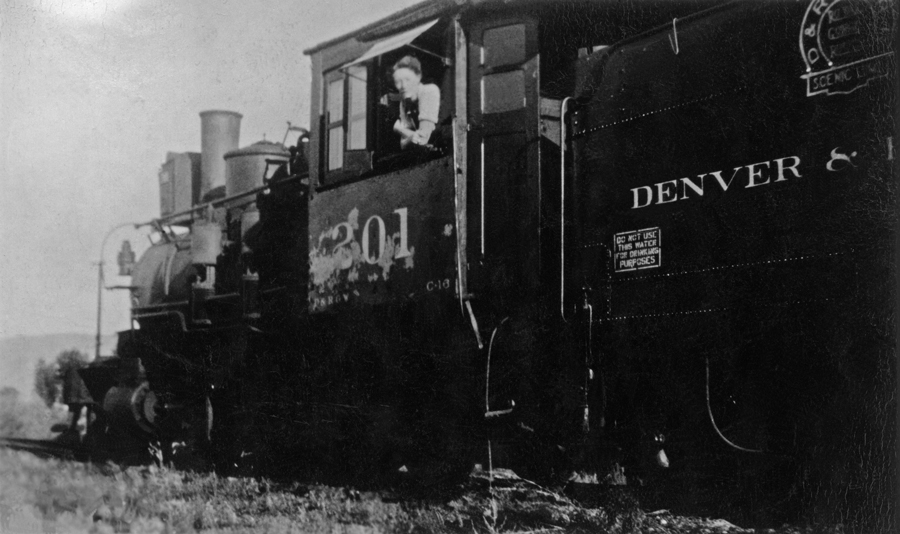
Another of the older locomotives in the Radcliffe collection is this rather unflattering view of Denver & Rio Grande Western locomotive #201. She is a 2-8-0 built by Grant in 1881 as a class 60 machine and I’ve read that she was named “Ohio Creek”. The Rio Grande later reclassified this locomotive as C-16, this classification being more familiar to railfans. She was scrapped in 1937.
This image was taken by an unknown photographer in 1918 at Gunnison, Colorado. Former collection of William H. Radcliffe; collection of Jack C. Shall.
Last week I mentioned a new photo topic for “narrow minded” folks. Well railfans probably knew immediately that I was hinting about the narrow gauge railroads. And that would be correct . . . the three-foot gauged lines in Colorado and New Mexico.
Back in the late 1980s I made the acquaintance of Mr. William H. Radcliffe, an elderly gentleman would also happened to be blind. In return for a favor, he gifted me with a manila envelope which he said were a few photographs that he was sure I would enjoy. When I got home and opened the envelope, it contained a couple dozen photographs of Colorado narrow gauge locomotives and trains. I noticed the envelope had been mailed to him by Mallory Hope Ferrell, and some notes indicated that Mr. Ferrell had received negatives sent him by Mr. Radcliffe. Knowing that Mr. Ferrell had authored perhaps two dozen books about the narrow gauge railways, I assume that he had been reviewing photos from Mr. Radcliffe’s collection.
But on to those photos. They’re all black and white prints of varying sizes, from 2.75″x4.5″ up through 5″x7″. Unfortunately they are all in semi-rough to very rough condition. I’ve scanned them, and attempted to restore them as well as my very limited skills allow. I’ll feature these photos over the next several months.
On to the show!
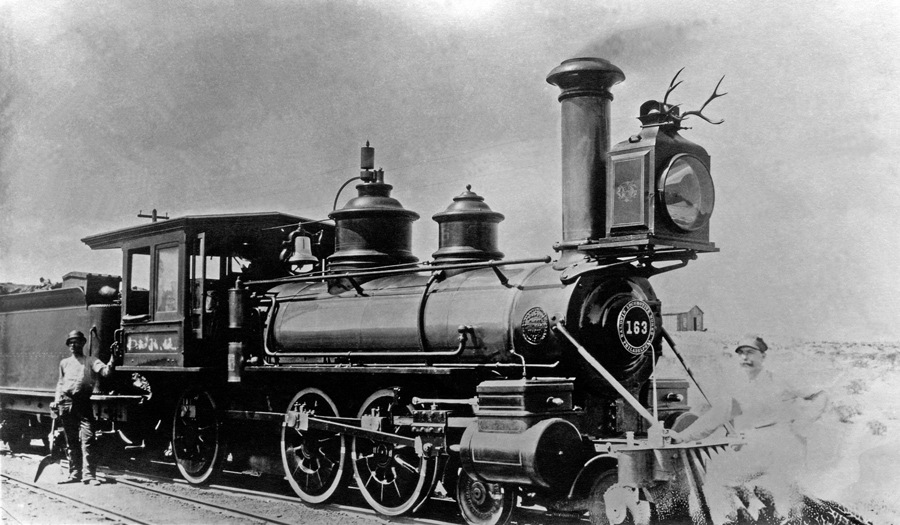
This first image is one of the oldest in the collection. The locomotive is the Denver & Rio Grande 4-6-0 #163, posed at an unknown location. She’s a product of the Baldwin Locomotive Works, built in 1882. The engineer is posed at the pilot with his oilcan, and the fireman is back at the cab with scoop in hand. And note the antlers on the headlight. She was scrapped in 1916.
Former collection of William H. Radcliffe, collection of Jack C. Shall.
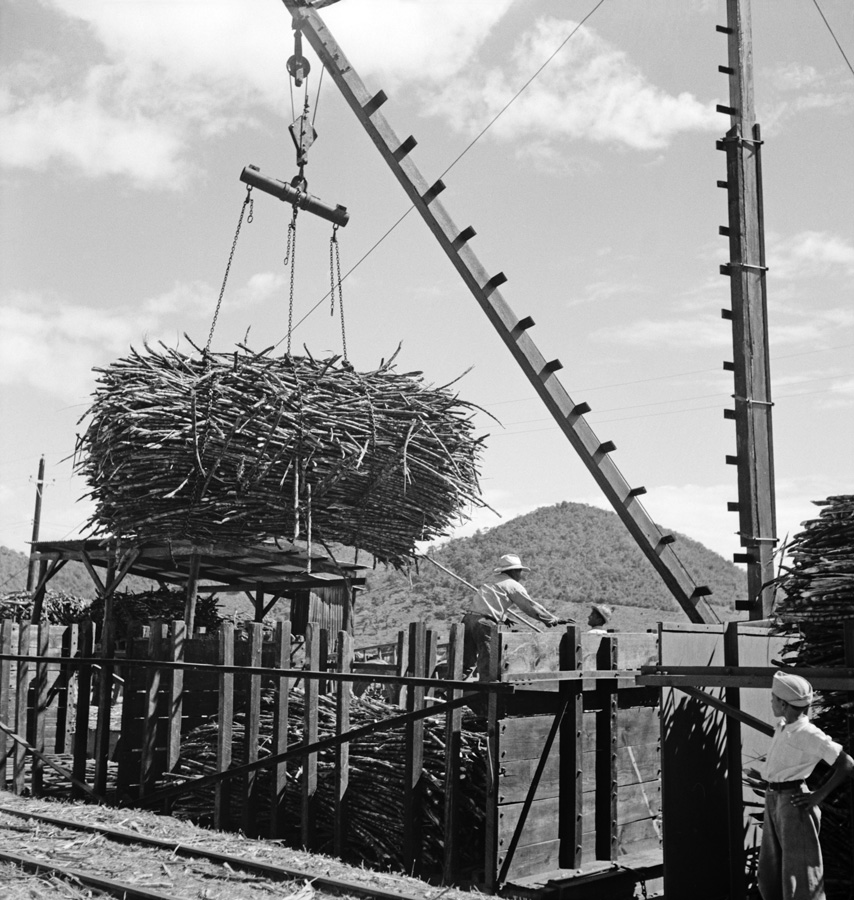
In January of 1942 Jack Delano spent a bit of time down in Puerto Rico. While there he recorded the work going on in the sugar cane fields. The workers bring the harvested cane in from the field in carts drawn by oxen, where it is trans-loaded onto freight cars for the trip to the mill. Here we see a freight car being loaded with cane at the loading station near Guánica.
Jack Delano fell in love with Puerto Rico while working there, and ultimately took up residence on the island after WWII. There is a nice write-up about him in Wikipedia that you might find interesting.
With this photograph we’ve concluded our journey with Jack Delano. We’ve seen almost 250 of the thousands of images that Mr. Delano created back in the early 1940s. I have a couple dozens images by others that I’ll be presenting over the next several months. They should appeal to the “narrow minded” folks that visit this blog. Come back next week to see what I refer to.
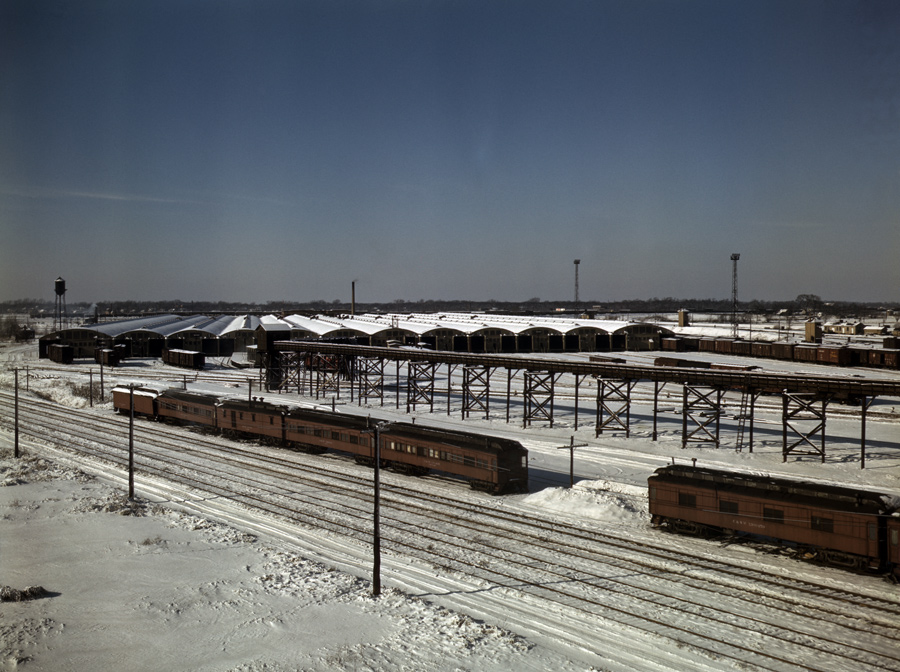
Last week we saw some aerial views of the C&NW’s Proviso yard near Chicago. I’ve a few other aerial images that Jack Delano recorded while in the Chicago area. This first photograph is of the C&NW freight house located in the Proviso yard. It’s a cold day in December of 1942, a year after the beginning of the U.S. involvement in WWII.
In the foreground are old passenger cars used as living quarters for some yard workers and itinerant help.
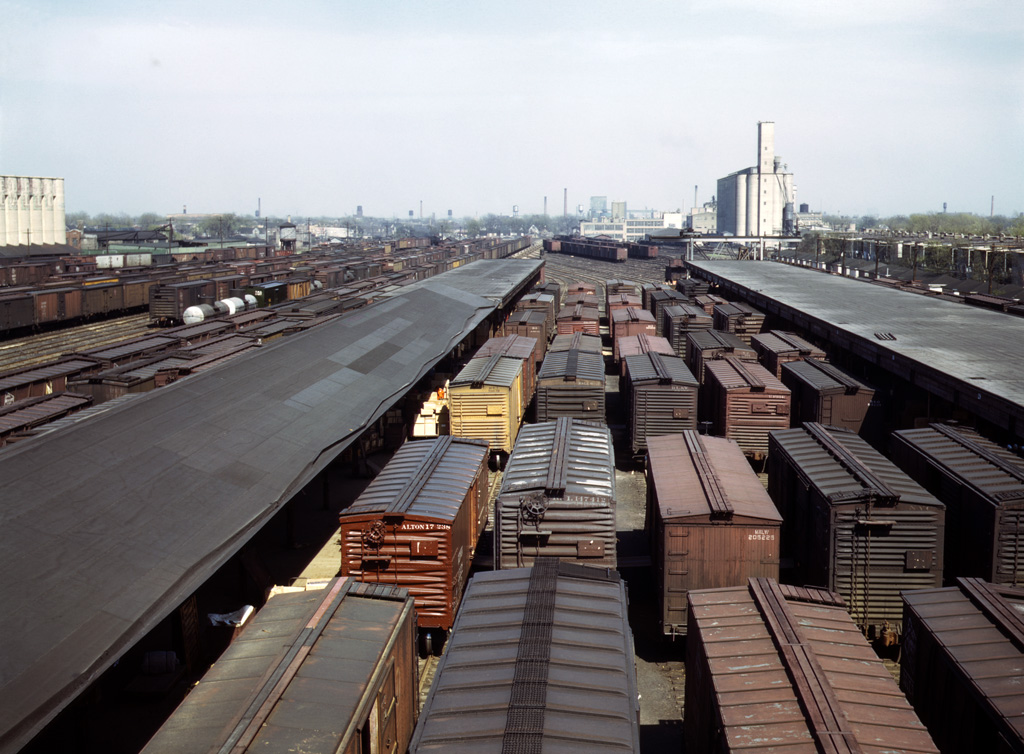
This next view was taken in April of 1943 at the Chicago, Milwaukee, St. Paul and Pacific Railroad (CMStP&P), often referred to as the “Milwaukee Road”. Their reporting mark was MILW. This is the Galewood yard and that appears to be their freight house at center, with the actual yard at left.
Note the interesting mix of wood and steel boxcars in use at this time.
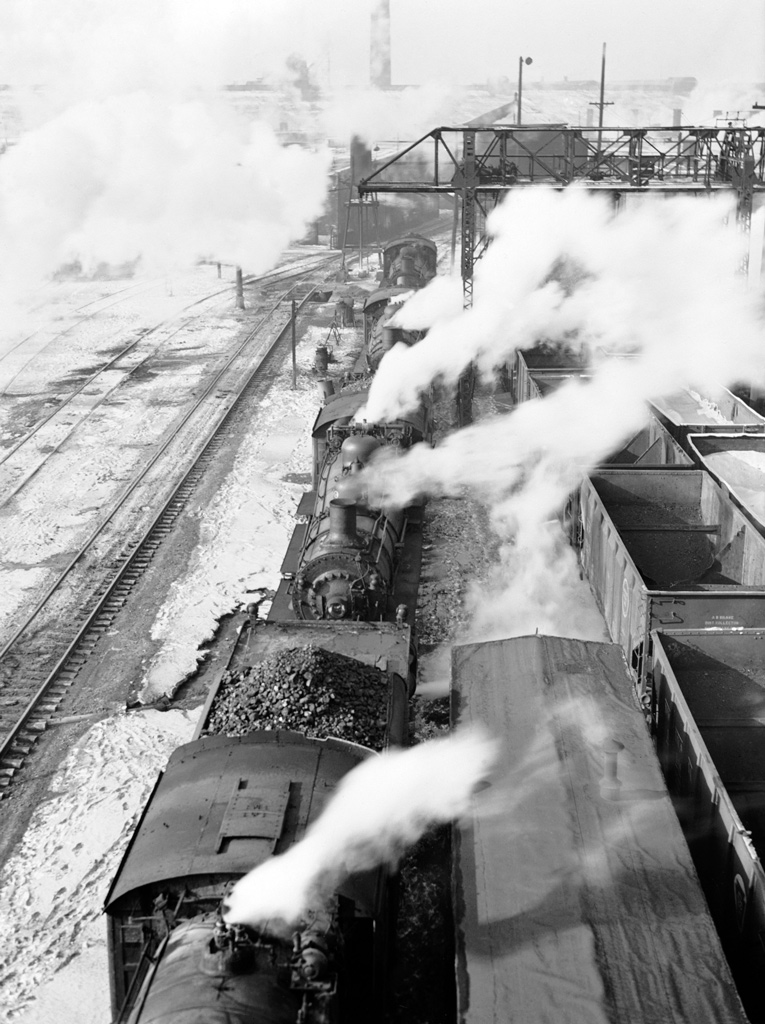
And in November of 1942 Mr. Delano recorded this image of the Illinois Central yard in Chicago. The vapor plumes on this frosty day reveal the locations of several steamers hard at work around the yard. In the distance a couple of the retarder operator’s towers are seen. These are used to control the gravity descent of cars rolling down the hump. You can read about them in this post.
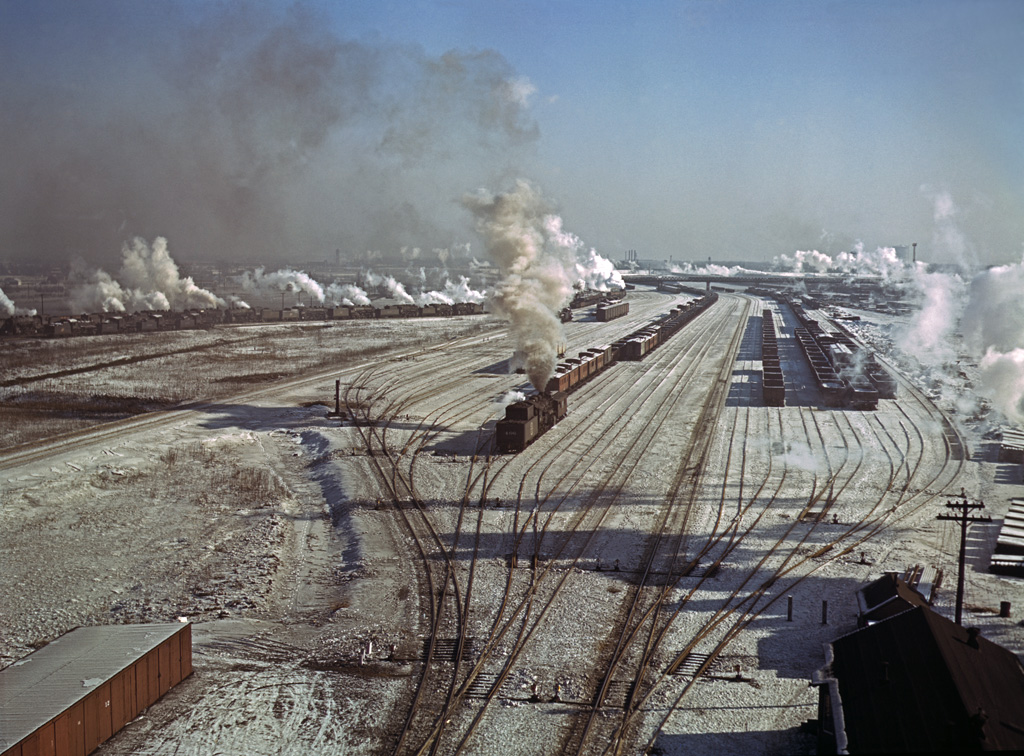
Jack Delano was able to record some nice aerial views of several of the yards that he visited in the Chicago area. These first two images were taken in December of 1942, and are looking generally to the east. A roadway bridge can be seen in the distance crossing over the entire yard. I believe this is the Mannheim Road bridge, which still exists.
Note the storage lockers at bottom left. This is the location where the employees have their Victory Garden. Also note the line of steamers sitting on the ready track at left, having been serviced at the coaling stage (to be seen in the next photo).
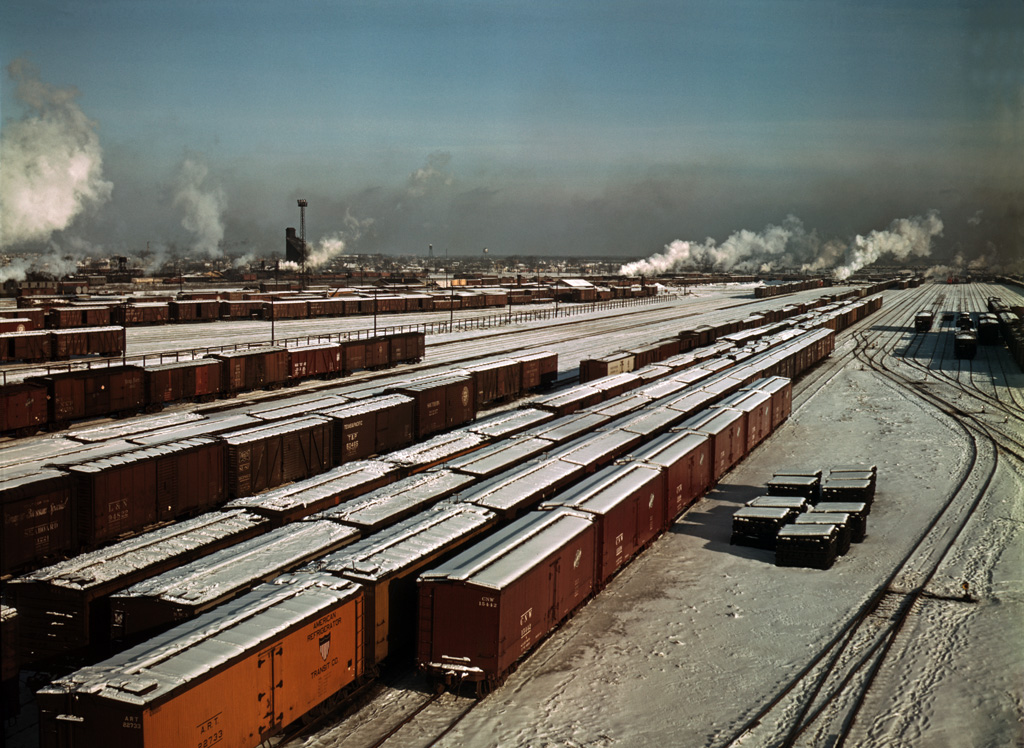
Panning a bit to the left, the view below was apparently captured on a different day as the snowfall is considerably heavier. Note the coaling tower in the distance. Delano spent considerable time in that area recording the locomotives as they were serviced. And we’ve seen several of those images here, here and here.
I’m speculating that these aerial views were made by climbing the various yard light towers, one of which can be seen in front of the coaling tower. This gentleman went the extra mile to get the image he wanted!
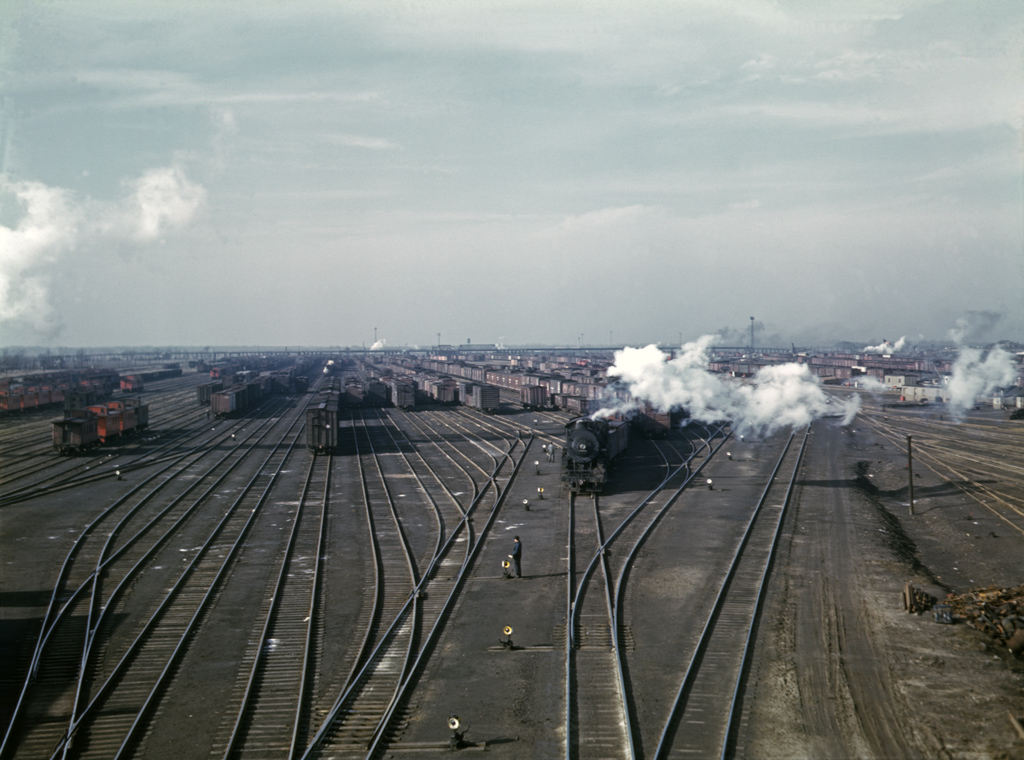
The image below was taken in April of 1943. The snow is gone, but with the large amount of condensate in the stack exhaust, it’s likely still chilly. Judging by the shadows, I believe we’re looking west now. The Mannheim Road bridge is again visible in the distance.
Jack Delano spent considerable time at the locomotive servicing facility while touring the C&NW Proviso yard near Chicago. It’s December of 1942, and he has recorded this view of a line of steamers that have had their coal, sand and water replenished, and they stand at the ready. Four locomotives are lined up here, and one can faintly discern two others in the background.
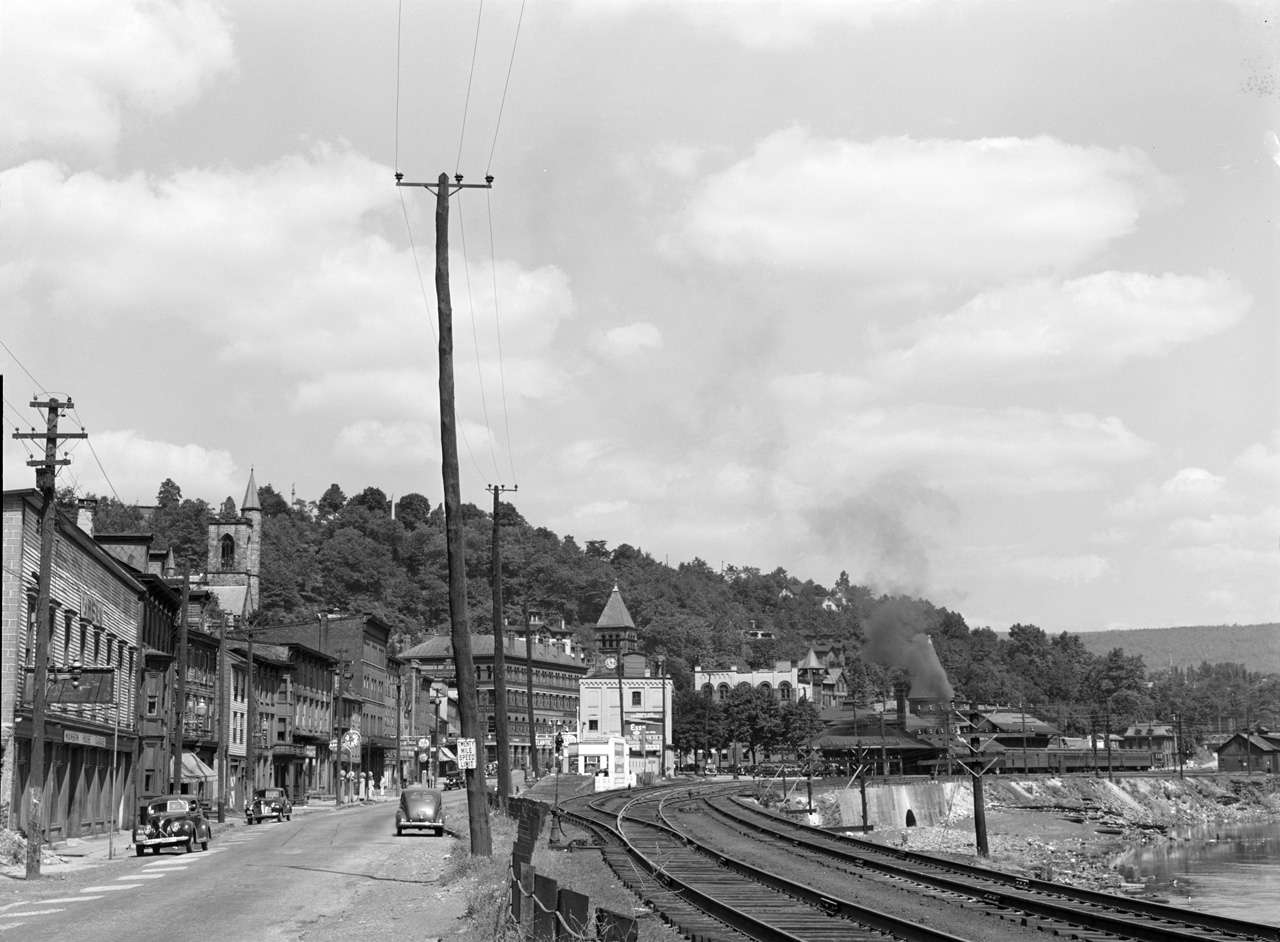
Jack Delano was passing through the town of Mauch Chunk, Pennsylvania back in August of 1940. While there he recorded this view along Susquehanna Street, with the Lehigh Valley Railroad depot visible at far right. It’s a bit cluttered with the town and railroad all competing for a piece of land along the river in this narrow valley. And there is a wealth of detail in this image! I’ve posted this photograph in a larger than normal format so one can zoom in to study it.
The railroad itself clings to the bank of the river, with two tracks expanding into three; all those track switches laid out on the curve. A short (likely local) passenger train is stopped in front of the depot, with it’s steamer hiding behind some power poles.
Susquehanna Street has an abundance of service stations on it. The first one at left is the Manson House Garage, a Shell dealer. Several doors down is an Amoco dealer, with their gasoline pumps right at the street’s curb (obviously space is tight!). A few more doors down is a Tydol Gasoline station (the Flying A) also with pumps at the curb. And finally, across the street we see both Atlantic and Esso signs side-by-side. There seems to be no shortage of petrol in this city!
I also noticed several monuments in the hills, and apparently spires were in vogue with this city’s architects as witnessed by their proliferation on the buildings (including the depot).
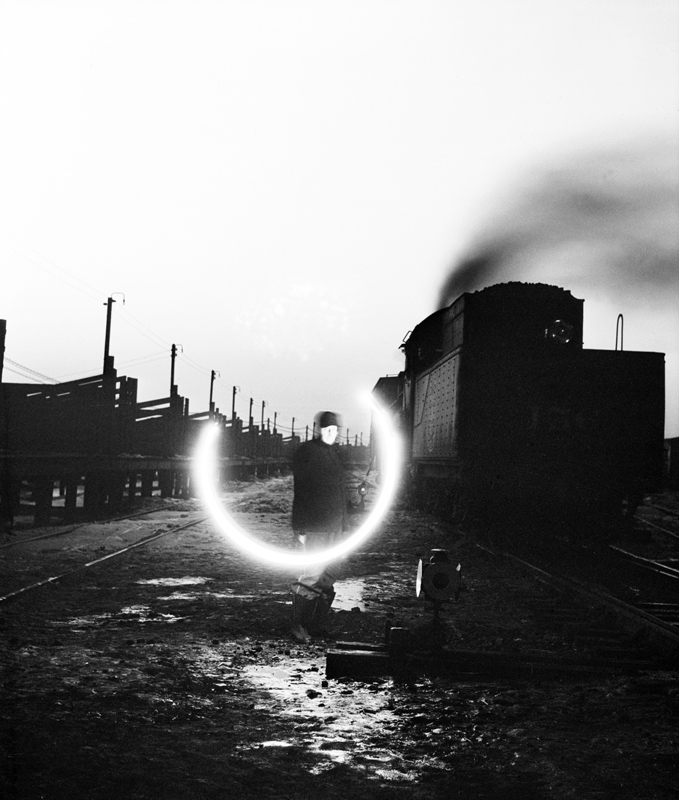
Last week we saw the image Jack Delano captured of a brakeman flagging his train on a cold January day in 1943. It’s now nighttime, and he’s still at the Indiana Harbor Belt yard observing and recording the crews in their labor.
We’re adjacent to the cattle pens here, and the switchman is signaling the engineer to stop. He’ll line that switch for the other route, and then signal the engine to come back.
Railroading on most railroads is a 24 hour/day proposition, and work goes on regardless of the time or weather.
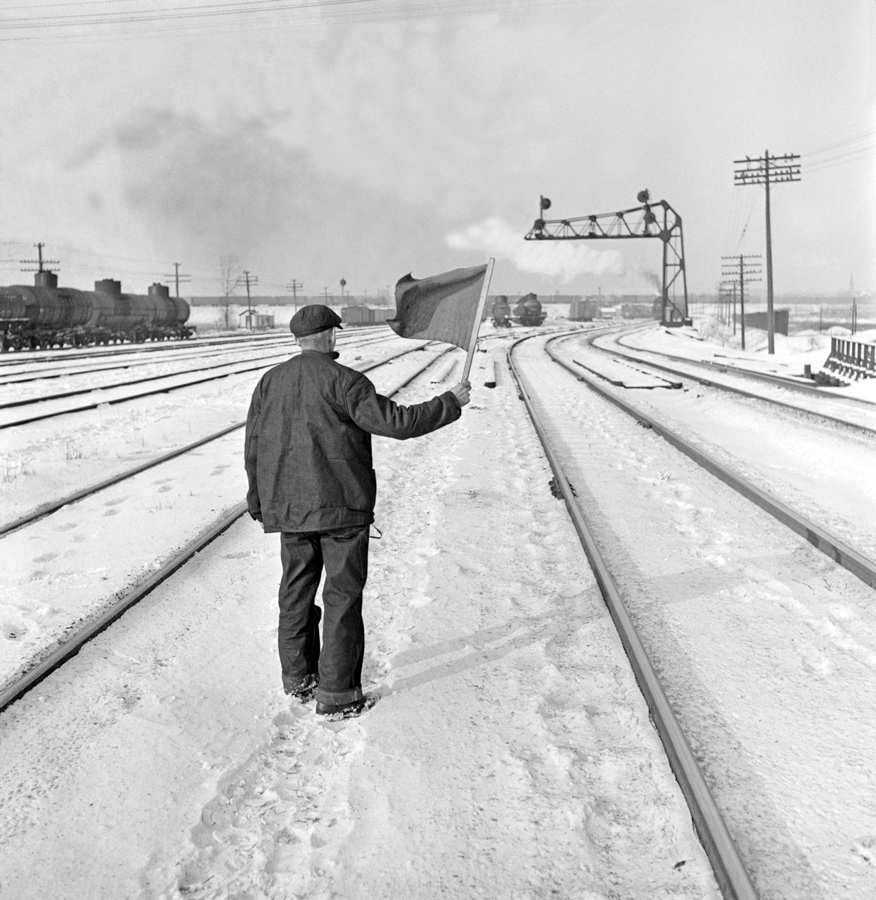
In January of 1943 Jack Delano spent a bit of time on the Indiana Harbor Belt Railroad. He was observing a train crew doing some work when he noticed Brakeman Zerkel flagging the rear of his train. Sure enough, there is an approaching train down by that unique looking cantilevered signal in the distance. Though we’re in yard limits here, the rules apparently still require flag protecting your train if it’s on the mainline.
The IHB ran freight operations between Chicago, Illinois and Hammond, Indiana.
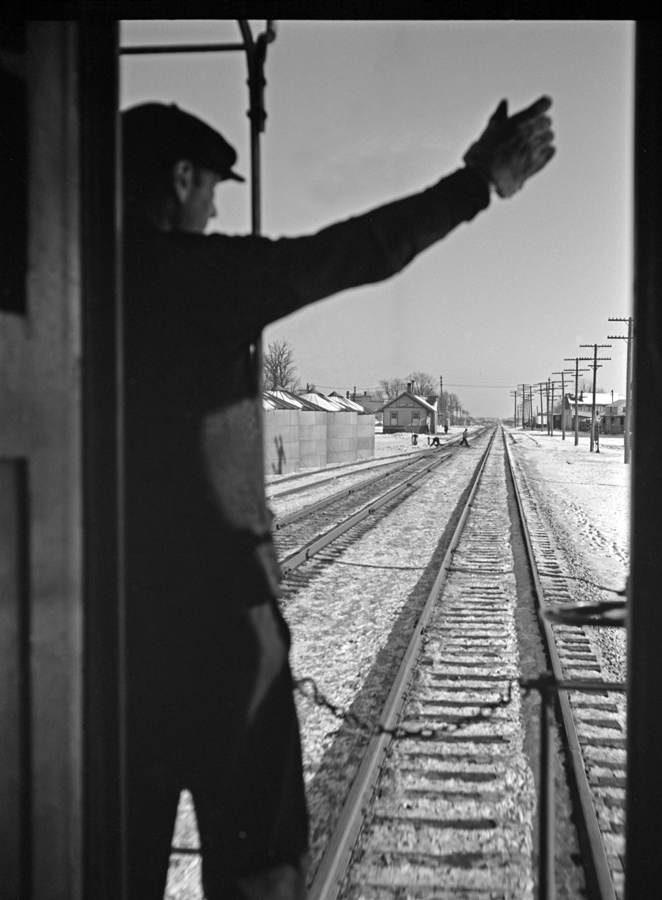
In January of 1943, while traveling in the caboose of a Chicago and North Western freight train, Jack Delano captured this image of the conductor acknowledging a “high sign” from a switch tender as they were passing through Cortland, Illinois. The workers on the ground (some can be seen down by the switch) have visually inspected the train for problems as it was passing by.
Cortland is on the route running between Chicago and Clinton, Iowa. The depot can be seen in the distance, left of the track.