I've been a model railroader and railfan for well over 60 years now. My interests lie in the steam era and the early diesel era. My modeling has been in HO, but I do have a closet interest in Fn3 :-)
It's been a number of years since I've done any layout construction, and the new Louisiana Central pike under construction is by far my most ambitious effort. Follow along with me on this new adventure of the Louisiana Central.
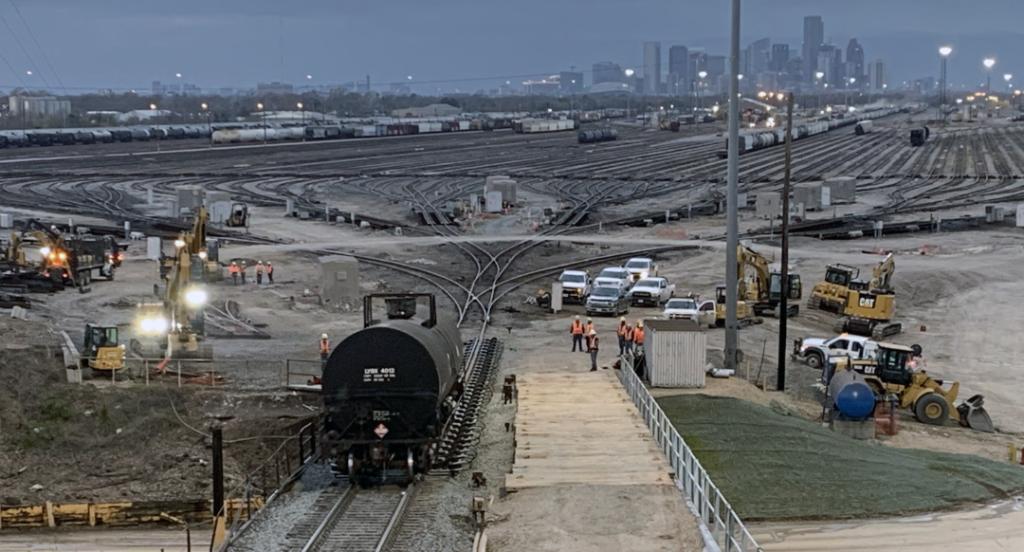
How about this overall view of the Union Pacific’s Englewood Yard in Houston, Texas! This image is from an article in the U.P.’s newsletter Inside Track about their recent replacement of the master retarder for the yard (that’s the section of track below the tank car). This entire task was done in about eight hours! Read the brief story of this accomplishment here.
In January of 1943 Jack Delano managed to get a ride on a Chicago and North Western freight train. The trip started at the Proviso Yard near Chicago and made the trip to Clinton, Iowa and return. I’ve shown a couple photos that he took along the way in previous posts. See them here and here.
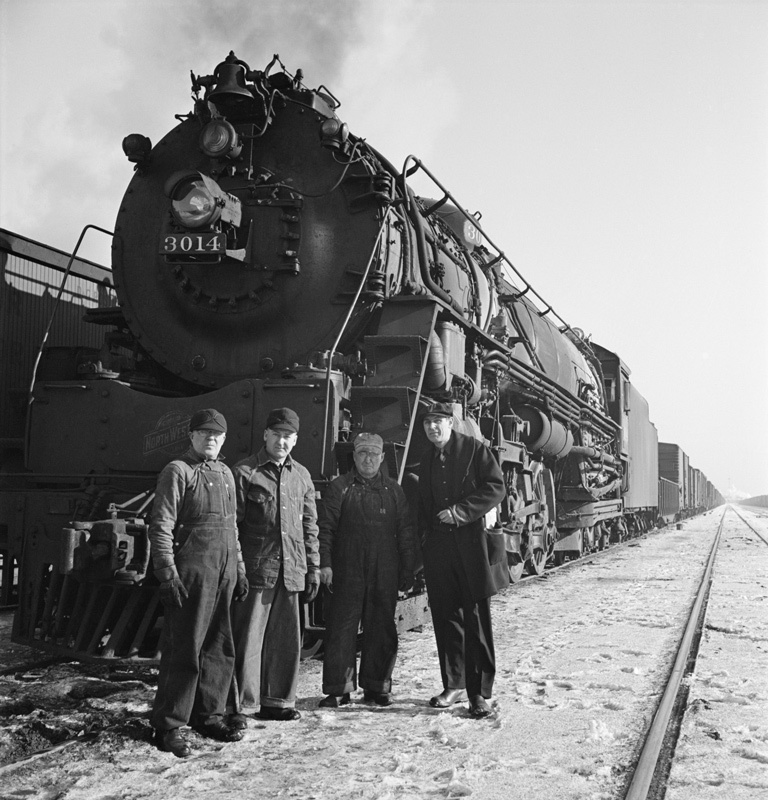
Here Mr. Delano has lined up most of the crew for a portrait before they start on their journey. Unfortunately the fireman didn’t make the cut, as he was busy tending the fire on the locomotive. But seen here are the two brakemen at left, the engineer, and the conductor at right. In a few minutes they’ll be on their way on this frosty morning.
The #3014 is a 1929 product of the Baldwin Locomotive Works, and is a class ‘H’ 4-8-4 Northern. She has 76″ drivers, runs with a 250 psi boiler pressure, and generates 65,225 lbs. of tractive force.
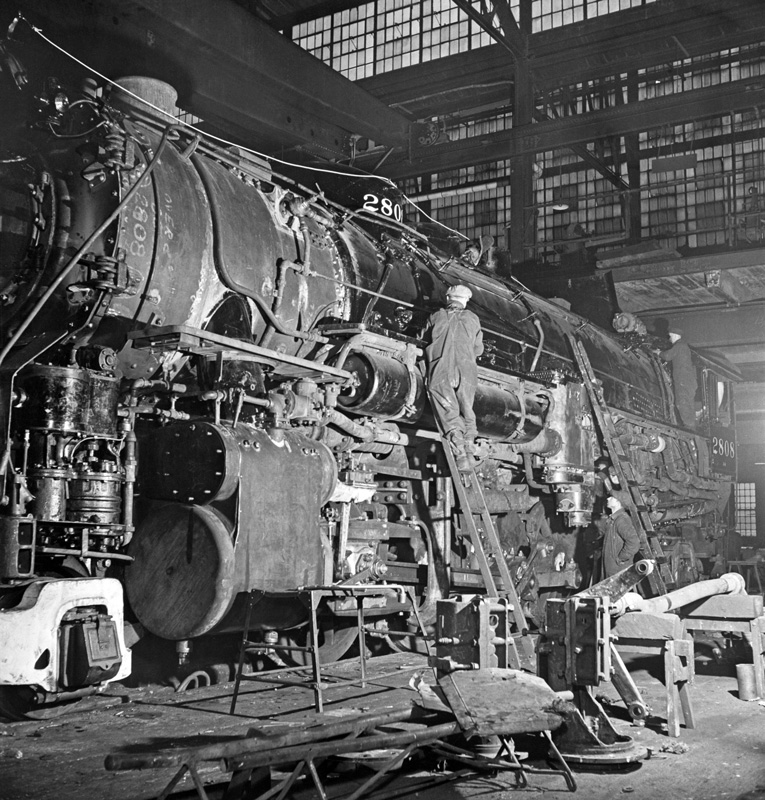
Jack Delano was visiting the C&NW’s 40th Street shops in December of 1942. There he recorded this view of steam locomotive #2808 undergoing heavy repairs. The 2-8-4 Berkshire was of the class J-4, and was built by Brooks (Alco) in August of 1927. She was scrapped in 1950. It looks like they’ve installed a new air pump (at left above the pony truck). It will eventually be tucked behind a stair leading up to the walkway along the boiler. I also assume that a fresh coat of graphite will be applied to the smokebox, and a bit of touch-up done to piping and other appurtenances that have been worked on.
The locomotive looked familiar to me, and after investigation I realized that it had been featured in this earlier post, and was also in this overall photograph inside the shop.
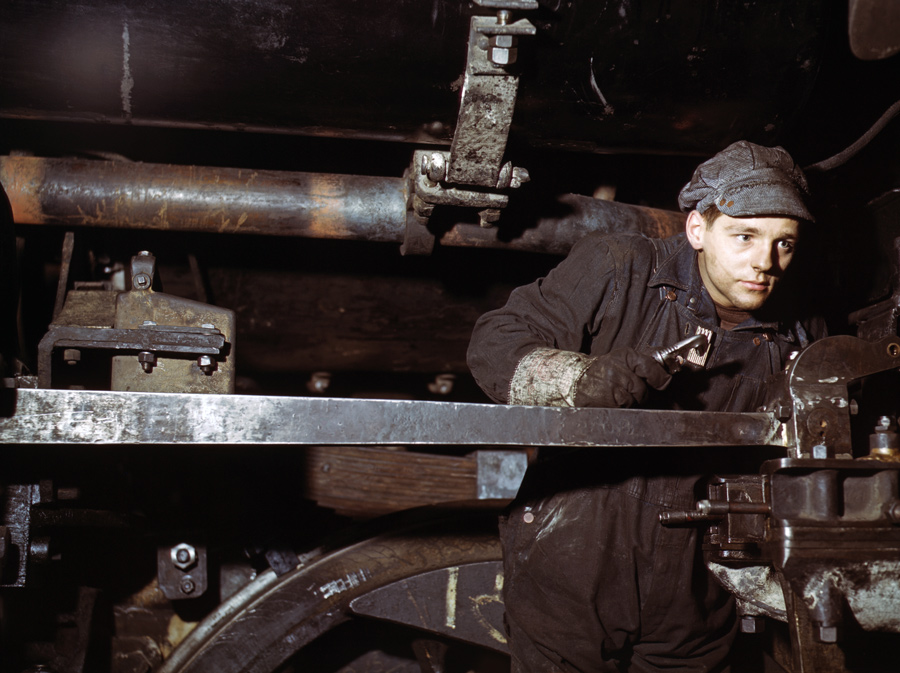
In the previous post Jack Delano photographed a pair of workers in the cab of a steam locomotive under repair. Afterward he headed to the front half of the steamer to find this young man. With Stillson wrench in hand and folding rule in his pocket, and surrounded by rods, pipes and wheels, he is busy working with the machine’s valve gear. We’re at the C&NW railroad’s 40th Street shops near Chicago in December of 1942.
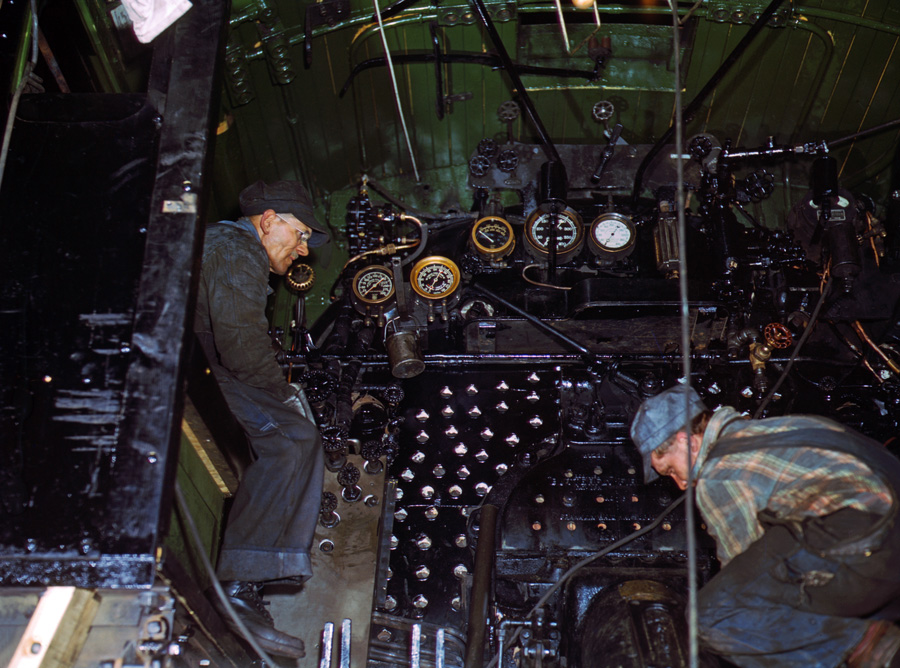
In December of 1942 while visiting the C&NW railroad property near Chicago, Jack Delano went exploring inside their 40th Street shops. He recorded this view of a couple workers doing some repair in the cab of a steam locomotive. Judging from the look of these two men, it appears that this is a senior mechanic (left) observing and guiding an apprentice.
A pair of steam locomotives are at work in the Chicago & North Western’s Proviso Yard near Chicago. Jack Delano visited the facility several times, in December of 1942 and again in April and May of 1943. This photograph’s date is uncertain but I’d judge it to be either December or April. Whatever the date, it’s obviously chilly as that switchman (barely visible near the end of a gondola) is bundled up, and the steamers have quite a bit of condensate in their exhaust.
The lead locomotive, #2570, is an Alco product of 1922 and is a “J” class 2-8-2 Mikado. I’m not able to identify the second machine, but it appears to be a similar locomotive. The switchmen must have been working with a long cut to need this much power!
Jack Delano recorded this night-time image of AT&SF steam locomotive #3167 as it departed the Argentine Yard with its freight train in tow. This yard is located in Kansas City, Kansas, and there are traces of snow still on the ground in this March, 1943 scene.
The #3167 was a ‘Mikado’ type 2-8-2 built by the Baldwin Locomotive Works in 1917. She sported 63″ diameter drivers, 27″ x 32″ cylinders, a 200 psi boiler pressure, and exerted 62, 950 pounds of tractive effort.
She was lost in a flood in 1952 and is said to still be sunk in the Kaw River in Topeka, Kansas.
I know, this post strays a bit from railroading. But I love this image, and it does have what is obviously (at least to me) a railroad station.
In October of 1940 Jack Delano found himself in Caribou, Maine. This photograph was recorded of a group of potato trucks parked alongside the road, and by a train depot. The notes accompanying the image say that this group of almost 50 trucks was waiting in line outside of a starch factory to be weighed and graded. Some had been waiting for over 24 hours!
The view of the trucks is interesting, but it’s the depot that caught my eye. A bit over a year ago I posted a photograph of the Bangor and Aroostook Railroad depot in Caribou. The railroad serving this facility isn’t mentioned. A bit of research revealed that another railroad, the Aroostook Valley, had existed here at this time. This electrified line had both freight and passenger service, and potatoes were it’s largest freight revenue. So is this an A.V. depot, or perhaps an older B.A.R. structure? If any readers know, please comment and solve the mystery.
It’s still three months before the United States would enter World War II, and Jack Delano is already traveling the country documenting people and industry at work. He found himself at the United Farmers’ Cooperative Creamery in Sheldon Springs, Vermont on a September day in 1941. He photographed this worker shoveling chunks of ice over the milk cans that have just been loaded into a refrigerated railroad car (a reefer in railroad parlance). One would assume that there is no icing dock in Sheldon Springs, thus requiring the workers to cover the cans with large ice chunks as we see here.
There is no information with the photograph indicating what railroad line this creamery is served by, but I would speculate that it’s the Central Vermont based on where Sheldon Springs is located (just below Canada).
Jack Delano rode a number of trains on the Santa Fe railroad during his trip out west in March of 1943. This scene was recorded in the caboose while traveling the run between Waynoka, Oklahoma and Canadian, Texas. Conductor James M. Johnson and Brakeman Jack Torbet have just wrapped up their lunch, with Brakeman Torbet washing down the last of his meal, while Conductor Johnson lights up his cigar.
I like the clever way they have stored a supply of air hose gaskets (seen at upper left), making a holder from a scrap of wire and a pair of those rubber gaskets. And I note that Conductor Johnson has acquired a new broom to keep his caboose tidy.
When Jack Delano traveled out to California on the Atchison, Topeka and Santa Fe in March of 1943, he recorded this view of a brakeman riding on the roof of their freight train as they were descending slowly down a grade. They’re in the vicinity of Summit, California on the line running between Barstow and San Bernardino.
I suspect that the train had stopped to let the brakes cool a bit when this photograph was taken. I doubt Mr. Delano would have been atop a moving train with his large camera! Note that the brakeman is carrying a brake club, used primarily to tighten vertical staff brake wheels. And also note the wooden running boards atop the reefer (refrigerated car) that the brakeman is riding. Can you imagine walking those in inclement weather wearing leather-soled shoes?
In April of 1943 Jack Delano was visiting an Illinois Central rail yard, along with some of their facilities in Chicago. He spied this New York Central locomotive spotting cars at the I.C. freight terminal located on South Water Street. The locomotive is a 600 HP model SW1 switcher built by EMD. The number 622 was in the N.Y.C.’s second order of this type.
The N.Y.C. was one of the railroads that leased terminal facilities from the I.C.R.R. in Chicago.