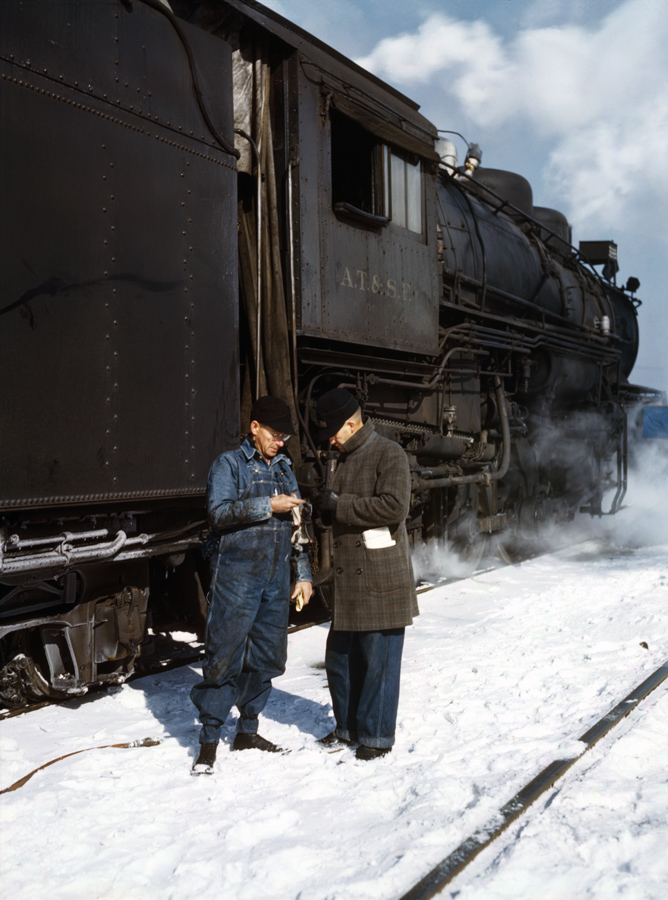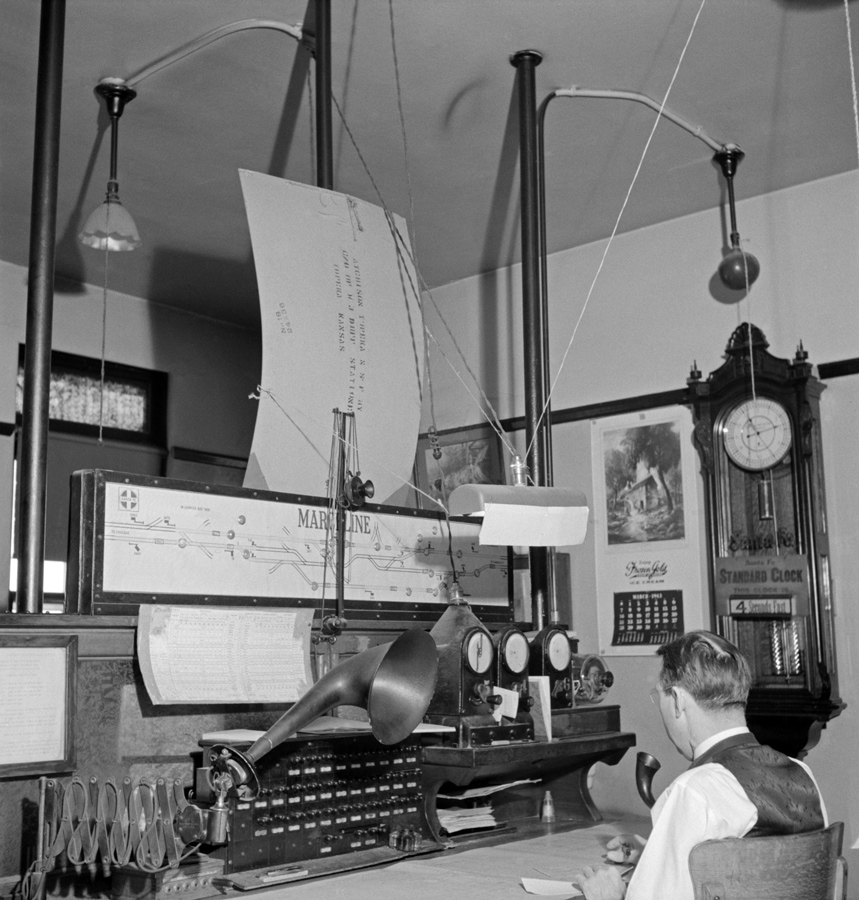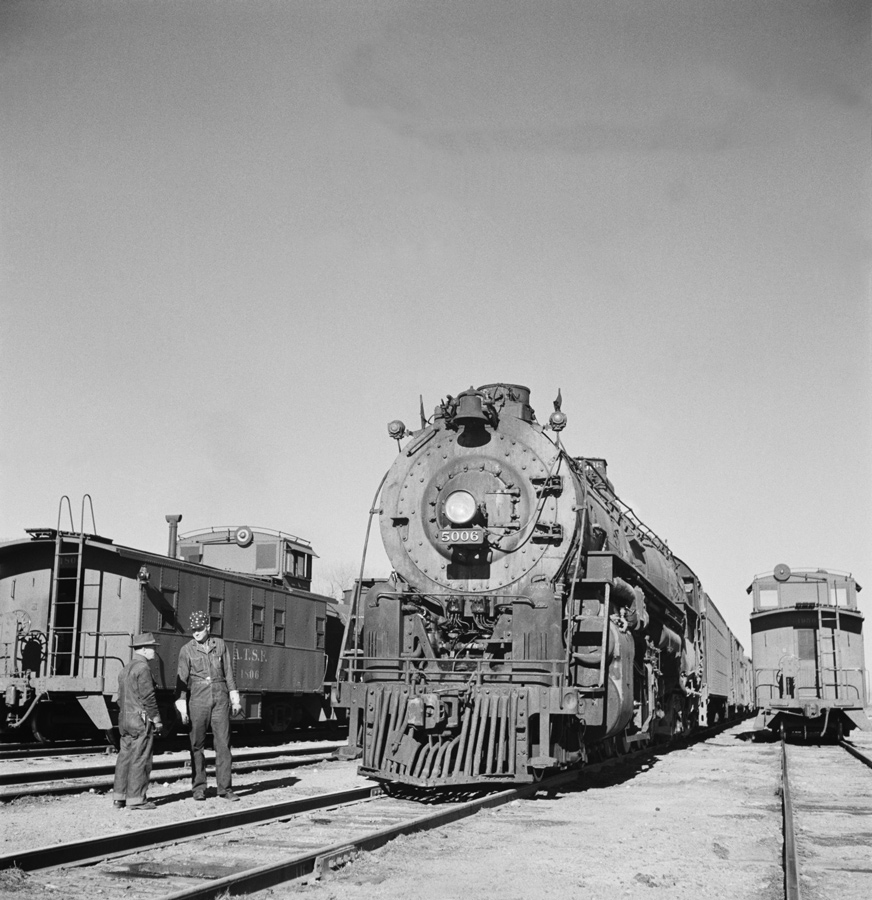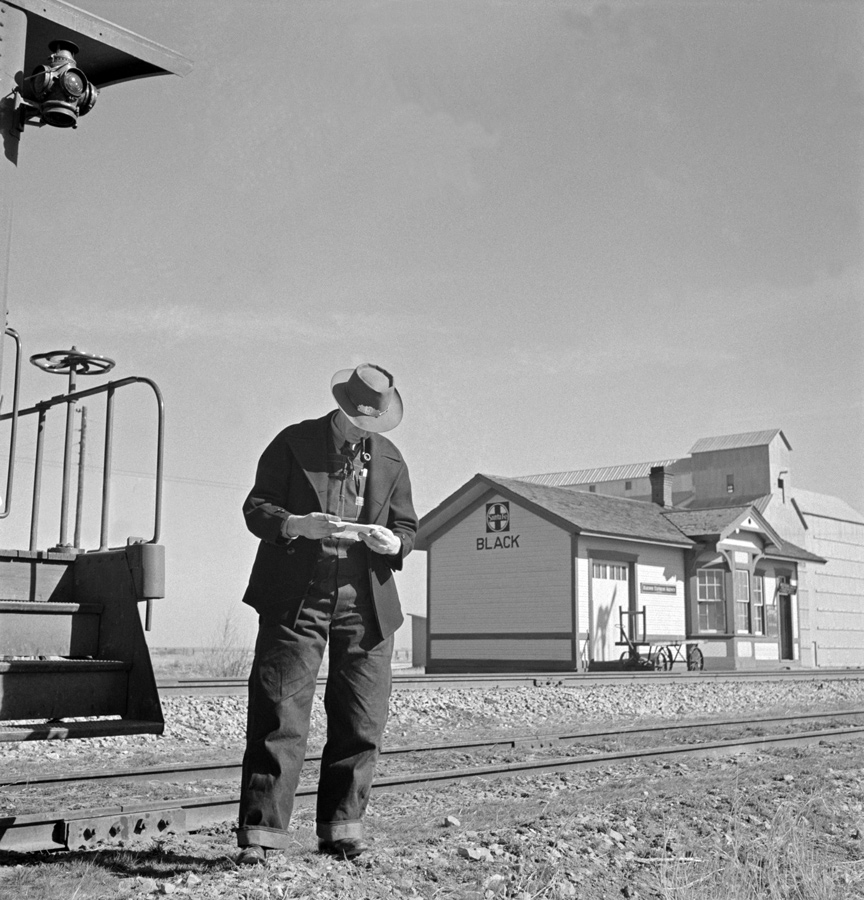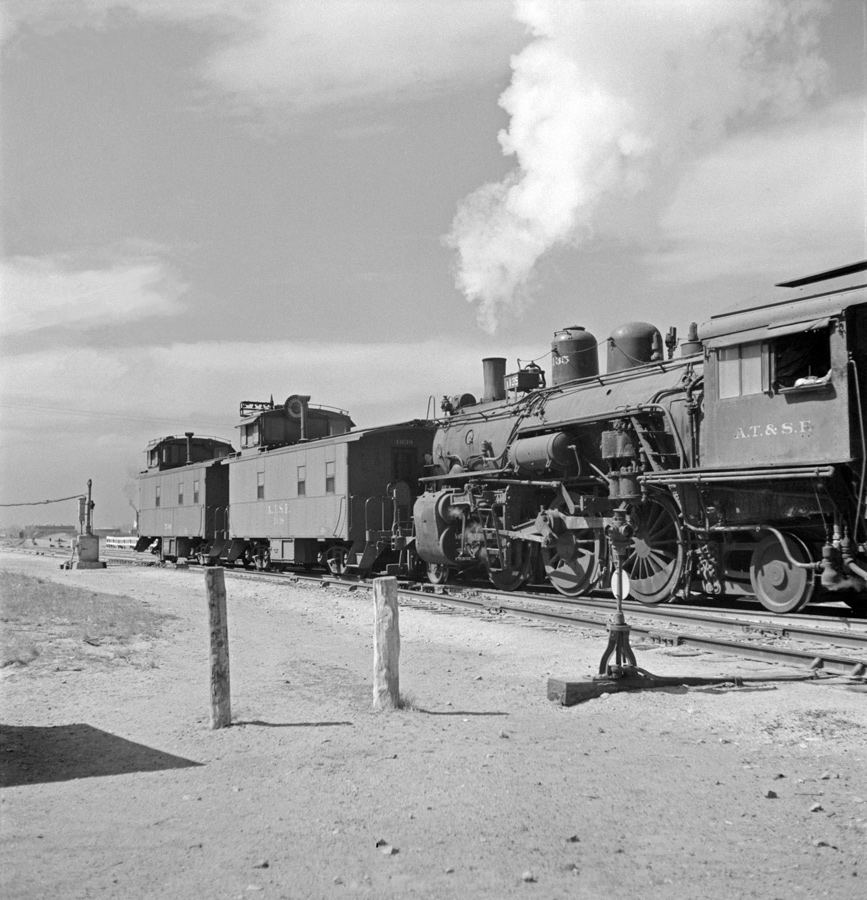
During his layover at Needles, California, Jack Delano took advantage of the time to mosey about the yard. He documented this view of a Santa Fe switchman, Mr. W.E. McCaniel, as he passed by while switching cars. Though it’s March of 1943, apparently it’s comfortable in Needles this time of year judging from the short sleeves McCaniel is attired in.
Needles, California, March, 1943: The Santa Fe freight train has arrived at the yard and Jack Delano decided to stretch his legs during the crew change and servicing. Down by the roundhouse he captured this image of a worker as he was topping off the sand supply on a locomotive. Note the twin sand domes on this locomotive. The terrain is hilly in this area of the country, and the engineer will often need to apply sand to the rails for traction.
The #3843 is a Santa Fe 2-10-2 type built by Baldwin. It was an oil-fired locomotive, and had 63″ drivers, a 220 psi boiler pressure, and exerted 85,485 pounds of tractive effort. Some years ago an impressive HO scale brass model of this locomotive was offered.
Continuing our tour of the Santa Fe work train in Iden, New Mexico, Jack Delano has made his way to the dining facilities. As we saw last week, the berthing facilities and commissary were rather stark, though functional. The kitchen and dining room follow suit.
Below is the view of a cook preparing the dough for bread. The work area is rather austere, but everything needed seems to be close at hand. Baking powder and various other ingredients line the shelves, along with the ever-present cigar box, possibly containing the “secret ingredient” (what would railroaders do without cigar boxes?). Note the wash stand in the foreground . . . a bowl of water and bar of soap. It must be pre-dawn, as the cook is working under the light of a Coleman lantern.
And below is the view inside the dining room. It must be near the end of the meal period, as only a few workers are left. I would assume that these folks ate a pretty hearty breakfast considering the hard work ahead of them each day. Unlike the military, it appears that a busboy was employed to pick up the worker’s dishes at the end of the meal.
During his trip out west on the Santa Fe in March of 1943, Jack Delano’s train had a stop in Iden, New Mexico. Iden is located between Clovis and Vaughn, and is rather isolated. A few weeks ago we saw a photograph of a section gang doing some track alignment in Iden. While there Mr. Delano also recorded some images of the camp cars of the work train that the workers were assigned to.
The scene below is inside one of the bunk cars where these men rested when off duty. It’s not too fancy, but does have heat, along with a table and chair(s). At least one kerosene lamp is visible over one of the bunks. And speaking of bunks, those look virtually identical to the ones I enjoyed while employed by the Marines back in the ’60s . . . some things didn’t change much between those decades! 🙂
And below we have the commissary car. Here workers could acquire the various supplies needed during their stay in this remote area. Just about any clothing was available, from head to toe. And one could buy toothpaste and a brush, medical supplies such as Bayer aspirin, Ex-Lax and Vicks, and more. For comfort, you had a choice of pipes and a variety of tobaccos, or cigarettes (Lucky Strike seems to be the brand most often purchased). And if you had the time, you could enjoy a few games using the Bicycle playing cards. The store’s clerk is Mr. J.E. Straight of Newton, Kansas.
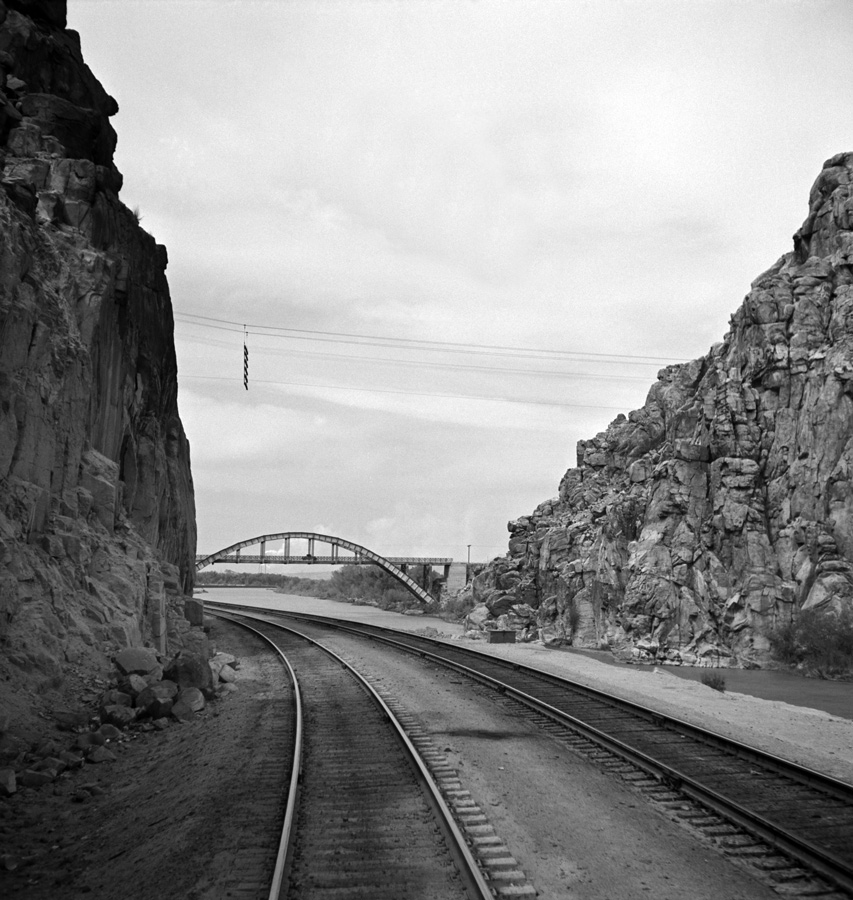
We’re in the vicinity of Topcock, Arizona. Here the AT&SF line running between Seligman, Arizona and Needles, California crosses the Colorado River into California. There are several interesting things in this photograph. Since we’re well into WWII, note the military sentry guarding the bridge. Also note the gauntlet trackage crossing the span. A gauntlet (sometimes spelled gantlet) is typically used to bring a pair of tracks together, overlapping them in areas that have insufficient clearance, such as a narrow bridge. Here we have the four rails of the two mainline tracks, and a pair of guardrails in the center.
This bridge and alignment have since been replaced with an elevated structure supported from below. Judging from the telltale over the curved tracks leading to the bridge, I would speculate that clearances on this bridge weren’t sufficient to handle the now-common double stack container traffic. This new span is also wider, allowing the double track mainline to cross without the use of the gauntlet. And another interesting note: the Google Maps street view shows the current bridge still displaying the Santa Fe heralds on several spans.
In Vaughn, New Mexico the Santa Fe (literally) crosses over the Southern Pacific Railroad (the EsPee, as it was affectionately known). Mr. Delano recorded this scene as they were passing above the EsPee mainline. Note the coaling tower, along with the huge water tank and penstock. Off in the far distance one can make out the rather large two-story Southern Pacific station, along with a smaller building and a large storage tank.
There doesn’t seem to be much here beyond that. A look at Google maps shows this location still exists, with the BNSF Railway crossing over the Union Pacific. There is what appears to be an interchange track connecting the two lines, but beyond that, there is not much else. The structures are gone now, replaced by what appears to be a trailer near where the wooden structure is in the foreground.
Jack Delano’s train has stopped at the Atchison, Topeka and Santa Fe yard in Winslow, Arizona. While stretching his legs, Mr. Delano captured this image as an engineer was climbing up to the cab of his locomotive. This is an EMD model FT diesel-electric freight locomotive, and as one of the newest members of the fleet, has been washed to look its finest for the run.
During his trip out west on the Atchison, Topeka and Santa Fe Railroad in March of 1943, Jack Delano would take advantage of the various stops along the way to observe the surroundings. When the train reached a place named Iden, New Mexico, located between Clovis and Vaughn, he photographed this section gang as they were lining the track.
Assistant Foreman George Zamora is seen sighting down the rail looking at its alignment. They are checking for both vertical and horizontal alignment, and are also checking the track gauge as they work down the line.
During his trip to the west coast in March of 1943, Jack Delano recorded images of many of the depots along the route. Though they vary considerably in appearance, they are all recognizable as Santa Fe depots, this due to certain elements in their architecture. Some have a “mission style”, and others are rather plain. But they all have a certain “look” that says Santa Fe. I’ll intersperse them occasionally with other photographs taken along this journey.
As stated in the title above, this depot is located in Isleta, New Mexico, about 15 miles south of Albuquerque. Isleta is an Indian reservation, and is referred to as a pueblo (pueblo is Spanish for village). Indeed, the official name is Pueblo of Isleta, or Isleta Pueblo.
Note that the train order signal displays horizontal indications for trains in both directions. This indicates that the next train (in each direction) has orders to pick up as they pass by. It must be a chilly day as all the depot windows are closed. And with four chimneys, the building is apparently well heated. It seems that the waiting gentleman in the suit has found a new friend with the large dog.
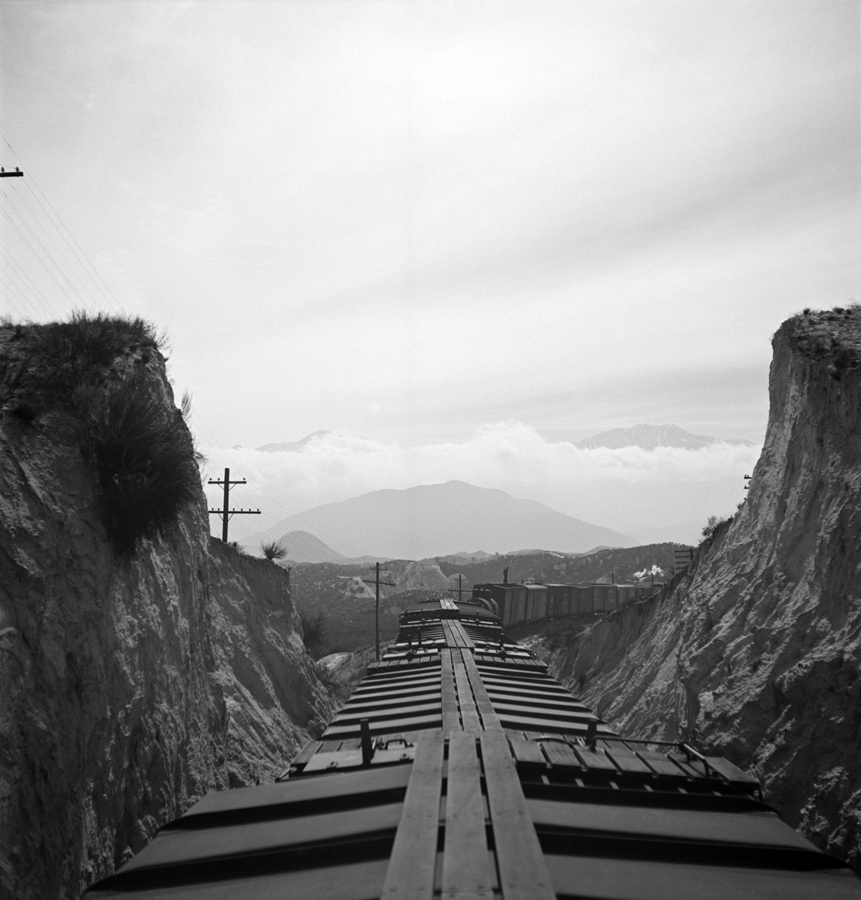
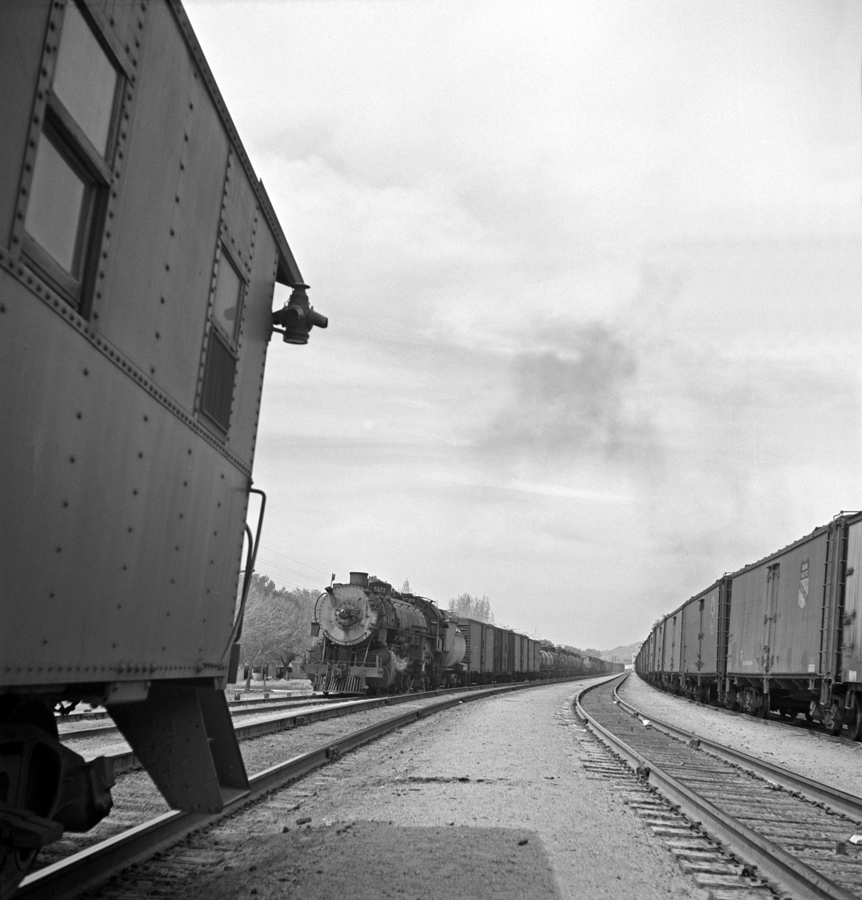
In March of 1943, somewhere between Marceline, Missouri and Argentine, Kansas, our Santa Fe freight has pulled into a siding for an opposing train to pass. The crew will do a “rolling inspection” of the passing train, watching for any problems such as shifting freight, loose loads, hot boxes, etc. The brakeman for our train is likely on the other side of the mainline out of view, having looked over the far side of the passing train.
Jack Delano caught this view of the conductor giving a friendly wave and “highball” sign to the conductor and brakeman on the eastbound train indicating that all looks good on their train.
Continuing our trip to the west, we’ve arrived at Waynoka, Oklahoma. Mr. Delano was poking around stretching his legs, and took this image of the servicing area near the roundhouse. At center is an oil column used to fill locomotive tenders with fuel oil. Most AT&SF steamers used oil rather than coal due to air quality requirements on the west coast. To the left is the spout for a water penstock, this used to fill a tender’s water tank.
After water, fuel and lubrication, the train will be continuing its way west, likely with a fresh crew.
I recently posted several photos that I’d taken this past Thursday and Friday of the Union Pacific’s “Big Boy” steam locomotive, a 4-8-8-4 behemoth that has been touring Louisiana for the past several days. I mentioned in Sunday’s post that a few of us would be heading down to Donaldsonville, Louisiana to hopefully see and photograph the locomotive and train another time or two.
The crowds were quite heavy, and traffic was, as expected, slowed to a crawl for miles! But we did manage to capture a few views from several places. Below are some highlights of the “chase”.
Click on each photo below to see a larger version without the comment imprinted on it.
U.P. 4-8-8-4 “Big Boy” #4014 is running west and is on the outskirts, and heading into Donaldsonville, Louisiana.
U.P. Big Boy #4014 approaching the crossing at McCall Road in McCall, La., a bit west of Donaldsonville.
U.P. Big Boy #4014 and train at the Industrial Blvd. crossing south of Addis, Louisiana (near Dow Chemical). Note that the name “Big Boy” has been chalked onto the smokebox front (it was missing last Thursday when the train arrived in Livonia).