I've been a model railroader and railfan for well over 60 years now. My interests lie in the steam era and the early diesel era. My modeling has been in HO, but I do have a closet interest in Fn3 :-)
It's been a number of years since I've done any layout construction, and the new Louisiana Central pike under construction is by far my most ambitious effort. Follow along with me on this new adventure of the Louisiana Central.
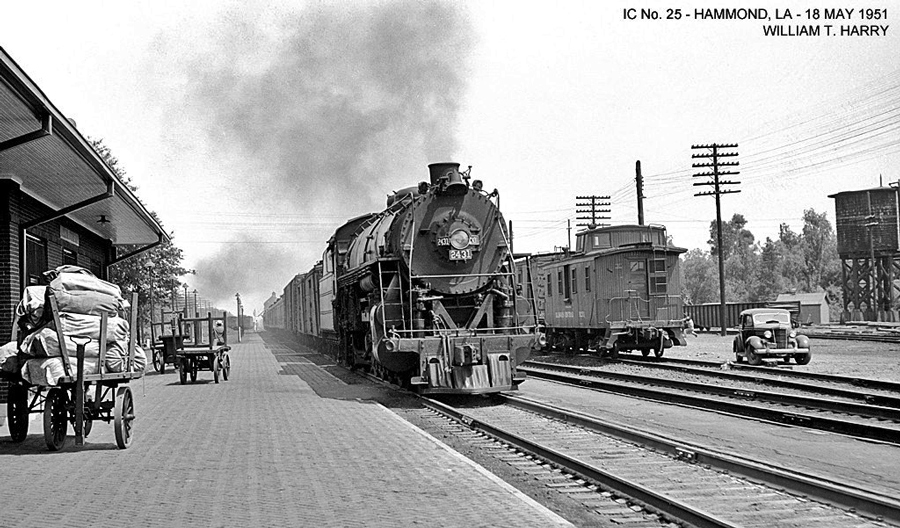
For the past couple weeks we’ve seen distant views of the Illinois Central facilities in Hammond, Louisiana. And here we move in for a closer look, now at the depot and still looking north. This image by William T. Harry is taken from the station’s platform. I’ve paraphrased the caption of the photograph below.
On May 18th of 1951 at around 10 a.m., Illinois Central mail-and-express train No. 25, the SOUTHERN EXPRESS, was pulling up to the station at Hammond, Louisiana behind 4-8-2 #2431. Despite its name, No. 25 was anything but an express, taking 23 hours and 10 minutes to cover the 921 miles between Chicago and New Orleans. Visible above the train’s last cars was the Hammond coaling tower, from which Coal Shoot (sic) Road got its name. The wooden caboose on the right was the #9231.
For the record, Google Maps shows that the city now has the more appropriate name Coal Chute Road on the street sign.
This is another view in Hammond, Louisiana, apparently captured from the rear of a railcar. As in last week’s posting, we’re still looking north, but from a vantage point about one block further south. The street with the pedestrians and automobile is West/East Charles Street (West to the left, East to the right). You can see the turret on the depot beyond the group of trees at center. The street side of the depot faces N.W. Railroad Avenue, and W. Church Street intersects it at about the center of the depot.
This image is chock full of interesting details. That’s W/E Robert Street a block further north. Note the water penstock near there, it serving the southbound mainline track. It’s location is just about right to fill the tender of a steamer as passengers are departing or boarding the train down at the depot. The water tank itself can be spotted towering above that express reefer sitting just beyond the automobile. It’s located in a wye, which still exists today. The track, including the sidings and spurs, appears to be well groomed and in excellent condition.
The coaling tower can be seen in the far distance through the smoke. And note the one-story brick structure at the far right. I can’t make out the name painted on it, but in later years it housed Guy’s Quality Foods, a neighborhood grocery store located in the south end of the building facing E. Church Street. The grocer closed down just a few years ago, but the building remains.
The photograph is undated, so I’ll speculate it’s from the mid-late 1940s. The photographer is John Barriger, and it comes from the Barriger Library Collection.
I’ve posted views of the train depot in Hammond, Louisiana a couple of times before: this view recorded in February of 2004, and this one from the year 2015. Going further back, below is how it appeared at an even earlier time. The image was recorded by C.W. Witbeck on April 20th of 1954.
Back at this time, the Illinois Central was running a double track mainline through here. The track closest to the depot is the southbound main running to New Orleans, the next over is the northbound main to Chicago. Note the small motorcar on the southbound track near the train order signal. If you look very closely in the open area between the train and depot, you can faintly see a track curving away in the distance. This track is the beginning of the Hammond Subdivision, the line heading west to Baton Rouge.
It’s likely that this was the shipping time for strawberries, evidenced by the reefer (refrigerated car) in the foreground that the photographer is using for his vantage point. Hammond (and Ponchatoula a bit further to the south) each claimed to be the strawberry capital of the world, and so many strawberries were shipped from these points that the I.C. would build strawberry trains that would very swiftly carry this valuable cargo up to points north. Indeed, the train parked in the siding appears to be a string of express reefers.
This Witbeck image was given to me by the late Tom Davidson from his collection. Thanks to Tony Howe for providing the photo credit and date.
New Orleans built (Algiers Shops, 1921), the Southern Pacific 2-8-2 #745 is seen taking a spin on the turntable at Avondale, Louisiana for its final time. It’s May of 1956, and in a few days she would be delivered for display at the New Orleans Audubon Park Zoo. That would be her home until removed in 1984 by the Louisiana State Railroad Museum/Old Kenner Railway Association, for restoration.
As a kid, I climbed all over this locomotive while it was on “park duty”. In later years, it became fenced off to keep the vandals at bay. I never imagined that one day she would be back under steam. You can scroll back in this blog to find several images that I’ve recorded while she was running back in the mid-2000s. Type “#745” in the search box and you’ll get a list of postings featuring the old girl.
This photograph was featured for the month of January in the 1986 calendar published by the Louisiana State Railroad Museum. It is from the collection of Richard L. Podawiltz.
The Arkansas & Louisiana Missouri Railroad had their shops in Monroe, Louisiana. Mike Palmieri made a visit there back in February of 1977 and recorded this view of the road’s tired, but serviceable turntable in front of the roundhouse.
The turntable appears to be an “Armstrong” type, in that it is rotated by personnel pushing on the bent-up pole seen in the foreground projecting out from the bridge. I’ve actually done this myself on the Reader Railroad’s turntable up in Arkansas (great fun for a railfan, perhaps not so much for an employee).
Note the pit is somewhat filled with water. I visited this facility myself many years later, perhaps the early 90s, and seem to recall that the pit was filled with water then. If it stays that way, I can’t help but wonder what shape the table bearings are in!
Edit: Ron Findley reminded me of some dates. He and I visited the road in May of 1989. Here is a photo of the roundhouse taken by Ron in May of 1989. The turntable was still in place at that time.
He and I again visited during an NRHS-SELA Chapter excursion on the now Arkansas, Louisiana & Mississippi Railroad in November of1992 (Georgia-Pacific had purchased the road by that time and renamed it). By that time the turntable pit had been filled in and the bridge lay on the ground nearby.
In February of 1975 Mike Palmieri was visiting the Louisiana & North West Railroad’s facility in Gibsland, Louisiana. The L&NW operates 62 miles of shortline pike between Gibsland, northward across the state line to McNeil, Arkansas. At this time, it interchanged with two railroads in Gibsland: the Illinois Central Gulf, and the North Louisiana & Gulf.
Once a day there was a flurry of activity lasting for several hours when the ICG and NL&G railroads came into Gibsland to interchange cars with the L&NW. The action could be intense during that time, and the activity became known as “The Gibsland Shuffle”.
While there, Mike spotted this interesting little structure, recording and labeling it as the ICG “depot” in Gibsland, La. Its sign is almost bigger than the depot! I would speculate that the building has a telephone inside, and the box on the wall held the paperwork covering the cars that the crew was interchanging with the L&NW.
Two weeks ago this story began in Hammond, Louisiana with the post Clearing the Main. There we saw a group of trackwork machines clearing the Canadian National mainline track for oncoming traffic. It was a wet and foggy Saturday back in February of 2004 when I photographed the event.
A week ago I posted And Along Came the Train which captured that oncoming traffic, a southbound Canadian National loaded coal train at speed as it approached the train depot there in Hammond.
To wrap up the story: hot on the heels of that freight was Amtrak train #59, the City of New Orleans, as it arrives a bit late. Amtrak loco #156 apparently had a problem along the way and is being assisted by CN (formerly Grand Trunk) locomotive #6227, an EMD GP38-2. Hammond is the last stop before the train hits New Orleans, its final destination. And note the man carrying flowers to greet someone with as they disembark the train.
The passengers have to carefully get to and from the passenger cars by walking across the track ballast (sometimes a problem for the elderly, and infirm). Eventually this problem will go away when a new raised platform gets constructed here, making the boarding process much easier.
I’ve mentioned on occasion that the original purpose of this blog was to follow the construction of the Louisiana Central, a 1:87 model railroad that runs between Monterey, Louisiana and Bude, Mississippi. The modeled portion of this line is that from Monterey to Willis, Mississippi. The continuation of the line from Willis to Bude is represented by hidden staging track. (Note that all layout town names are fictitious except for Bude, a real city in Mississippi.)
The majority of trackage between these points is installed and operational. But there are two breaks in the mainline. The first is the connection between Whitcomb and Oneida, both are towns along the line. The other break is between the mainline west, and well out of Oneida, to the terminus at Monterey. Some of this trackage is to be on a four foot lift-up section spanning the entry into the layout room.
The Great Flood of 2016 put a halt to layout construction (you can read about that here, and a follow-up here). For many reasons, I did essentially nothing on the layout itself until earlier this year. This year finally sees the first trackwork being laid in over eight years! And the trackage now in place connects the towns of Whitcomb and Oneida . . . a major goal accomplished.
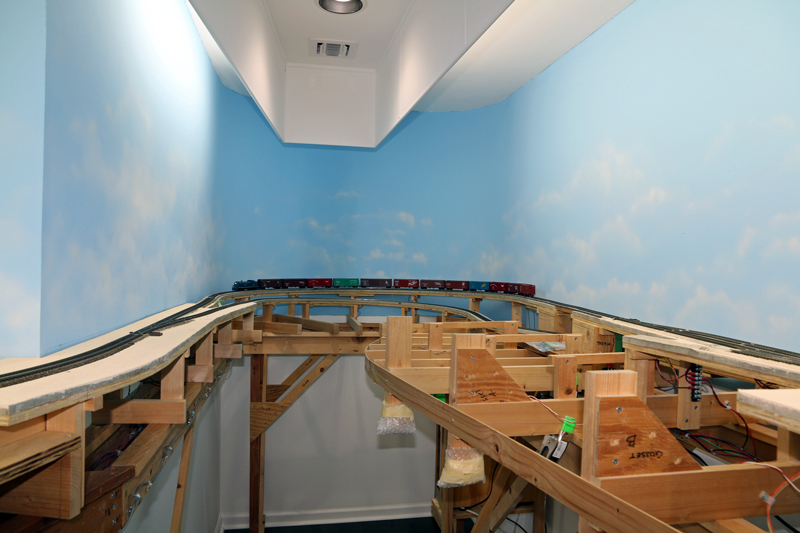
To celebrate this goal, I took a few minutes to photograph the first train to traverse this new trackage. At exactly 5:09 pm (Central Daylight Savings Time) I recorded this movement midway in its journey.
This trackage is located in an alcove of the room. At right one can see the very western edge of the town of Whitcomb, while on the left the town of Oneida lies just a half dozen feet beyond the view. That switch visible on the left is to the line of the Spencer Lumber Company. Spencer suffered the washout loss of a trestle spanning a river a few years ago. Soon after that the SLC managed to gain trackage rights over a short section of the LC that spans that river. You can see their line diverging, going downgrade through the curve, and then passing beneath the LC at right, where it continues its journey into the woods.
Click on this link if you’re interested in seeing the layout plan.
Last week I posted a photo of some trackwork machinery clearing the mainline for an oncoming train. The location is milepost 859 on the Canadian National line running through Hammond, Louisiana. And it’s a rainy Saturday in February of 2004. We didn’t have to wait long for the train to arrive, a loaded coal freight headed up with two (former) Illinois Central SD40-2 locomotives.
Note the consecutive locomotive numbers, 6101 and 6102, with the 6101 showing off its CN paint job (and note the IC subscript at the bottom of the cab). The 6102 would soon also wear this new paint.
It was a wet and foggy Saturday back in February of 2004 when I recorded this view of some trackwork machinery clearing the Canadian National mainline for an oncoming train. The location is milepost 859 at the Amtrak depot in Hammond, Louisiana. The signal indicates there is traffic ahead, likely a freight train as it isn’t time yet for Amtrak train #59, the City of New Orleans.
The day after Christmas in 1988, Ron Findley and I took a journey west from our homes to check out the Louisiana and Delta Railroad (the L&D) at their headquarters in New Iberia, Louisiana. The railroad was quiet that day, and we found a couple of ex-Santa Fe CF7 locomotives resting quietly at the service area near the depot. Ron recorded this view of locomotive #1501, the City of New Iberia, late in the afternoon.
The L&D railroad had been created just the year before. Initially they had a few EMD GP9 locomotives, but soon received several of these CF7s. The Santa Fe had done a massive rebuilding program back in the 70s of tired, old EMD “F” units, producing these “Geep styled” units, of which some are still operating today on shortlines around the country.
Note the CF7 numbered 1503 just behind the 1501. Still in Santa Fe paint, she would soon receive the L&D colors, and would be named Bayou Sale.
On a hot Saturday afternoon in August of 1990, Tom Blackwell was exploring the Arkansas & Louisiana Missouri Railroad facility in Bastrop, Louisiana. He found locomotive #11, an EMD SW7, resting near the scale house. To the left is the road’s Bastrop office and freight house (and often referred to as the depot). That structure is curious and interesting, and folks I’ve spoken with each claim it serves as one, some, or all of these functions.
It’s near the end of time for the A&LM. The road will soon be purchased by the Georgia-Pacific Corporation and renamed as the Arkansas, Louisiana & Mississippi.