LCRR Avatar

About Jack Shall

I've been a model railroader and railfan for well over 60 years now. My interests lie in the steam era and the early diesel era. My modeling has been in HO, but I do have a closet interest in Fn3 :-) It's been a number of years since I've done any layout construction, and the new Louisiana Central pike under construction is by far my most ambitious effort. Follow along with me on this new adventure of the Louisiana Central.

Changing the Cabooses

Cabooses were often assigned to a specific conductor in earlier days. If you’ve followed this blog for the past few years, you’ve likely noticed how caboose interiors would be “customized” by the crew (usually the conductor).

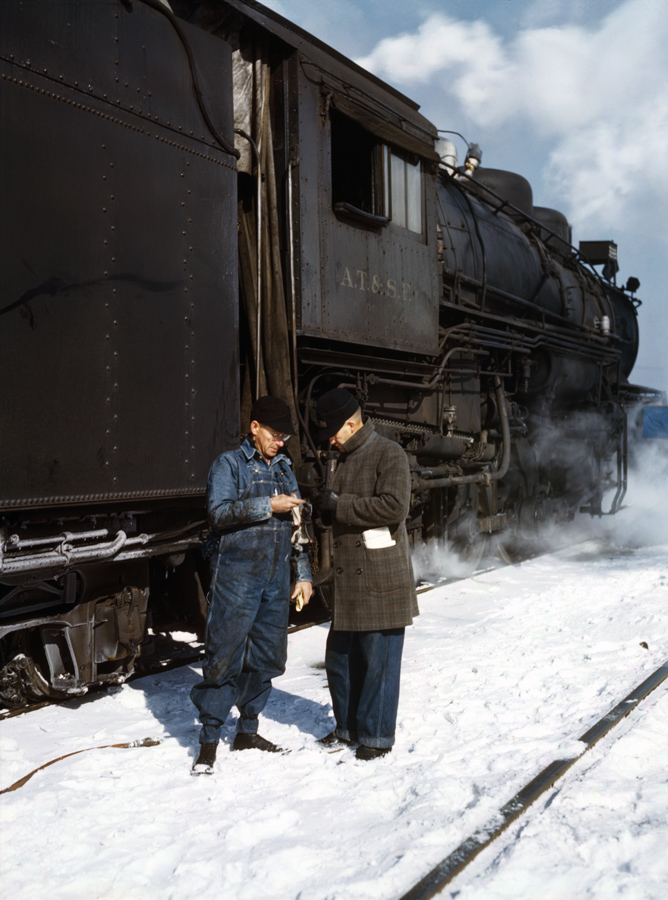
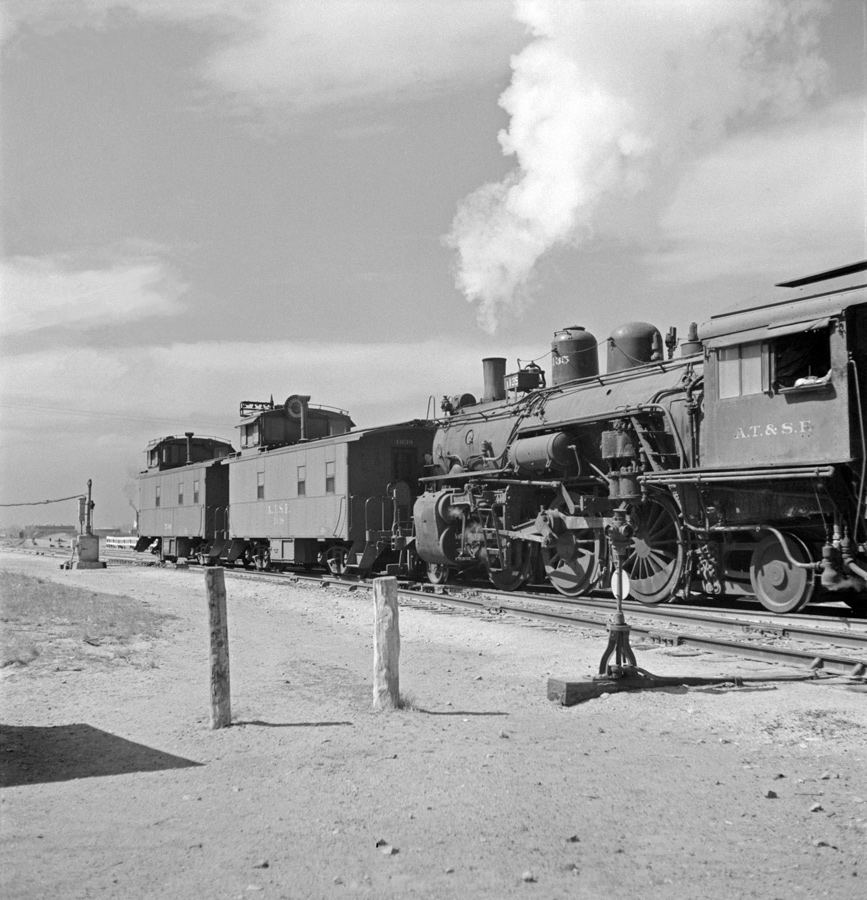
We’re in Canadian, Texas and the freight train crews are changed at this point. A yard crew is exchanging the cabooses on the train on which Jack Delano has been riding, with the new conductor receiving his personal ride. Note the “wig-wag” target on the caboose cupola. Many Santa Fe cabooses utilized this interesting and somewhat unusual device during this time. The purpose was for signaling the engineer in those days before radios. The wig-wag was mounted on an arm (barely visible in the photograph), and had a lever extended into the cupola. This allowed the conductor to swing the target in an ark. There were essentially two signals: waving the target back and forth was a “highball” (the engineer was free to accelerate the train up to speed). Holding the signal straight up meant to stop. I believe these signals also had white and red lights mounted near the target center for nighttime use, with white indicating the highball, and red to stop the train.

Steam locomotive #1135 was holding the yard assignment on this day in March of 1943. This little 2-6-2 was in a group of “Prairie” locomotives delivered by Baldwin in 1902-3. Originally built as a 4-cylinder Vauclain compound, the locomotive was eventually converted to a conventional twin cylinder arrangement as shown here.

Changing the Cabooses

Going Through the Narrows

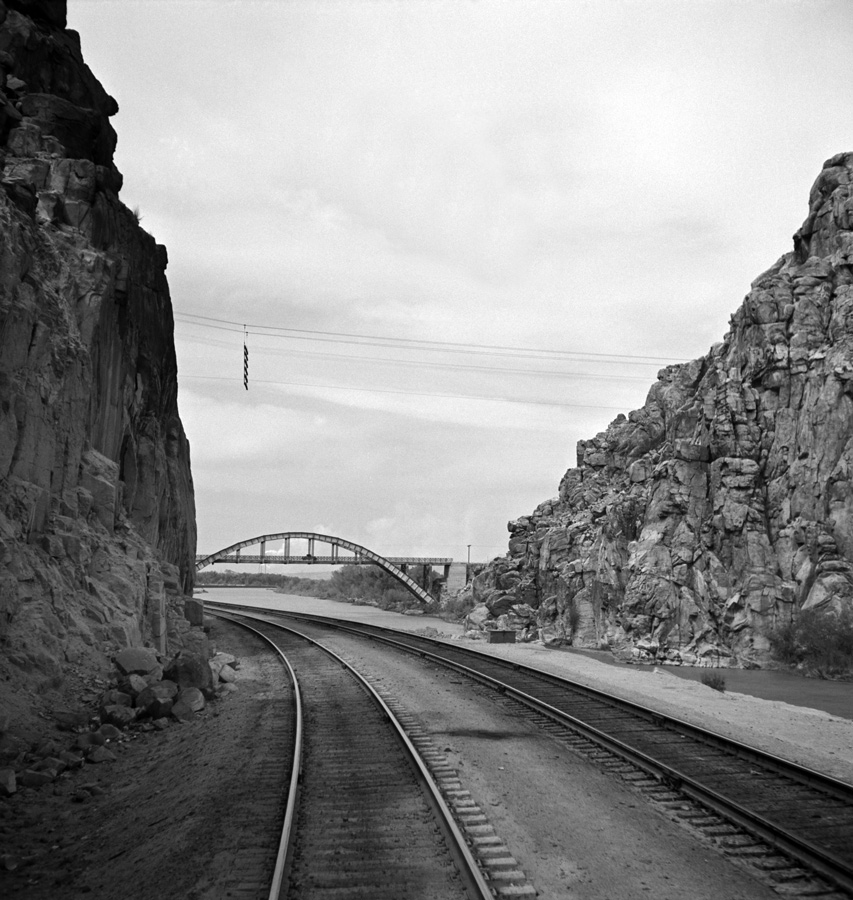
The Santa Fe freight train that we’ve been following is leaving Victorville and is heading south (railroad west) to San Bernardino, the last stop on our journey. The train is traversing what is known as the “Upper Narrows”, a winding route through the mountains. In the image below Jack Delano has photographed an unusual arched bridge from the rear platform of the caboose in which he’s riding. Known as the Rainbow Bridge, this carries Mineral Road over the Mojave River, a bit of which can be seen at right. A second plate girder span, out of view around the curve, continues the roadway across the tracks. This bridge still exists today, though it is out of service. This scene is no longer possible as a twin span of newer concrete bridges immediately adjacent to the Rainbow Bridge obstructs the view.

Going Through the Narrows

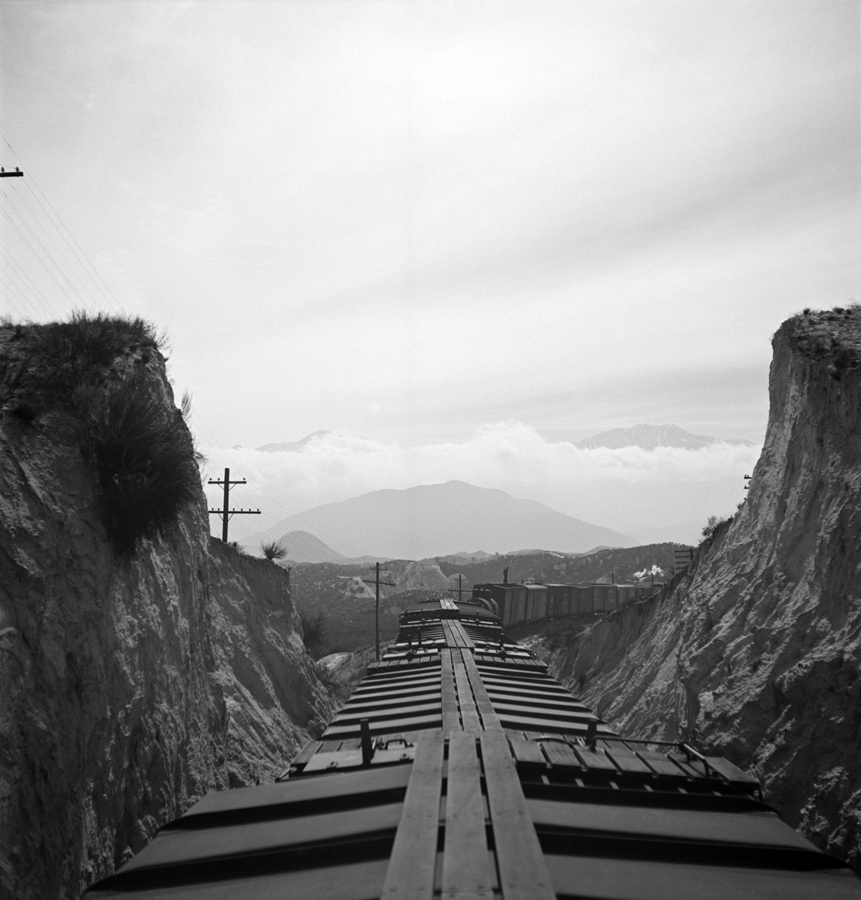
Below, our train is getting closer to San Bernardino, and is in the vicinity of Summit (Valley). These are the Lower Narrows. We’re easing downgrade here, and as we’ve seen in earlier postings, a brakeman is riding the top of the cars (look for him in the distance). And far ahead around the curve, the locomotive’s position is betrayed by a bit of steam exhaust as the train drifts down the hill.

Going Through a Cut

Photographs by Jack Delano, March of 1943.

Trains Through Victorville

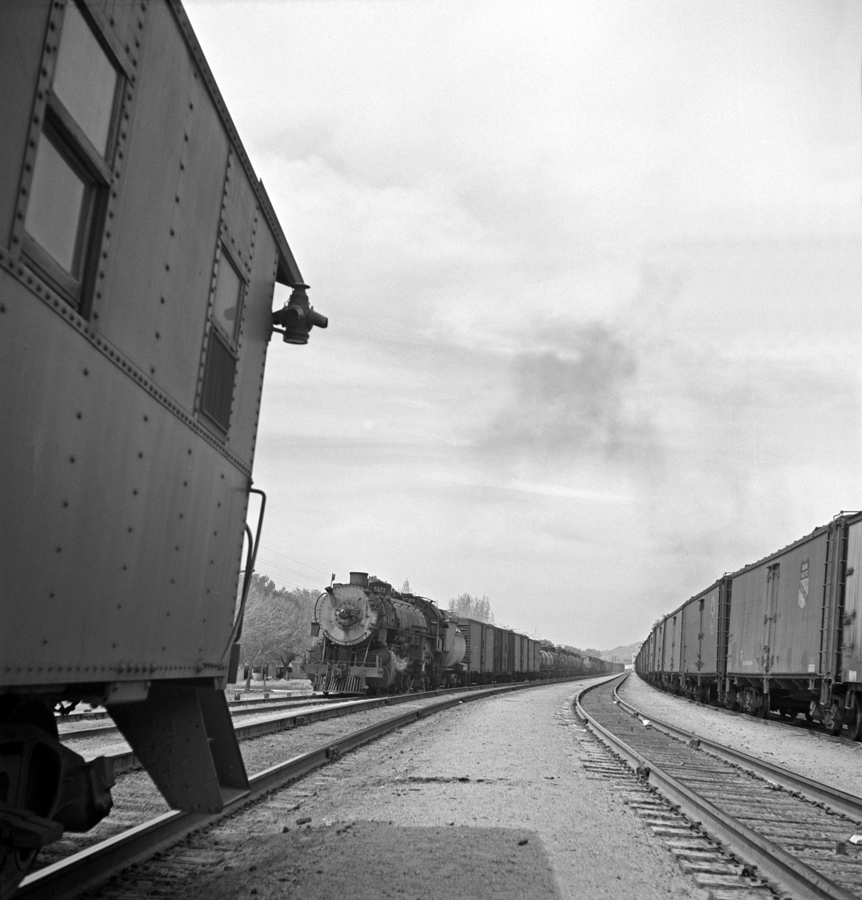
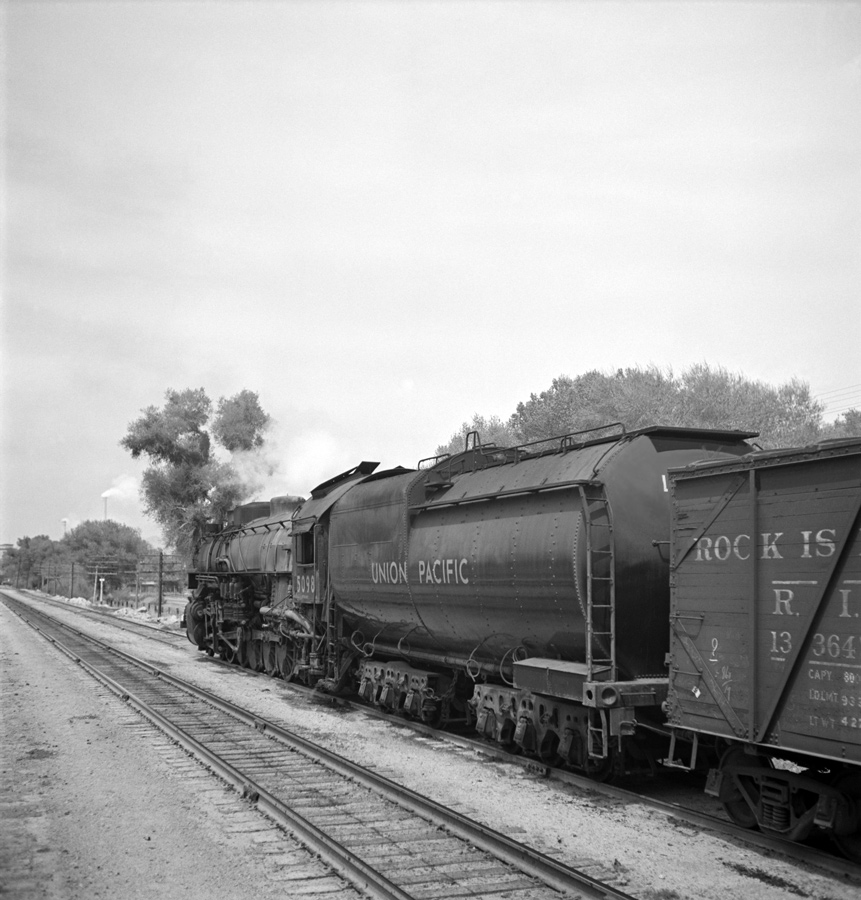
Victorville, California was a busy place in March of 1943 (and likely always) as Jack Delano found while he stretched his legs during his train’s servicing. The locomotive #5522 in view (I believe) is a Union Pacific 2-10-2, built by Baldwin in 1924. Originally leased to the Los Angeles & Salt Lake Railroad, the loco returned to the U.P. roster in 1943.

As in other photos we’ve seen previously, this locomotive is equipped with the tightly visored headlight as required by the wartime restrictions in effect for the western portion of the country. Note that the locomotive’s class lights are also visored, as are the marker lamps of the caboose in the foreground.

The fireman and the brakeman both seem to be watching intently from the cab for a signal from the rear of their train.

As I mentioned last week, the U.P. had trackage rights over the Santa Fe between San Bernardino and Daggett, California.

Trains Through Victorville

Passing a Union Pacific Train on the Santa Fe

Our Santa Fe freight train is in Victorville, California, the last town we’ll pass through before reaching our destination in San Bernardino. There is a lot of activity here, and Jack Delano photographed this Union Pacific freight train as it passed by on a nearby track. The U.P. has trackage rights over the Santa Fe between San Bernardino and Daggett, California (just east of Barstow), so these scenes are quite common.

The U.P. steam locomotive is interesting. It’s a 4-10-2 type, and was originally a Los Angeles & Salt Lake Railroad class FTT-1 three cylinder locomotive built by Alco in 1925. In 1942 the U.P. rebuilt the ten locomotives in this class to twin cylinder locomotives, removing the center cylinder and valve gear, and raising the boiler pressure to help offset the reduction in cylinder volume. In this rebuilt form they had new 27″ x 32″ cylinders running under 230 p.s.i. of steam pressure. Their drivers were 63″ in diameter, and tractive effort in re-built form was 72,391 lbs. This image recorded in March of 1943 shows the locomotive relatively fresh out of the shops. She would be taken out of service in 1949.

Passing a UP Train on the Santa Fe

Nighttime at Barstow

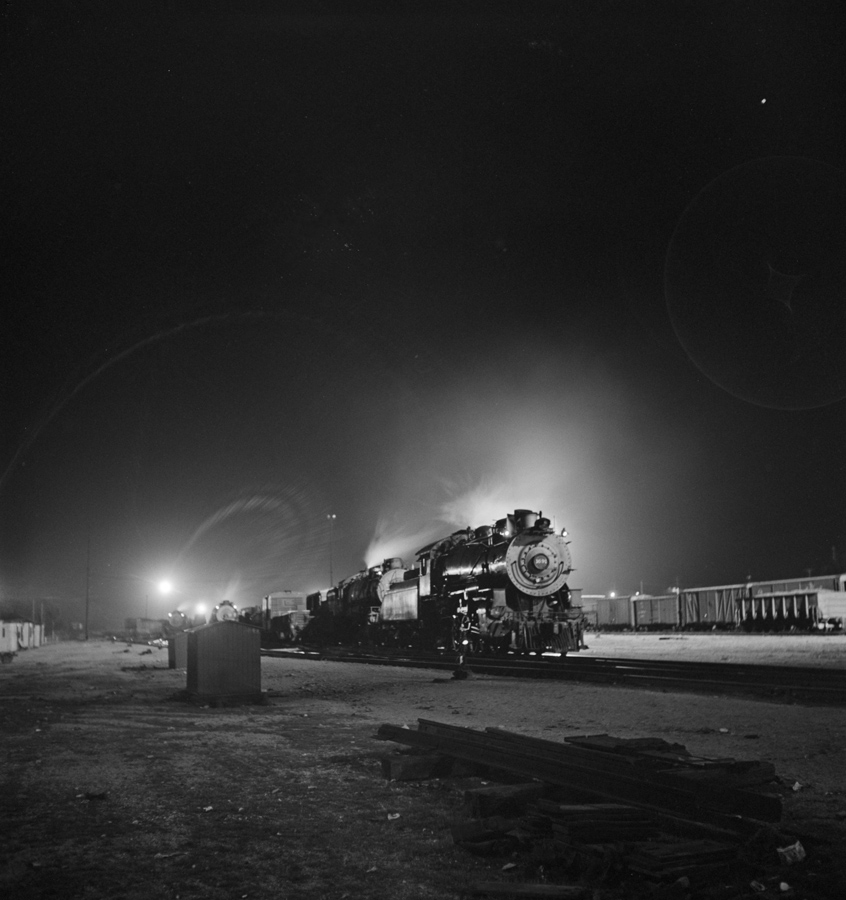
Looking through the images I have of Jack Delano’s trip out west on the Santa Fe, I realized that I’d overlooked this nighttime scene that he had recorded while in Barstow, California. Pictured is the yard there, and the scene includes three trains apparently ready for departure. The locomotive in the foreground is 2-10-2 #1691, built by Baldwin back in 1912. Note the unusual turtle-back tender (some sources refer to it as a whale-back, I don’t know which term is correct).

The image is surprisingly sharp for what was obviously a time exposure, and Mr. Delano shows his mastery of the art with this photograph.

Nighttime at Barstow

Meeting the Eastbound Chief

The Santa Fe freight that Jack Delano is riding is easing down a mountain having just crossed its summit. And passing at right is an eastbound passenger train, the Chief, as it nears the end of it’s charge up the grade. At this point the Chief is only about three hours into its 45 hour run to Chicago.

This section of railroad is located between Barstow and San Bernardino, California. There are some long, winding grades along this route. The brakeman is seen riding the running boards, keeping a close eye out for problems.

The #3770 steamer powering the Chief is a Baldwin built 4-8-4 Northern and is quite the beast, sporting 80″ drivers, running 300 lbs. of boiler pressure, and producing 79,968 lbs. of tractive effort. Note the war-time required tightly visored headlight.

Photograph by Jack Delano, March of 1943.

Meeting the Eastbound Chief

Loading Tanks on Flatcars

The Santa Fe freight train on which Jack Delano is riding has reached Goffs, California (located a bit west of Needles). As usual Mr. Delano has taken this stop to explore the surroundings. And here he’s found a string of flatcars being loaded with military tanks from nearby U.S. Army Camp Goffs. Judging from the line of tanks over on the right, more flatcars will be needed to move the rest of the battalion. This is March of 1943, and the war effort is in full swing, with railroads hauling a constant stream of men, equipment and material for the military.

That appears to be a two-story depot at left, with a semaphore train order signal in front. To the right a searchlight style track signal can barely be discerned. And between those signals I think I can make out a water penstock. Crews must have spent a lot of time here “in the hole” (waiting) judging by the number of conical water cups littering the roadbed in the foreground.

Per Wikipedia: “Goffs, an unincorporated community in San Bernardino County, California, is a nearly empty one-time railroad town at the route’s high point in the Mojave Desert. Goffs was a stop on famous U.S. Route 66 until 1931 when a more direct road opened between Needles and Essex”.

Note the whistle post near center in the photo, likely for the Route 66 track crossing. Though the BNSF railroad still has a presence in Goffs, not much else can be seen from the aerial views on Google Maps.

Loading Tanks on Flatcars

A Yard Switchman at Work

During his layover at Needles, California, Jack Delano took advantage of the time to mosey about the yard. He documented this view of a Santa Fe switchman, Mr. W.E. McCaniel, as he passed by while switching cars. Though it’s March of 1943, apparently it’s comfortable in Needles this time of year judging from the short sleeves McCaniel is attired in.

Yard Switchman at Work

Topping Off the Sand

Needles, California, March, 1943: The Santa Fe freight train has arrived at the yard and Jack Delano decided to stretch his legs during the crew change and servicing. Down by the roundhouse he captured this image of a worker as he was topping off the sand supply on a locomotive. Note the twin sand domes on this locomotive. The terrain is hilly in this area of the country, and the engineer will often need to apply sand to the rails for traction.

The #3843 is a Santa Fe 2-10-2 type built by Baldwin. It was an oil-fired locomotive, and had 63″ drivers, a 220 psi boiler pressure, and exerted 85,485 pounds of tractive effort. Some years ago an impressive HO scale brass model of this locomotive was offered.

Topping Off the Sand

Camp Cars – Part 2

Continuing our tour of the Santa Fe work train in Iden, New Mexico, Jack Delano has made his way to the dining facilities. As we saw last week, the berthing facilities and commissary were rather stark, though functional. The kitchen and dining room follow suit.

Below is the view of a cook preparing the dough for bread. The work area is rather austere, but everything needed seems to be close at hand. Baking powder and various other ingredients line the shelves, along with the ever-present cigar box, possibly containing the “secret ingredient” (what would railroaders do without cigar boxes?). Note the wash stand in the foreground . . . a bowl of water and bar of soap. It must be pre-dawn, as the cook is working under the light of a Coleman lantern.

Inside an AT&SF Kitchen Car

And below is the view inside the dining room. It must be near the end of the meal period, as only a few workers are left. I would assume that these folks ate a pretty hearty breakfast considering the hard work ahead of them each day. Unlike the military, it appears that a busboy was employed to pick up the worker’s dishes at the end of the meal.

Inside an AT&SF Dining Car

Photographs by Jack Delano, March, 1943.

Camp Cars – Part 1

During his trip out west on the Santa Fe in March of 1943, Jack Delano’s train had a stop in Iden, New Mexico. Iden is located between Clovis and Vaughn, and is rather isolated. A few weeks ago we saw a photograph of a section gang doing some track alignment in Iden. While there Mr. Delano also recorded some images of the camp cars of the work train that the workers were assigned to.

The scene below is inside one of the bunk cars where these men rested when off duty. It’s not too fancy, but does have heat, along with a table and chair(s). At least one kerosene lamp is visible over one of the bunks. And speaking of bunks, those look virtually identical to the ones I enjoyed while employed by the Marines back in the ’60s . . . some things didn’t change much between those decades! 🙂

Inside an AT&SF Bunk Car

And below we have the commissary car. Here workers could acquire the various supplies needed during their stay in this remote area. Just about any clothing was available, from head to toe. And one could buy toothpaste and a brush, medical supplies such as Bayer aspirin, Ex-Lax and Vicks, and more. For comfort, you had a choice of pipes and a variety of tobaccos, or cigarettes (Lucky Strike seems to be the brand most often purchased). And if you had the time, you could enjoy a few games using the Bicycle playing cards. The store’s clerk is Mr. J.E. Straight of Newton, Kansas.

Inside an AT&SF Commissary Car

Colorado River Rail Bridge

We’re in the vicinity of Topcock, Arizona. Here the AT&SF line running between Seligman, Arizona and Needles, California crosses the Colorado River into California. There are several interesting things in this photograph. Since we’re well into WWII, note the military sentry guarding the bridge. Also note the gauntlet trackage crossing the span. A gauntlet (sometimes spelled gantlet) is typically used to bring a pair of tracks together, overlapping them in areas that have insufficient clearance, such as a narrow bridge. Here we have the four rails of the two mainline tracks, and a pair of guardrails in the center.

This bridge and alignment have since been replaced with an elevated structure supported from below. Judging from the telltale over the curved tracks leading to the bridge, I would speculate that clearances on this bridge weren’t sufficient to handle the now-common double stack container traffic. This new span is also wider, allowing the double track mainline to cross without the use of the gauntlet. And another interesting note: the Google Maps street view shows the current bridge still displaying the Santa Fe heralds on several spans.

Photographed by Jack Delano in March, 1943.

Colorado Rail Bridge with Guard